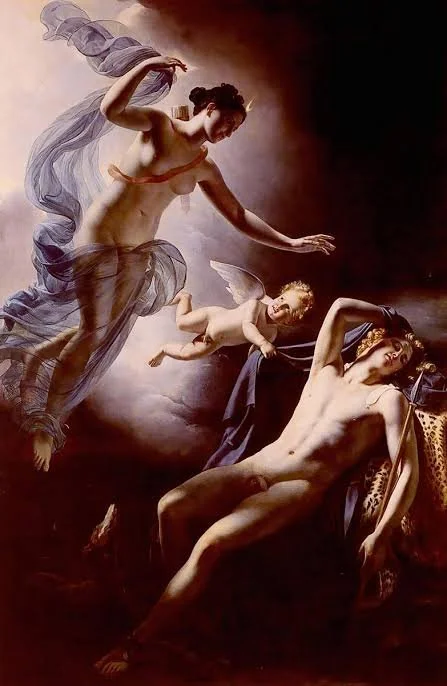
The myth of Endymion and the Moon is one of the most beautiful and enigmatic love stories in Greek mythology. At its center is Endymion, a handsome mortal associated with extraordinary beauty and eternal sleep, and Selene, the goddess who personified the Moon.
Unlike many Greek myths in which divine love leads to conflict, violence, or transformation, the story of Endymion is dominated by stillness. The mortal remains asleep while the Moon continues to visit him.
The myth therefore became an enduring meditation on beauty, desire, mortality, sleep, and the impossible relationship between gods and humans.
Endymion the Beautiful
Endymion was traditionally described as a young and exceptionally handsome man.
His parentage varies.
Some traditions identify him as the son of Zeus.
Others associate him with King Aethlius and the region of Elis.
Endymion's identity was particularly connected with Mount Latmus in Caria, in western Asia Minor.
Endymion as a Shepherd
In some traditions, Endymion was a shepherd or hunter.
This association placed him in the natural landscape of mountains and forests.
The image of the beautiful young man sleeping outdoors beneath the moon became central to later artistic interpretations.
His isolation made him an ideal object for divine observation.
Selene, the Moon Goddess
Selene was the Greek personification of the Moon.
She was traditionally the daughter of the Titans Hyperion and Theia.
Her brother Helios represented the Sun, while her sister Eos represented the Dawn.
Selene was therefore part of a divine family associated with the celestial cycle.
Her nightly movement across the sky became one of the most recognizable features of Greek mythological cosmology.
Selene Sees Endymion
According to the most famous version of the story, Selene saw Endymion while he slept.
She was captivated by his beauty.
The goddess became deeply attached to him.
But Endymion was mortal.
His youth and beauty would eventually disappear through aging.
The myth therefore introduces a problem that appears repeatedly in stories involving gods and humans: divine beings may desire mortals, but mortals remain subject to time and death.
The Eternal Sleep
The solution was extraordinary.
Endymion was placed into eternal sleep.
In this state, he would never age.
His beauty would remain unchanged.
Selene could continue visiting him.
The sleep therefore preserves Endymion's physical perfection while separating him from ordinary human life.
Why Sleep?
Sleep occupies an unusual position between life and death.
A sleeping person is alive but temporarily disconnected from the world.
Endymion's eternal sleep therefore resembles a form of suspended mortality.
He does not experience ordinary aging.
He does not participate in human society.
He exists in an intermediate condition.
This ambiguity is central to the myth's emotional power.
Beauty and Mortality
The story can be interpreted as an attempt to solve the problem of beauty.
Human beauty is temporary.
Youth disappears.
Bodies age.
Death eventually arrives.
Endymion's sleep stops this process.
His beauty becomes permanent.
Yet the price of permanence is consciousness.
He remains beautiful because he does not live a normal life.
The myth therefore asks whether eternal beauty is meaningful without ordinary experience.
The Moon and Sleep
The connection between Selene and Endymion also reflects an ancient association between the Moon and sleep.
The Moon dominates the night sky while humans sleep.
Its light is gentle compared with the Sun.
This made it naturally suitable for stories involving dreams, nighttime, romance, and mystery.
Selene's visits to the sleeping Endymion therefore create an image that connects celestial movement with human sleep.
The Children of Endymion and Selene
Some ancient traditions attribute children to Endymion and Selene.
The number and identities vary among sources.
This variation reflects the broader flexibility of Greek mythology.
Different regions and writers preserved different versions of the same divine genealogy.
Endymion as a Mortal King
Some traditions describe Endymion not as a shepherd but as a king.
He was associated with Elis and with the organization of succession.
A story about a king falling into eternal sleep could carry additional symbolic meaning.
The ruler is removed from ordinary political life, while his descendants continue the royal line.
The Cult of Endymion
Endymion was not merely a literary figure.
Traditions surrounding him existed in particular regions of Greece and Asia Minor.
The myth appears to have had local religious significance, particularly around Mount Latmus.
Caves and landscapes associated with Endymion reinforced the connection between the sleeping hero and the natural environment.
The Cave and the Mountain
Mount Latmus became one of the principal settings associated with the myth.
A cave provides a natural place for eternal sleep.
It is dark, enclosed, and separated from ordinary human life.
At night, the Moon's light enters the surrounding landscape.
This creates a symbolic connection between the underground darkness of the sleeping chamber and the celestial world above.
The Tragedy of Eternal Youth
At first glance, eternal youth appears to be a gift.
But Endymion's condition is also deeply tragic.
He cannot grow old.
But he also cannot fully live.
He cannot experience the ordinary stages of human life.
He cannot consciously share Selene's love.
His immortality therefore comes through suspension rather than participation.
Selene's Love
Selene's role is equally complex.
She is a goddess capable of eternal existence.
Endymion cannot share her condition naturally.
Her love therefore depends upon keeping him outside ordinary time.
The relationship is beautiful but fundamentally unequal.
One partner is divine and immortal.
The other is mortal and unconscious.
The Myth and Dreams
The story also became associated with dreams.
A sleeping Endymion can be imagined as permanently inhabiting a dreamlike state.
Selene becomes the distant figure who visits him during the night.
This interpretation helped make the myth attractive to poets and artists interested in romantic idealization.
The Legacy of Endymion
The myth remained influential in Greek and Roman literature.
Later poets often used Endymion as a symbol of youthful beauty and unattainable love.
The story also inspired paintings and sculptures.
Artists particularly favored the image of Selene approaching the sleeping Endymion.
Endymion and Modern Interpretations
Modern readers can interpret the myth through several lenses.
It can be viewed as a love story.
It can be understood as an explanation for the relationship between moonlight and sleep.
It can symbolize humanity's desire to preserve youth.
It can also represent the tension between immortality and meaningful existence.
These interpretations are not mutually exclusive.
Conclusion
The myth of Endymion and the Moon is powerful because its central miracle is also its central tragedy.
Endymion receives eternal youth, but only through eternal sleep.
Selene receives a beloved who never ages, but she cannot share an ordinary relationship with him.
The story therefore explores a fundamental human desire: the wish to preserve beauty and escape time.
Yet Greek mythology suggests that mortality is inseparable from life itself.
Endymion remains forever young because he no longer participates in the passage of life.
Under the light of Selene, he becomes an eternal image of beauty—beautiful precisely because he is suspended between waking life and death.