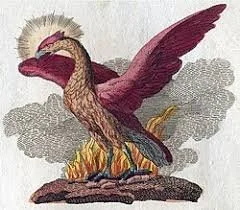
The Phoenix is one of the most famous symbols of rebirth in world mythology. It is commonly imagined as a magnificent bird that lives for centuries before dying in flames and rising again from its ashes. Although this familiar version became enormously influential in later literature and popular culture, the ancient Greek tradition surrounding the Phoenix was more complex.
The Phoenix illustrates how mythological ideas evolve across cultures. Greek writers inherited and transformed traditions that may have had connections with Egypt and the broader eastern Mediterranean. Over time, the bird became associated with longevity, death, renewal, cosmic cycles, and resurrection.
The Phoenix in Greek Literature
One of the earliest Greek literary references to the Phoenix appears in the works of Herodotus. His description is notably different from the modern popular story.
Herodotus reports that the Phoenix resembles an eagle in appearance and is associated with the Egyptian city of Heliopolis. According to the tradition he records, the bird appears only rarely. When its parent dies, it creates an egg-like container from aromatic materials, carries the remains of its parent, and transports them to the temple of the sun.
Herodotus does not describe the Phoenix in exactly the same way as later Christian and medieval writers. The famous image of a bird deliberately burning itself and rising from its own ashes developed gradually.
Possible Egyptian Connections
The Phoenix has often been connected with the Egyptian Bennu bird.
The Bennu was associated with Heliopolis and with solar and creation symbolism. It was connected with the gods Atum and Ra and played a role in Egyptian concepts of cosmic renewal.
Greek travelers and writers encountered Egyptian religious traditions and sometimes translated foreign concepts into familiar Greek terms.
The Phoenix may therefore represent an example of cultural interpretation rather than a myth created entirely within Greece.
Death and Renewal
The central concept associated with the Phoenix is cyclical renewal.
Fire normally destroys. In the Phoenix story, however, destruction becomes the beginning of another existence.
This apparent contradiction gives the myth its power. The bird does not simply escape death. It passes through death and emerges transformed.
The story therefore offers a mythological solution to one of humanity's oldest questions: whether death represents an absolute ending.
The Phoenix and Time
Ancient writers differed about the length of the Phoenix's life. Some traditions assigned extraordinarily long periods to the bird.
These enormous lifespans helped connect the Phoenix with cosmic time rather than ordinary human time.
Human beings live for decades. Empires may last centuries. The Phoenix operates on a symbolic scale far beyond ordinary biological life.
It therefore became a convenient metaphor for civilizations and institutions that disappear and later return.
The Phoenix in Roman Thought
Roman authors continued developing the Phoenix tradition. Writers such as Ovid, Pliny the Elder, and Tacitus referred to it in different contexts.
The bird gradually became associated with ideas of regeneration and imperial continuity. This made the Phoenix especially useful as a political symbol.
If a state or ruler could claim to embody renewal, the Phoenix provided a powerful visual metaphor: destruction does not necessarily mean permanent defeat.
The Phoenix and Christianity
The Phoenix later became particularly important in Christian literature.
Early Christian writers used the bird as an analogy for resurrection. If a creature could symbolically return to life after death, it could serve as an illustration of Christian beliefs about resurrection and eternal life.
This did not mean that Christianity simply adopted a Greek myth unchanged. Rather, Christian writers reinterpreted an existing Mediterranean symbol within a new theological framework.
The Phoenix subsequently appeared in medieval manuscripts, religious art, heraldry, and literature.
The Modern Phoenix
The Phoenix is now one of the most recognizable mythological symbols in the world.
It appears in novels, films, games, national emblems, corporate logos, and political symbolism.
Its meaning has expanded beyond literal resurrection. It can symbolize recovery after disaster, personal transformation, cultural revival, or rebuilding after war.
The phrase “rising from the ashes” comes directly from this long tradition.
Conclusion
The Phoenix demonstrates how mythology changes over time. Its ancient origins, Egyptian associations, Greek literary development, Roman interpretations, and Christian symbolism all contributed to the image recognized today.
At its heart, however, the Phoenix remains a story about transformation.
Its greatest message is not simply that something can return after death. It is that destruction can become part of renewal. The old form disappears, but something new emerges.
That is why the Phoenix has survived for thousands of years as one of humanity's most enduring symbols of hope.