If the Acropolis represents the sacred and monumental face of ancient Athens, the Ancient Agora reveals something equally important: the everyday civic life of the city.
This was a place where Athenians gathered, debated, traded, conducted legal business, participated in religious activities, and encountered political institutions.
The Agora was not simply a marketplace.
It was one of the central spaces of Athenian public life.
For visitors interested in understanding how ancient Athens actually functioned, the Agora can be more revealing than any single temple.
What Was the Agora?
The Greek word agora is related to gathering.
In ancient Greek cities, the agora could serve multiple purposes.
At Athens it developed into a large public space surrounded by important buildings.
People could encounter:
merchants;
politicians;
judges;
philosophers;
craftsmen;
soldiers;
religious officials;
ordinary citizens.
The space therefore brought together many aspects of civic life.
The Agora and Democracy
Athens is famous for developing a form of direct democracy.
The Agora was not the only location where political activity occurred, but it was deeply connected with civic life.
Citizens encountered political announcements, legal procedures, commercial activity, and public debate within this environment.
The democratic system itself was complicated and highly restricted.
Women, enslaved people, and resident foreigners did not possess the same political rights as adult male citizens.
Therefore, the Agora should not be imagined as a modern public square where everyone participated equally.
The Stoa of Attalos
The most visually impressive reconstructed building in the Agora is the Stoa of Attalos.
The original structure was built in the second century BCE during the reign of Attalos II of Pergamon.
A stoa was a covered colonnaded structure.
Stoas provided shelter while also creating spaces for commerce, social interaction, and public activity.
The modern reconstruction houses the Museum of the Ancient Agora.
The Museum
The museum contains artifacts discovered during archaeological excavations.
Objects include:
pottery;
inscriptions;
coins;
sculptures;
household objects;
political artifacts;
objects associated with public life.
The museum is especially useful because it helps visitors understand the Agora beyond the surviving architecture.
A broken pottery fragment can reveal daily life.
An inscription can reveal political organization.
A coin can reveal economic activity.
The Temple of Hephaestus
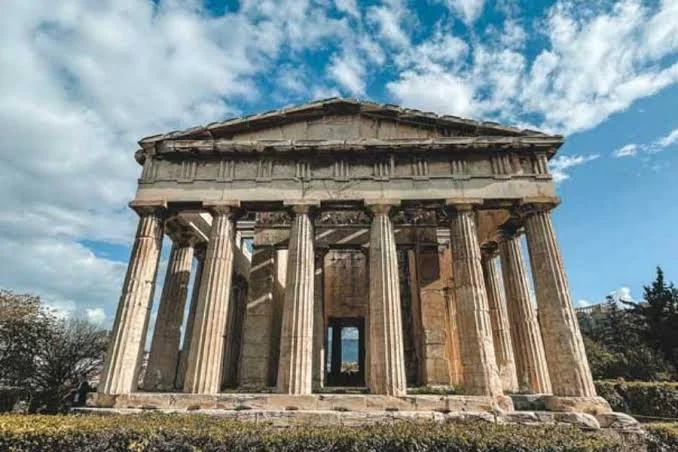
One of the best-preserved ancient Greek temples stands on the western side of the Agora.
It is commonly known as the Temple of Hephaestus.
Hephaestus was associated with metalworking, fire, and craftsmanship.
The temple is remarkably well preserved compared with many other Greek temples.
Its survival is partly due to later reuse.
The building was incorporated into Christian religious traditions, which helped protect its structure from complete destruction.
Socrates and the Agora
The Agora is strongly associated with Socrates in the modern imagination.
Plato's dialogues frequently depict Socrates questioning people in public spaces.
The historical Socrates did not operate from a conventional philosophical school.
He interacted with people in the public life of Athens.
The Agora therefore provides an appropriate setting for understanding the social environment of Socratic philosophy.
Socrates' philosophical practice was deeply connected with conversation.
The Trial of Socrates
Socrates was tried in Athens in 399 BCE.
The charges included impiety and corrupting the young.
His trial occurred within the broader civic institutions of Athens.
The Agora therefore forms part of the urban landscape surrounding the society in which the trial took place.
However, the trial itself should not be imagined as occurring literally in the middle of the marketplace.
Ancient Athens possessed specialized civic and judicial spaces.
The Tholos
The Tholos was one of the Agora's important civic buildings.
It was associated with the Council's executive committee, the prytaneis.
Members of this group served temporary terms and handled important administrative responsibilities.
The building therefore provides evidence of how Athenian democracy operated institutionally.
Democracy required administration.
It was not simply people voting.
Officials had to manage schedules, finances, religious responsibilities, communications, and civic business.
The Bouleuterion
The Bouleuterion was associated with the Council of 500, the Boule.
The Council prepared matters for the citizen assembly and performed important administrative functions.
This demonstrates the complexity of Athenian government.
The democratic system depended upon institutions that organized political decision-making.
Ostraka and Ostracism
The Agora is also associated with the practice of ostracism.
Athenians could vote to exile an individual from the city for a limited period.
They used broken pieces of pottery known as ostraka as voting tokens.
An ostrakon could bear the name of a person whom the voter wanted to remove.
Ostracism was not technically a criminal conviction.
It was a political mechanism designed partly to prevent excessive concentration of power.
Markets and Commerce
The Agora was also an economic environment.
Merchants sold goods.
Craftspeople worked.
Food was exchanged.
Visitors encountered products from Athens and beyond.
This commercial activity reveals that the political Agora was also embedded in everyday economic life.
Ancient citizens did not separate "politics" and "economics" as neatly as modern institutions sometimes do.
Religion in the Agora
Religious activity was present throughout the Agora.
Temples, altars, shrines, processions, and festivals formed part of civic life.
Athens did not separate religion from public identity in the modern secular sense.
Religious traditions were integrated into citizenship, festivals, law, and political institutions.
Roads and Movement
The Agora was connected to the wider city through roads and pathways.
Movement through Athens brought citizens into contact with different types of activity.
The Acropolis rose nearby.
The Agora occupied a lower urban area.
The Pnyx was another important political space.
The Areopagus provided another important civic and judicial environment.
Together, these locations reveal that Athens functioned as a network of specialized public spaces.
How to Explore the Agora
Begin at the archaeological entrance and take time to orient yourself.
Then visit the Stoa of Attalos and museum.
Walk through the open Agora.
Look toward the Temple of Hephaestus.
Pay attention to the foundations of civic buildings.
Try to reconstruct the movement of people rather than simply photographing individual ruins.
Ask:
Where would merchants stand?
Where would officials work?
Where would citizens gather?
Where would religious ceremonies occur?
This approach makes the site far easier to understand.
Conclusion
The Ancient Agora was the civic heart of Athens.
It was a marketplace, political environment, religious landscape, administrative center, and social meeting place.
The site helps explain why Athens became such an influential city.
Its democracy depended on institutions.
Its economy depended on markets.
Its religion depended on sanctuaries and ritual.
Its philosophy developed through public conversation.
Its citizens lived within a highly interconnected urban environment.
The Agora therefore provides something that the monumental Acropolis cannot provide by itself.
It shows the working city behind the monuments.