In the waters between the Peloponnese and Crete lies one of the most important archaeological discoveries ever made in the Mediterranean.
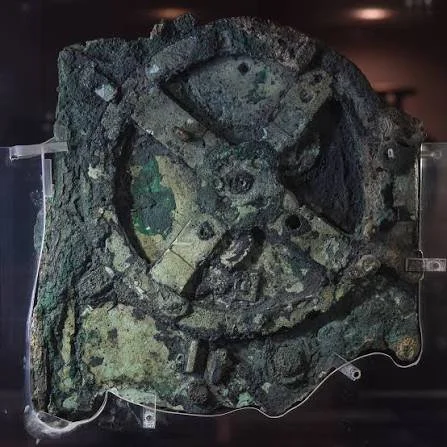
The Antikythera shipwreck has revealed an extraordinary collection of ancient artifacts, including statues, coins, luxury goods, vessels, and—most famously—a complex bronze mechanism that has become known as the Antikythera Mechanism.
The mechanism is frequently described as the world's first computer.
That phrase is useful as a popular description, but it requires explanation.
The device was not a computer in the modern electronic sense.
It was a sophisticated ancient analog calculating mechanism that used gears and pointers to model astronomical cycles.
Its existence transformed historians' understanding of ancient Greek technology.
The Discovery of the Wreck
The shipwreck was discovered by sponge divers in 1900–1901.
The wreck lay in deep water near the island of Antikythera.
The recovery produced an extraordinary range of artifacts.
The National Archaeological Museum of Athens records the initial discovery and recovery of the wreck at the beginning of the twentieth century.
Among the objects were:
bronze and marble statues;
glass vessels;
coins;
jewelry;
ceramics;
architectural fragments;
scientific instruments;
the famous geared mechanism.
The ship had apparently been carrying valuable cargo.
The Antikythera Mechanism
The mechanism initially appeared to be an unremarkable collection of corroded bronze fragments.
Its true importance became clearer only through decades of investigation.
Researchers discovered complex gear wheels.
The device contained multiple interconnected components that could represent astronomical cycles.
Its complexity was astonishing.
Ancient Greek technology was already known to include impressive engineering achievements.
But the Antikythera Mechanism demonstrated a level of precision and miniaturized mechanical design that exceeded many previous assumptions.
What Did It Do?
The mechanism was designed to model astronomical cycles.
Research indicates that it could represent relationships involving:
the Sun;
the Moon;
the lunar calendar;
eclipses;
calendrical cycles;
the zodiac.
Some reconstructions also indicate mechanisms associated with planetary movements, although the precise original configuration remains an area of continuing research.
The device therefore functioned as a mechanical model of the heavens.
Why Is It Called a Computer?
The term "computer" is modern.
The ancient mechanism did not use electricity, software, binary code, or digital memory.
But it performed a task conceptually similar to an analog computer.
An analog computer represents information through physical quantities and relationships.
The Antikythera Mechanism represented astronomical cycles through gears.
Turning a handle changed the positions of pointers according to mathematically structured relationships.
The National Archaeological Museum's historical overview notes that Derek de Solla Price later characterized the device as an ancient Greek computer because of its complex gear system.
The Mathematics Behind the Mechanism
The mechanism demonstrates that ancient Greek astronomical knowledge was highly mathematical.
Astronomers observed recurring cycles in the sky.
The Moon's movements were particularly complicated because lunar months do not fit neatly into a solar year.
Ancient astronomers therefore developed cycles to reconcile different calendars.
The Antikythera Mechanism encoded some of these relationships mechanically.
This is what makes it so extraordinary.
The device was not merely measuring time.
It was representing mathematical relationships in physical form.
The Saros Cycle
One important astronomical cycle represented in the mechanism is associated with predicting eclipses.
The Saros cycle describes a recurring relationship between lunar and solar eclipses.
The mechanism's inscriptions and gearing indicate that its creators possessed knowledge of such cycles.
This demonstrates the practical relationship between mathematical astronomy and mechanical engineering.
The Metonic Cycle
Another important cycle is the Metonic cycle, associated with the relationship between lunar months and solar years.
Approximately 19 solar years correspond to 235 lunar months.
Ancient Greek calendrical systems needed ways to reconcile lunar and solar measurements.
The Antikythera Mechanism incorporated this kind of calendrical knowledge.
It therefore functioned partly as an astronomical calendar.
Who Built It?
The exact maker is unknown.
There is no secure ancient inscription saying who designed the mechanism.
Its technical sophistication has encouraged historians to connect it with astronomical traditions associated with major Hellenistic centers.
Rhodes is sometimes discussed because of its importance in ancient astronomy and mechanical technology.
But attributing the mechanism to one famous individual would go beyond the available evidence.
The device belongs to a broader intellectual environment.
The Ship's Cargo
The wreck itself is just as important as the mechanism.
The ship carried objects from different parts of the Mediterranean.
The cargo included sculptures and luxury goods.
Some objects were probably being transported toward wealthy consumers.
The wreck therefore provides evidence of ancient trade and elite consumption.
It also demonstrates that scientific instruments could travel within the same maritime networks as art and luxury commodities.
Dating the Mechanism
The Antikythera Mechanism is generally placed within the Hellenistic period, around the second or first century BCE, although precise dating remains a subject of research.
The shipwreck itself is usually dated to approximately the first century BCE.
This places the mechanism within a period when Greek astronomy, mathematics, and engineering were developing sophisticated traditions.
Why the Discovery Changed History
Before the mechanism became understood, historians possessed evidence for ancient Greek mathematics and astronomy.
They knew Greek scholars could perform complex calculations.
They knew ancient engineers could construct machines.
But the Antikythera Mechanism provided physical evidence that mathematical astronomy could be integrated into a highly sophisticated geared device.
This was revolutionary.
It demonstrated that ancient technological capabilities were not always preserved in the surviving literary record.
The Problem of Lost Technology
The mechanism also highlights an important issue in archaeology.
Ancient technology is often underrepresented because mechanical devices rarely survive.
Wood decays.
Bronze corrodes.
Small mechanisms are easily destroyed.
Written descriptions can disappear.
Workshops may leave little archaeological evidence.
Consequently, surviving artifacts may represent only a fraction of ancient technological knowledge.
The Antikythera Mechanism gives us a rare glimpse into a much larger technological world that may have largely disappeared.
The Mechanism and Greek Philosophy
The device also reflects a philosophical interest in the cosmos.
Greek philosophers and astronomers sought mathematical order in celestial movements.
The heavens appeared to follow recurring patterns.
The mechanism transformed those patterns into physical motion.
A user could manipulate the device and observe representations of astronomical cycles.
This was therefore more than mechanical craftsmanship.
It was a material expression of mathematical astronomy.
Underwater Archaeology
The Antikythera wreck also became important for the development of underwater archaeology.
Recovering objects from deep water is extremely difficult.
Divers must deal with:
pressure;
limited visibility;
currents;
corrosion;
fragile materials;
complex seabed environments.
Modern research continues to investigate the wreck and its surrounding archaeological landscape.
This means the story of Antikythera is not finished.
New investigations can still reveal information about the ship, its cargo, and ancient Mediterranean maritime networks.
The Human Story Behind the Mechanism
It is tempting to focus exclusively on the machine.
But the wreck represents people.
Someone designed the mechanism.
Someone manufactured the gears.
Someone calculated astronomical cycles.
Someone operated the device.
Someone transported it.
Someone purchased or commissioned it.
A ship's crew carried it across the Mediterranean.
The eventual wreck transformed an object of ancient technology into an archaeological time capsule.
Is It Really the "First Computer"?
The phrase should be used carefully.
The Antikythera Mechanism is one of the earliest known surviving examples of a complex geared astronomical calculator.
Calling it an "ancient computer" helps modern audiences understand its function.
But it should not create the impression that ancient Greeks possessed electronic computing.
The device belongs to a completely different technological tradition.
Its importance lies precisely in the fact that sophisticated computation can exist without modern electronics.
Conclusion
The Antikythera shipwreck transformed our understanding of ancient Greek technology.
The Antikythera Mechanism demonstrated that Hellenistic engineers could combine mathematics, astronomy, precision gearing, inscription, and mechanical design into a remarkably sophisticated device.
It was not a modern computer.
But it performed a conceptually related task: representing and calculating complex information through a physical system.
The wreck also reminds us that ancient history contains technological achievements that written sources alone cannot fully reveal.
Every gear, inscription, statue, and broken fragment recovered from Antikythera provides another piece of evidence about a civilization whose scientific and engineering capabilities were far more sophisticated than many earlier generations of historians imagined.
The mechanism is therefore not simply an ancient curiosity.
It is evidence of a technological world that once existed—and of how much of that world may still be waiting beneath the Mediterranean.