Few archaeological sites have captured the modern imagination as strongly as Knossos.
Located on the island of Crete, the site is associated with the Minoan civilization, one of the most important prehistoric cultures of the eastern Mediterranean. Its monumental architecture, colorful frescoes, elaborate storage facilities, writing systems, religious imagery, and extensive trade connections reveal a society considerably more complex than the simplistic image of an ancient "palace."
Knossos was not merely a royal residence.
It was an administrative, economic, religious, and social center within a much larger Minoan landscape.
The site also became connected to one of the most famous stories in Greek mythology: the Labyrinth and the Minotaur.
Archaeology, however, reveals a civilization considerably older and more complex than the later Greek myths.
Who Were the Minoans?
The term Minoan is a modern archaeological label.
It was popularized by Sir Arthur Evans, the British archaeologist who excavated Knossos extensively beginning in 1900.
Evans connected the site with the legendary King Minos and therefore called the civilization "Minoan."
The ancient people themselves did not leave us a surviving historical text identifying their civilization by that name.
The Minoans flourished on Crete during the Bronze Age, roughly from the third to the second millennium BCE.
UNESCO's current World Heritage designation for the Minoan Palatial Centres recognizes six major sites: Knossos, Phaistos, Malia, Zakros, Zominthos, and Kydonia. Together they represent the principal palatial centers of Minoan civilization.
Knossos Before the Great Palace
Knossos was not suddenly created as a monumental palace.
The area had a much longer history of occupation.
Communities lived at the site during the Neolithic period, long before the monumental palatial structures of the second millennium BCE.
Over generations, settlement expanded and became increasingly organized.
By the early second millennium BCE, Knossos had developed into one of the major palatial centers of Crete.
This long development is important.
The palace was not simply built by one king.
It represented generations of architectural, economic, political, and religious development.
The First Palace
The earliest major palatial phase at Knossos dates to approximately the beginning of the second millennium BCE.
The palace underwent destruction and rebuilding several times.
Earthquakes, fires, social changes, and other events repeatedly altered the settlement.
Instead of imagining the palace as a single building constructed at one moment, it is better understood as a continuously modified complex.
Its architecture changed as the needs of the community changed.
A Palace Unlike a Modern Palace
The word "palace" can be misleading.
A modern reader might imagine a royal residence containing bedrooms, dining rooms, servants' quarters, and ceremonial halls.
Knossos certainly contained spaces that could have accommodated elite activities.
But the complex was far more extensive.
It included:
storage magazines;
workshops;
ceremonial spaces;
courtyards;
staircases;
administrative areas;
religious spaces;
residential areas;
drainage systems;
specialized rooms;
corridors and passageways.
The palace therefore functioned as a major institutional center.
Storage and the Minoan Economy
One of the most impressive aspects of Knossos is its storage system.
Large clay vessels known as pithoi were used to store commodities.
These enormous containers could hold products such as:
olive oil;
wine;
grain;
other agricultural goods.
Storage was essential to a complex economy.
Agricultural production had to be collected, managed, redistributed, and perhaps exchanged.
The palace therefore participated in an economic system that connected farmers, craftspeople, administrators, and elites.
The Minoan Writing Systems
The Minoans used several writing systems.
One is known as Cretan Hieroglyphic.
Another is Linear A.
Linear A remains largely undeciphered.
This is one of the great mysteries of Minoan archaeology.
Researchers can identify many signs and understand certain aspects of the writing system, but the underlying language has not been securely deciphered.
Later, Linear B was used at Knossos.
Linear B has been deciphered as an early form of Greek and is associated with Mycenaean administration.
This distinction is crucial.
The earlier Minoan writing systems cannot simply be assumed to represent Greek.
The Frescoes of Knossos
Perhaps the most visually striking discoveries at Knossos are its frescoes.
They depict:
human figures;
animals;
plants;
ceremonial scenes;
marine imagery;
elaborate decorative patterns.
The famous Bull-Leaping Fresco has become one of the defining images associated with Minoan civilization.
The imagery demonstrates the importance of bulls in Minoan symbolic culture.
However, interpreting these scenes requires caution.
A fresco showing people interacting with a bull does not automatically prove precisely how bull-leaping rituals were conducted.
Archaeologists must distinguish what the image literally depicts from what modern observers believe it symbolized.
The Marine World
Minoan art frequently incorporates marine imagery.
Octopuses, dolphins, fish, shells, and other sea creatures appear in decorative contexts.
This reflects the importance of the maritime environment.
Crete occupied a strategic position in the eastern Mediterranean.
Ships connected Minoan communities with the Cyclades, mainland Greece, Anatolia, Cyprus, Egypt, and the Levant.
The Minoans therefore belonged to a highly interconnected Bronze Age world.
Trade Across the Mediterranean
Archaeological discoveries demonstrate that Minoan communities participated in long-distance exchange.
Minoan pottery has been found outside Crete.
At the same time, imported materials reached Crete from distant regions.
Such evidence indicates that the Minoans were not isolated island communities.
They were active participants in Mediterranean networks.
These networks moved not only goods but also ideas, artistic styles, technologies, and cultural practices.
Religion at Knossos
Religious interpretation is one of the most challenging areas of Minoan archaeology.
Archaeologists have discovered evidence of ritual activity, including:
figurines;
ceremonial vessels;
symbolic objects;
special architectural spaces;
possible shrines;
religious imagery.
But the names and identities of Minoan gods remain uncertain.
Later Greek mythology cannot simply be projected backward onto Minoan religion.
For example, the bull symbolism at Knossos may have contributed to later Greek traditions involving the Minotaur, but there is no archaeological evidence that the Minoans literally believed in a half-human, half-bull monster.
The Labyrinth and the Minotaur
The later Greek myth tells of a labyrinth constructed by Daedalus for King Minos.
Inside lived the Minotaur.
Theseus eventually entered the labyrinth and killed the creature.
The myth is strongly associated with Knossos because of the complexity of its architecture.
The palace contains numerous rooms, corridors, staircases, and architectural levels.
To later Greeks encountering the remains of such a monumental complex, it was easy to imagine that the site had once been the legendary Labyrinth.
But the archaeological palace predates the Classical Greek stories by many centuries.
The myth is therefore best understood as a later cultural memory associated with an older landscape.
The Bull Symbol
The bull appears repeatedly in Minoan art.
Bull horns also appear in architectural and religious contexts.
This has led scholars to believe that bulls had significant symbolic importance.
The precise religious meaning remains uncertain.
The bull may have represented strength, fertility, authority, or a deity-related symbol.
The evidence does not allow one universally accepted interpretation.
The Question of Minoan Kings
Was Knossos ruled by a king?
Possibly.
The scale of the palace and its administrative organization suggest some form of centralized authority.
But archaeology does not provide a straightforward historical biography of a "King Minos."
The later figure of Minos belongs to Greek mythology.
There may be a historical memory behind the name, but this cannot be demonstrated with certainty.
The Thera Eruption and Minoan Society
One of the major events affecting the wider Aegean world was the enormous volcanic eruption on Thera, modern Santorini.
The eruption occurred during the Bronze Age, although the precise chronological relationship between the eruption and specific Minoan events has been debated.
The eruption produced massive environmental disruption.
However, it is too simplistic to claim that the eruption alone destroyed Minoan civilization.
Minoan society continued after the eruption.
Later changes involved complex political and cultural transformations.
The Rise of Mycenaean Influence
By the later Bronze Age, mainland Mycenaean influence became increasingly important in Crete.
Linear B tablets from Knossos indicate an administrative system using an early form of Greek.
This suggests that the political situation had changed significantly.
The Minoan world did not simply vanish overnight.
Instead, Cretan society experienced transformation and increasing integration into a wider Mycenaean political environment.
Evans and the Reconstruction of Knossos
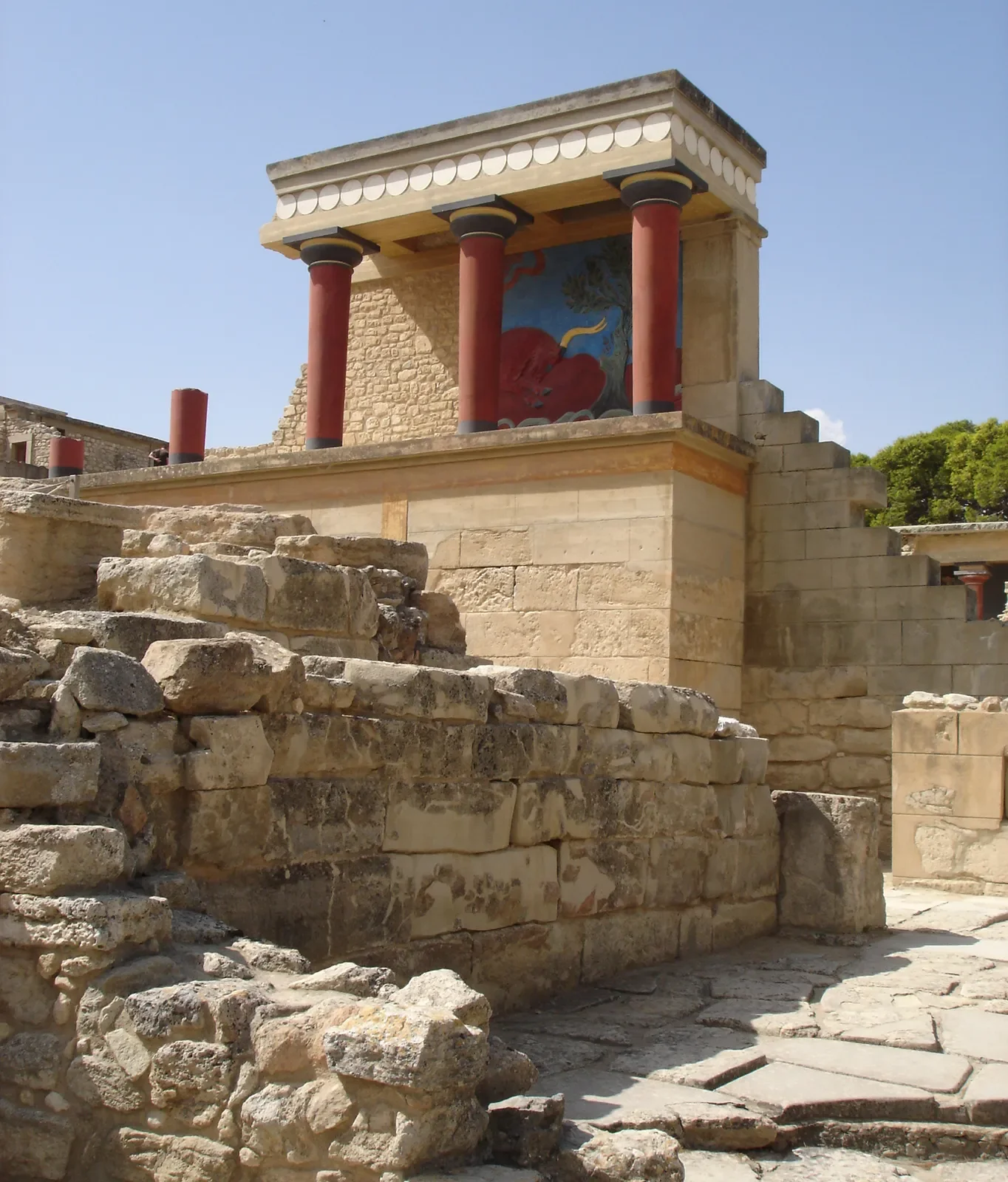
Modern visitors owe much of their understanding of Knossos to Arthur Evans.
But Evans also reconstructed portions of the site extensively.
Some reconstructed columns, walls, colors, and architectural features reflect his interpretations rather than untouched ancient remains.
This makes Knossos an important lesson in archaeological methodology.
Visitors should distinguish:
ancient archaeological evidence
from
modern reconstruction.
Evans' work was pioneering for its time, but modern archaeology has developed more cautious approaches to reconstruction.
Why Knossos Matters
Knossos matters because it provides evidence for a sophisticated Bronze Age society.
It demonstrates:
complex administration;
monumental architecture;
long-distance trade;
writing;
specialized craftsmanship;
agricultural organization;
artistic achievement;
religious practices;
urban planning.
The Minoans were not merely "mysterious people" living in colorful palaces.
They were participants in a complex Mediterranean civilization.
Conclusion
The Palace of Knossos is one of the world's great archaeological sites because it connects archaeology, mythology, art, architecture, technology, trade, and social organization.
The real Knossos was older and more complex than the later story of Minos and the Minotaur.
Its storage rooms reveal economic organization.
Its writing tablets reveal administration.
Its frescoes reveal artistic sophistication.
Its architecture reveals complex planning.
Its imported materials reveal international connections.
And its mythology demonstrates how later civilizations transformed ancient ruins into stories.
Knossos is therefore not simply the "home of the Minotaur."
It is one of the most important surviving windows into Bronze Age Mediterranean civilization.