Few archaeological discoveries have transformed the study of ancient Macedonia as dramatically as the royal tombs discovered at Vergina.
The modern town of Vergina stands near the ancient city of Aigai, the first capital of the Macedonian kingdom.
Here archaeologists uncovered an extraordinary royal cemetery containing monumental tombs, magnificent paintings, weapons, armor, jewelry, vessels, and other objects associated with the Macedonian elite.
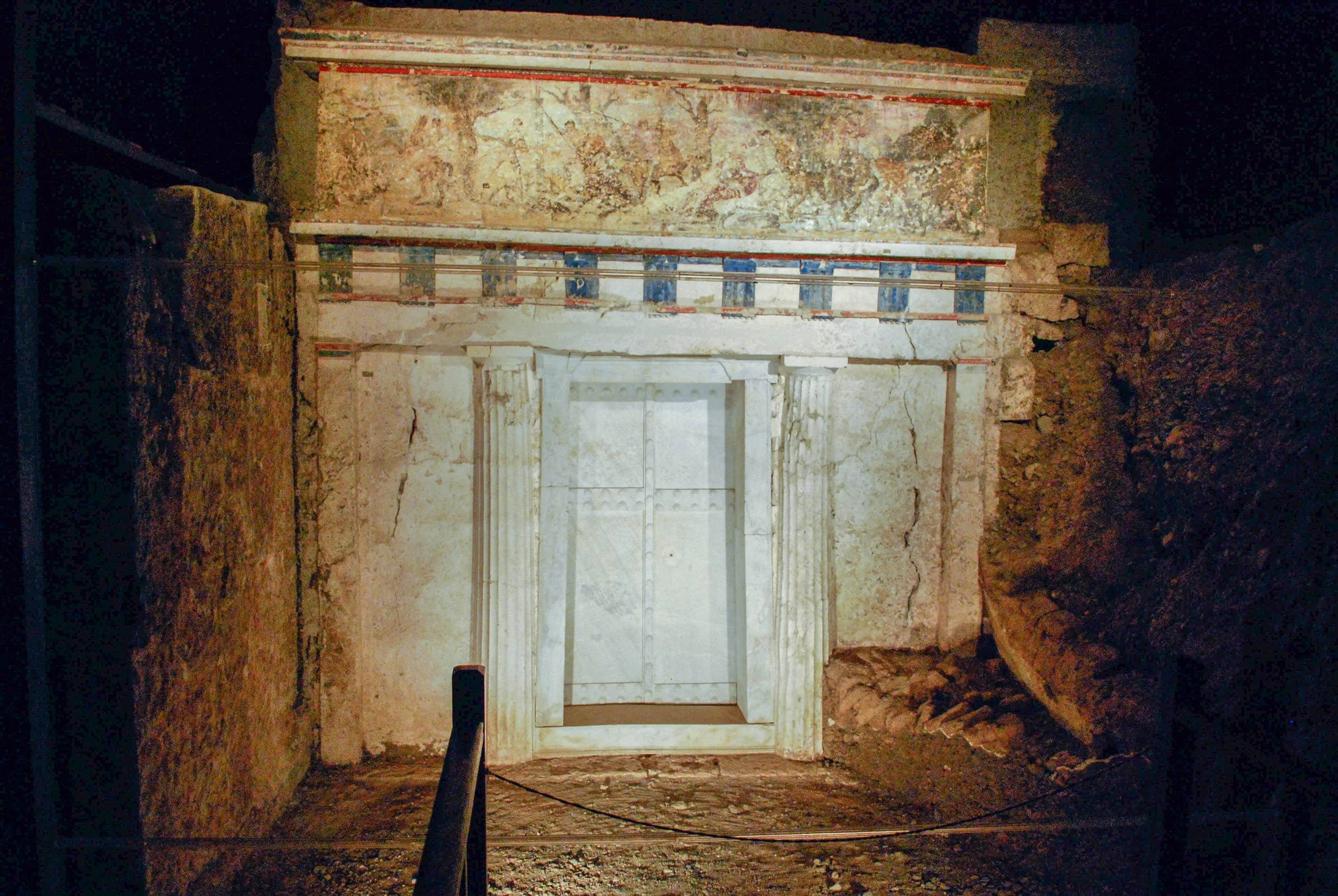
The most famous tomb has traditionally been identified as the burial place of Philip II, father of Alexander the Great.
That identification, however, has been debated for decades.
The archaeological site is therefore important not only because of its treasures but also because it demonstrates how historical interpretation can change when new scientific evidence is introduced.
Ancient Aigai
Vergina is the modern name of the area where ancient Aigai was located.
Aigai was the first capital of the ancient Macedonian kingdom.
UNESCO describes the site as the ancient royal capital of Macedonia and emphasizes its extraordinary combination of palace architecture, sanctuaries, theater, urban remains, and royal tombs.
The site was associated with the Argead dynasty.
This was the royal family to which Philip II and Alexander the Great belonged.
The Macedonian Royal Dynasty
Philip II became king of Macedon in 359 BCE.
He inherited a kingdom facing serious political and military challenges.
During his reign, Macedon became one of the most powerful states in the Greek world.
Philip reorganized the Macedonian army, expanded Macedonian influence, and defeated major Greek opponents.
His achievements created the political and military foundation from which Alexander launched his conquest of the Persian Empire.
The Death of Philip II
Philip II was assassinated in 336 BCE at Aigai.
Ancient sources describe his assassination during a public ceremony.
The exact motives behind the murder have been debated.
The political consequences were enormous.
Philip's death placed his young son Alexander on the throne.
Alexander would soon become one of the most famous conquerors in history.
Discovery of the Royal Tombs
Archaeologists excavated the royal cemetery at Vergina in the twentieth century.
The most dramatic discoveries came in 1977–1978 under the direction of archaeologist Manolis Andronikos.
The discoveries included several royal tombs within the Great Tumulus.
UNESCO describes the discovery of intact royal tombs as one of the most significant archaeological discoveries in Europe.
The Great Tumulus
The royal tombs were covered by a monumental mound known as the Great Tumulus.
The tumulus contained multiple burial structures.
Some had been looted in antiquity.
Others remained remarkably well preserved.
The surviving objects provide an extraordinary picture of Macedonian elite culture during the fourth century BCE.
Tomb II and the Traditional Identification
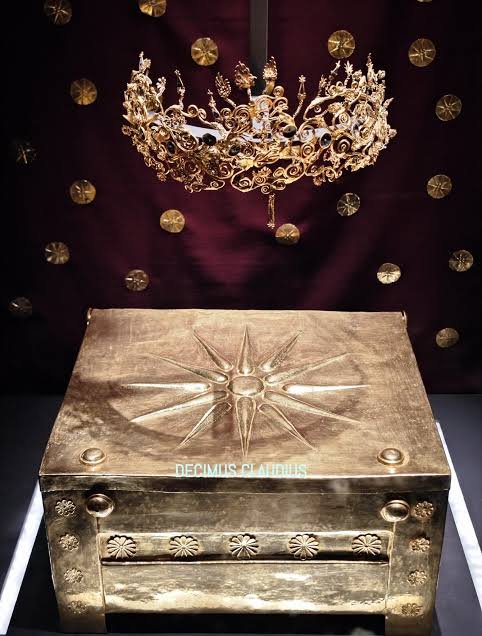
Tomb II became famous because it contained an exceptionally rich burial assemblage.
The tomb included:
weapons;
armor;
gold objects;
vessels;
ivory;
painted decoration;
elaborate burial equipment.
Andronikos identified the male occupant as Philip II.
This became the traditional interpretation.
The identification seemed attractive because the tomb's date, wealth, royal context, and associated objects appeared compatible with the historical Philip.
The Famous Macedonian Tomb Paintings
The tombs contain extraordinary painted scenes.
One famous composition depicts a hunting scene.
It includes figures hunting deer and other animals within a richly composed landscape.
The paintings are significant because very few large-scale examples of Greek monumental painting survive from antiquity.
The royal tombs therefore preserve evidence of artistic traditions that are otherwise known largely through literary references and later Roman copies.
Philip II's Physical History
Philip II was known from ancient sources to have suffered physical injuries.
He lost an eye during warfare.
He also had other injuries.
This became relevant to the archaeological identification of the tomb.
Researchers examined the skeletal remains in an attempt to determine whether the physical evidence corresponded to the historical descriptions of Philip.
This is where the debate became especially complex.
The Identification Debate
For decades, scholars debated whether Tomb II really belonged to Philip II.
One alternative hypothesis proposed that Tomb II belonged to Philip III Arrhidaeus, Alexander's half-brother, while Philip II was buried in Tomb I.
The question remains significant because identifying the occupant changes the interpretation of the objects found inside.
A major 2023 review in the Journal of Archaeological Science: Reports argues for the Philip II/Tomb I identification and concludes that Tomb II belonged to Philip III Arrhidaeus and his wife Eurydice.
This is an important scholarly position, but it should not be presented as though all debate has disappeared.
The traditional Philip II/Tomb II interpretation remains influential.
Why the Debate Matters
The debate illustrates an important archaeological principle.
A tomb does not come with a modern name tag.
Researchers must combine:
skeletal evidence;
chronology;
historical records;
burial customs;
inscriptions;
objects;
architecture;
artistic styles.
No single piece of evidence is necessarily decisive.
The Other Royal Tombs
Tomb III has commonly been associated with Alexander IV, the son of Alexander the Great.
Alexander IV was murdered while still young during the political struggles that followed his father's death.
If this identification is correct, Vergina contains the remains of several generations of the Macedonian royal family.
This makes the site extraordinarily important for understanding the final decades of the Argead dynasty.
The Royal Tombs and Alexander the Great
The treasures of Vergina also help illuminate the world into which Alexander was born.
The royal court possessed enormous wealth.
Macedonian rulers participated in Greek artistic traditions while maintaining distinctive court practices.
Weapons and armor reveal the importance of warfare.
Luxury goods reveal access to elite craftsmanship.
Paintings reveal artistic sophistication.
The tombs therefore provide a material context for understanding Macedonian power.
The Palace of Aigai
Vergina contains more than tombs.
The monumental palace of Aigai is one of the most impressive surviving royal buildings from Classical Greece.
UNESCO describes it as a vast fourth-century BCE complex and one of the largest and most impressive buildings of Classical Greece.
Its architecture demonstrates that Macedonian kingship required more than military power.
Royal authority was expressed through architecture, ceremony, art, and public space.
The Theater
The theater at Aigai is also historically important.
It is associated with the setting of Philip II's assassination.
The location therefore connects archaeological remains directly with a major political event recorded in ancient literature.
This is one reason Aigai is so valuable.
The landscape can sometimes be connected to historical narratives with unusual precision.
The Museum of the Royal Tombs
One of the most remarkable aspects of the modern site is the museum constructed around the royal tombs.
Rather than removing the tombs from their archaeological context and displaying them elsewhere, the museum creates a controlled environment around the burial complex.
Visitors can experience the tomb architecture while seeing the burial objects in an environment designed for preservation.
What the Tombs Reveal About Macedonian Society
The tombs demonstrate enormous social inequality.
Royal burials involved resources unavailable to ordinary people.
Gold, weapons, elaborate architecture, painted decoration, and imported luxury objects all communicated elite status.
Burial was therefore not merely a private religious event.
It was a public statement about political authority and dynastic legitimacy.
Conclusion
Vergina is one of the most important archaeological sites for understanding ancient Macedonia.
Its royal cemetery preserves extraordinary evidence of fourth-century BCE art, warfare, religion, craftsmanship, and political power.
Its association with Philip II and the Argead dynasty gives the site enormous historical importance.
At the same time, the continuing debate over the identities of the royal tomb occupants demonstrates that archaeology is not simply about discovering objects.
It is about interpreting evidence.
Whether one follows the traditional Philip II/Tomb II identification or the more recent Philip II/Tomb I hypothesis, Vergina remains extraordinary.
The tombs provide a rare material connection to the Macedonian royal dynasty that transformed the ancient Mediterranean and created the political conditions for Alexander the Great's extraordinary career.