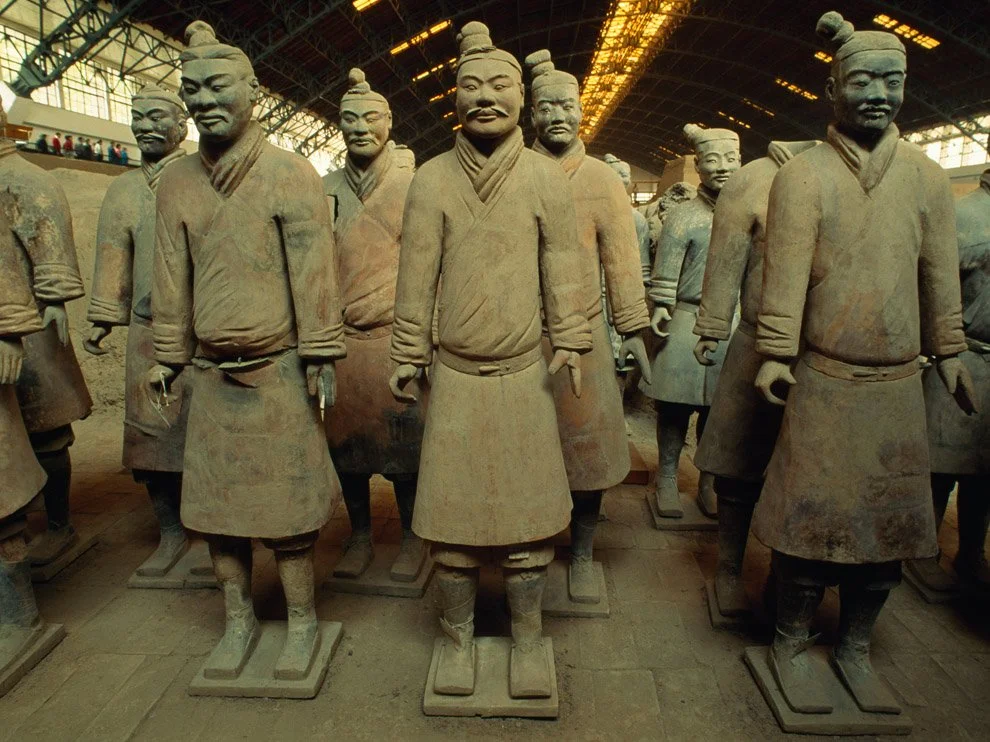
Samothrace is best known for its Sanctuary of the Great Gods and for the famous Nike of Samothrace, now displayed in the Louvre.
But the island's archaeological record is far broader.
It preserves evidence of prehistoric settlement, Archaic and Classical activity, Hellenistic development, Roman occupation, and religious life.
The idea of discovering terracotta warriors in unexplored cliffs therefore invites an intriguing investigation into votive figurines, sanctuary archaeology, and the symbolic representation of warriors in ancient Greek art.
The specific 2026 discovery suggested by this title could not be independently verified in authoritative sources located for this article.
Terracotta in Greek Archaeology
Terracotta figurines were relatively inexpensive compared with marble or bronze sculpture.
They could be mass-produced using molds.
This made them accessible to a much wider range of worshippers.
Terracotta figures could represent:
gods;
worshippers;
warriors;
musicians;
women;
children;
animals.
Their presence in sanctuaries can reveal the interests and identities of worshippers.
Samothrace and the Great Gods
The Sanctuary of the Great Gods became one of the most important religious centers of the ancient Mediterranean.
Its mystery cult attracted visitors from different regions.
This religious importance created demand for offerings.
Archaeological excavations have recovered numerous terracotta figurines.
Research on Samothracian figurines demonstrates that locally produced and imported examples could coexist. The sanctuary's archaeological material includes figurines from the Archaic through Roman periods.
Warriors as Votive Images
A terracotta warrior could represent several things.
It might commemorate:
military service;
victory;
protection;
personal identity;
devotion;
a deity associated with warfare.
The figure does not necessarily represent a specific historical soldier.
Instead, it may express a generalized ideal of the warrior.
Why Cliffs Are Interesting
Archaeological sites in difficult terrain can remain poorly explored.
Cliffs, caves, rocky slopes, and isolated terraces are challenging for conventional excavation.
But ancient people sometimes used unusual locations for ritual activity.
Objects deposited on inaccessible ledges could have been deliberately separated from ordinary settlement areas.
The Problem of "Uncharted"
The word "uncharted" should be used cautiously.
An area may not have been excavated recently but still be known to archaeologists.
Modern technologies such as:
drone photography;
LiDAR;
photogrammetry;
GIS mapping;
can reveal architectural traces and landscape modifications that are difficult to identify from ground level.
What a Genuine Discovery Could Reveal
If a securely documented group of Archaic terracotta warriors were found together, researchers would examine their context.
Were they in a sanctuary?
A burial?
A settlement?
A cave?
A collapsed building?
Their context would determine interpretation.
A sanctuary deposit could indicate military or protective religious associations.
A domestic context might suggest household devotion.
A burial context could indicate beliefs concerning status or identity.
Terracotta Production
The manufacturing process itself could provide information.
Clay composition can sometimes identify production areas.
Mold analysis can show whether several figures came from the same workshop.
Repeated molds can indicate standardized production.
Hand-finished details can demonstrate individual craftsmanship.
Thus even a small figurine can provide evidence for economic organization.
Conclusion
Samothrace's archaeological significance extends far beyond the famous Winged Victory.
Its sanctuary preserves evidence for a religious community connected to a much wider Mediterranean world.
The specific "Archaic terracotta warriors" described by this title have not been verified as a 2026 discovery in the sources located for this article.
But terracotta figurines are genuinely important evidence from Samothrace.
They provide a way to investigate worshippers, workshops, artistic exchange, religious symbolism, and the relationship between local traditions and broader Greek artistic styles.