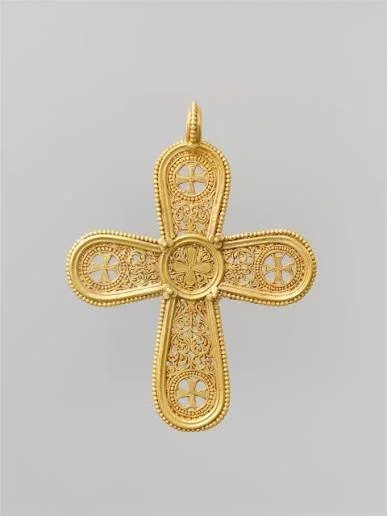
The discovery of gold crosses in the landscape of Messenia would immediately evoke the region's long Byzantine history.
Messenia contains archaeological remains spanning prehistoric, Classical, Roman, Byzantine, Frankish, Venetian, and Ottoman periods. The regional Ephorate of Antiquities emphasizes precisely this chronological depth in its archaeological programs.
The specific discovery of Byzantine gold crosses in olive groves described by this title could not, however, be verified as a documented 2026 find in the authoritative sources located for this article.
The broader archaeological subject is nevertheless well established.
Messenia in the Byzantine World
Messenia occupied the southwestern Peloponnese.
Its location placed it near important maritime routes connecting the western and eastern Mediterranean.
During Late Antiquity and the Byzantine period, settlements in the region participated in changing economic and religious networks.
Christianity gradually transformed the religious landscape.
Churches, cemeteries, monasteries, and Christian objects became increasingly important.
Why Gold Crosses Matter
A gold cross could have several possible functions.
It might have been:
a personal pendant;
a religious object;
a burial item;
a devotional object;
an elite possession;
part of a larger treasure.
The cross itself does not automatically identify the social status of its owner.
Its archaeological context is essential.
Gold and Christian Identity
Gold had a long history as a prestige material.
Byzantine Christians used precious metals in religious and secular contexts.
Gold objects could communicate wealth, devotion, social position, or institutional authority.
Crosses were especially powerful symbols because Christianity had become central to the ideological and religious life of the Byzantine Empire.
Why Olive Groves Can Preserve Archaeological Evidence
Modern agricultural landscapes often overlap with ancient settlement areas.
Olive cultivation has deep historical roots in the Mediterranean.
Repeated cultivation can disturb archaeological layers, but it can also bring buried artifacts to the surface.
Objects discovered during agricultural work can therefore provide clues about previously undocumented settlements.
However, isolated finds are difficult to interpret.
A cross found in soil does not necessarily mean a church stood immediately beneath the olive grove.
It could have been lost, buried, moved by later agricultural activity, or transported from elsewhere.
Messenian Gold Traditions
Messenia is already famous for ancient gold.
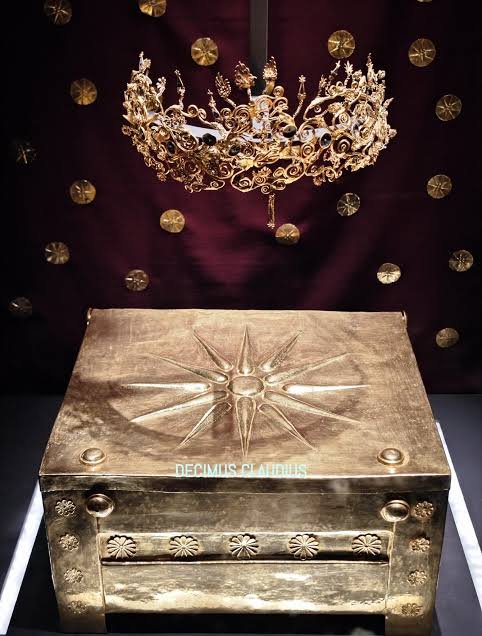
The regional archaeological authorities highlight extensive Mycenaean gold from funerary contexts, including the Griffin Warrior burial and the tholos tombs of Peristeria.
This makes the region particularly valuable for studying changing traditions of precious-metal craftsmanship.
The meaning of gold, however, changed across periods.
A Mycenaean funerary ornament and a Byzantine Christian cross belonged to completely different religious and social systems.
Byzantine Churches and Rural Landscapes
The Byzantine countryside was not simply a collection of isolated villages.
Rural communities were connected to towns, ports, churches, agricultural estates, and administrative centers.
Small churches could serve local populations.
Larger ecclesiastical institutions could control land and resources.
Archaeologists therefore investigate rural architecture alongside artifacts.
A discovery of crosses would become considerably more significant if associated with:
church foundations;
graves;
mosaic floors;
inscriptions;
pottery;
coins;
architectural fragments.
Dating the Crosses
Crosses cannot always be dated simply from their shape.
Researchers may study:
manufacturing technique;
decoration;
inscriptions;
metal composition;
comparable examples;
archaeological context.
Coins found alongside the objects can be especially valuable because their chronological ranges may be comparatively narrow.
The Problem of Treasure
The word "treasure" creates a modern expectation of wealth.
Archaeologically, a collection of gold objects is more complicated.
A group of crosses could represent buried valuables.
It could represent grave goods.
It could represent ecclesiastical objects hidden during a period of conflict.
Or it could represent accumulated personal possessions.
The historical circumstances of deposition are therefore as important as the objects themselves.
Conclusion
Messenia's archaeological record demonstrates that the region remained important across many centuries.
Its landscapes preserve evidence of prehistoric societies, Classical communities, Roman cities, Byzantine Christianity, medieval states, and later historical periods.
A verified discovery of Byzantine gold crosses in an olive-growing landscape would therefore be valuable not simply because the objects were made of gold.
The greatest significance would come from their archaeological context.
If associated with a church, cemetery, settlement, or securely dated deposit, the crosses could illuminate rural Christian life, religious practice, wealth, mobility, and the organization of Byzantine communities in southwestern Greece.