Few materials illustrate the interconnected nature of prehistoric Greece as clearly as obsidian.
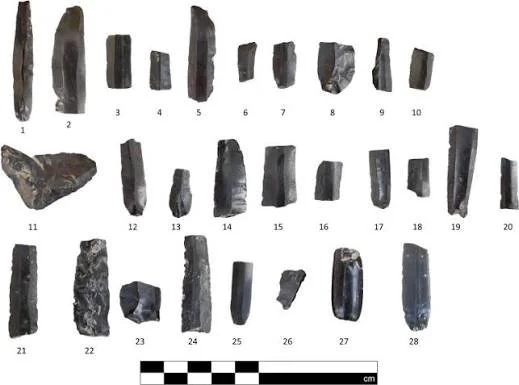
This naturally volcanic glass can fracture into extraordinarily sharp edges, making it an excellent material for producing prehistoric blades, flakes, cutting tools, and projectile points.
The Cyclades are particularly important because obsidian from the island of Melos circulated widely across the prehistoric Aegean.
Antiparos provides an especially interesting case.
Archaeological research has identified prehistoric obsidian artifacts on the island, although the idea of a newly discovered hidden cave assemblage should not automatically be treated as a confirmed recent discovery.
The official Ephorate of Antiquities of the Cyclades records Neolithic activity at sites including Spilaio and Vouni and notes substantial quantities of obsidian tools and manufacturing waste at Vouni.
What Is Obsidian?
Obsidian is volcanic glass.
It forms when lava rich in silica cools rapidly enough that crystals do not have time to develop.
The resulting material can fracture along extremely sharp edges.
Prehistoric communities recognized this property.
A carefully struck obsidian core could produce blades with remarkably fine cutting edges.
Why Obsidian Was Valuable
Stone tools were essential to prehistoric communities.
Obsidian could be used for:
knives;
cutting blades;
projectile points;
scrapers;
piercing tools;
specialized implements.
Its sharpness made it particularly useful.
But obsidian has another archaeological advantage.
Different geological sources have distinctive chemical signatures.
This means researchers can sometimes determine where an archaeological obsidian artifact originated.
Melos and the Aegean Network
Melos is the most famous source of prehistoric Aegean obsidian.
Artifacts made from Melian obsidian have been found far beyond the island.
The official Cycladic Ephorate notes that obsidian artifacts, cores, and flakes occur throughout the Aegean and mainland Greece, demonstrating maritime contacts and some of the earliest forms of long-distance exchange.
This is remarkable.
It means that prehistoric communities were moving valuable raw materials across the sea thousands of years before written history.
Antiparos
Antiparos lies in the central Cyclades.
The island is close to Paros and contains evidence of prehistoric occupation.
The archaeological record includes the Neolithic site of Vouni.
According to the Ephorate of Antiquities of the Cyclades, Vouni contains large quantities of obsidian tools and manufacturing waste, along with prehistoric pottery and evidence of metallurgical activity.
The Soros Obsidian Source
Antiparos itself possesses an obsidian source at Soros Hill.
This is particularly interesting because it complicates the simple assumption that every obsidian artifact on Antiparos must have come from Melos.
Scientific research has chemically characterized the Soros Hill source and demonstrated that its obsidian can be distinguished from other Aegean sources.
However, the small size of the nodules appears to have limited its attractiveness as a prehistoric raw-material source compared with better-known deposits.
The official archaeological authority likewise states that the Soros source does not appear to have been used extensively for prehistoric tool manufacture.
Hidden Caves and Archaeological Context
Caves can preserve archaeological evidence particularly well.
They may contain:
stone tools;
pottery;
hearths;
animal bones;
human remains;
ritual deposits;
manufacturing debris.
But caves can also be difficult to interpret.
A tool found inside a cave does not automatically mean that the cave was a workshop.
The object might have been carried there for shelter, storage, hunting, ritual activity, or another purpose.
Saliagos and the Antiparos Region
One of the most important prehistoric sites near Antiparos is Saliagos, a small islet between Paros and Antiparos.
Excavations in the 1960s recovered a remarkable quantity of obsidian.
The official archaeological record reports 1,176 well-processed obsidian tools along with additional tools made from other volcanic stones. The obsidian was predominantly from Melos.
This provides direct evidence for prehistoric maritime transport.
People had to travel by boat to obtain the raw material.
What Obsidian Tells Us About Navigation
Obsidian distribution provides indirect evidence for prehistoric seafaring.
People could not obtain Melian obsidian from central Cycladic settlements without crossing the sea.
Therefore communities possessed:
boats;
navigational knowledge;
knowledge of islands;
organizational capacity for maritime travel.
This is particularly important because it challenges the idea that early farming communities were primarily landbound.
The Aegean was already a maritime environment thousands of years ago.
Obsidian Workshops
A concentration of cores, flakes, blades, and discarded fragments can indicate production.
A craftsman might begin with a raw nodule.
The core would be struck repeatedly.
Blades would be removed.
Some would be transformed into finished tools.
The waste remained behind.
Archaeologists can reconstruct this process by examining the distribution and characteristics of lithic debris.
Scientific Sourcing
Modern archaeologists can use techniques such as X-ray fluorescence to identify the chemical signature of obsidian.
This allows researchers to compare artifacts with geological sources.
The method can distinguish sources that look almost identical visually.
The 2012 study of Soros Hill, for example, used energy-dispersive X-ray fluorescence to characterize samples from the Antiparos source.
Why Cave Discoveries Matter
If a new cave assemblage were securely excavated, its significance would depend on context.
A large concentration of manufacturing waste could indicate a workshop.
Tools associated with hearths and habitation debris could suggest domestic occupation.
Tools found alongside ritual objects might indicate ceremonial activity.
The same artifact can have very different meanings depending on its archaeological surroundings.
Conclusion
The Cycladic obsidian tradition demonstrates that prehistoric Greece was already connected by maritime networks.
Antiparos is especially interesting because archaeological research documents both substantial prehistoric obsidian use and the presence of a local Soros Hill source.
Nearby Saliagos provides even stronger evidence, with more than a thousand well-processed obsidian tools recovered from the Neolithic settlement.
A newly documented cave assemblage could therefore add another piece to this larger story.
The real importance of the tools would not simply be their sharpness.
They would provide evidence for technology, mobility, exchange, navigation, craftsmanship, and the remarkable ability of prehistoric island communities to remain connected across the Aegean.