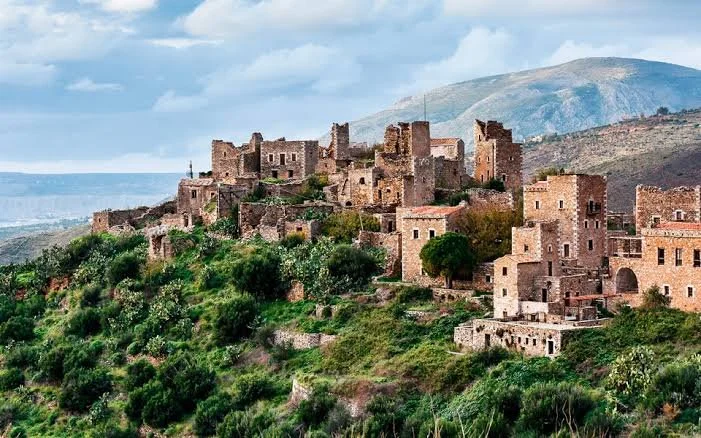
The Mani Peninsula is one of the most distinctive historical landscapes of southern Greece.
Stretching into the southern Peloponnese, Mani is famous for rugged mountains, fortified tower houses, dramatic coastlines, and villages that developed distinctive local traditions.
Its strategic geography also made the peninsula an important frontier zone during the Ottoman and Venetian periods.
Among the most fascinating remains are fortifications associated with the struggle for control of the southern Peloponnese.
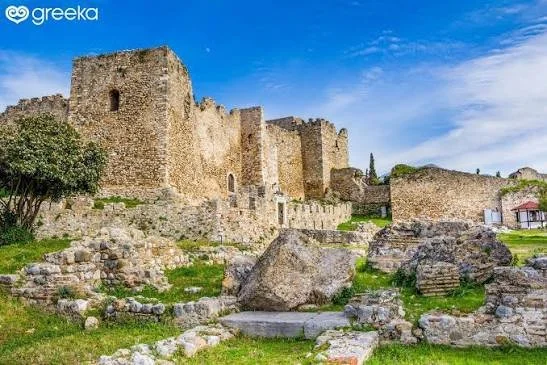
One of the most important examples is the fortress of Kelefa, located on the western side of the Mani Peninsula.
Historical research identifies Kelefa as part of a series of fortifications constructed or refurbished to defend the Ottoman maritime frontier against Venice during the late seventeenth century.
Mani as a Frontier
The Mani Peninsula was never simply an isolated mountain region.
Its location made it strategically important.
The peninsula projects into the Mediterranean and lies near maritime routes connecting the Ionian and Aegean worlds.
Control of fortified positions could therefore influence movement along the coast.
During the Ottoman-Venetian conflicts, the region became part of a broader struggle involving naval power, fortified ports, local communities, and competing imperial interests.
Why Fortifications Were Necessary
Early modern warfare differed substantially from ancient warfare.
Firearms and artillery transformed fortification design.
Walls needed to withstand cannon fire.
Defensive positions had to control roads and harbors.
Elevated locations offered observation advantages.
Fortifications could also protect supply routes and provide bases for military operations.
Kelefa Fortress
Kelefa is particularly interesting because its exact architectural history has been debated.
Historical scholarship has questioned whether the fortress should be understood as entirely Ottoman in origin or whether it incorporated an earlier Frankish structure that was later restored or modified by the Ottomans.
This is an important archaeological problem.
A fortress does not necessarily belong to one period.
Military structures are frequently reused.
Walls are repaired.
Towers are rebuilt.
Entrances are modified.
New artillery positions can be added to older medieval foundations.
The Ottoman Frontier
The Ottoman Empire's control of the Peloponnese was not uniform in every period.
The peninsula contained communities with different political relationships and local power structures.
The Mani region was particularly distinctive.
Its mountainous geography made centralized control difficult.
Fortifications therefore formed part of a wider strategy of territorial management.
Ottoman and Venetian Competition
The late seventeenth century was a period of intense competition between Venice and the Ottoman Empire.
The Morean War, fought from 1684 to 1699, dramatically changed control of parts of the Peloponnese.
Venetian forces captured significant territories.
Ottoman authorities responded by strengthening strategic positions.
The fortifications of southern Greece must therefore be understood within this international conflict.
Fortifications Beyond Kelefa
Mani's landscape contains many defensive structures.
Some are clearly associated with Ottoman-era or post-medieval conflict.
Others are older.
Some are local tower houses rather than formal imperial fortresses.
This distinction matters.
A tower house could function as a residence, defensive structure, or symbol of family status.
A large fortress, by contrast, could be designed for organized military defense.
Architecture and Power
The architecture of Mani reflects more than warfare.
Stone towers could communicate social authority.
A large fortified residence demonstrated the resources of a family.
Settlement patterns could reflect alliances and rivalries.
The landscape therefore becomes a record of political organization.
Why Some Fortifications Become "Forgotten"
Fortifications can disappear from public awareness for several reasons.
They may be:
located far from major roads;
overgrown;
damaged by earthquakes;
incorporated into later structures;
difficult to access;
poorly preserved;
overshadowed by more famous monuments.
Modern archaeological surveys can change this.
Researchers can document walls using drones, photogrammetry, GIS, and architectural recording.
Archaeology Versus Historical Memory
Mani has a strong tradition of local historical memory.
Families and communities preserve stories about towers, battles, migrations, and rivalries.
These traditions can be valuable.
But archaeology and oral tradition answer different kinds of questions.
Archaeological evidence can establish construction phases.
Written records can provide dates and names.
Oral histories can preserve memories of places and events.
The strongest historical interpretation often emerges when different types of evidence are compared.
Conservation Challenges
Fortifications face serious preservation problems.
Stone walls can deteriorate through:
vegetation;
water penetration;
earthquakes;
erosion;
neglect;
uncontrolled construction.
Preserving a fortress therefore requires more than simply identifying it.
Documentation is the first step.
Stabilization and conservation follow.
Why Mani's Fortifications Matter
The fortifications of Mani reveal the peninsula's position within wider Mediterranean politics.
They demonstrate how local landscapes became involved in conflicts between major powers.
They also show how communities adapted to changing military technologies.
Ancient walls were not necessarily abandoned when new political systems arrived.
They could be reused.
New defenses could be built beside older structures.
The result is a layered military landscape.
Conclusion
The "forgotten" fortifications of Mani are valuable precisely because they reveal a period when the southern Peloponnese was part of a complex frontier between competing political powers.
Kelefa is particularly important because historical scholarship continues to examine the relationship between its earlier architectural phases and later Ottoman modifications.
Studying these fortifications moves us beyond the image of Mani as simply a landscape of picturesque stone towers.
The peninsula was a strategic environment shaped by war, trade, local authority, imperial competition, and maritime geography.
Its fortresses are therefore not just ruins.
They are physical records of a Mediterranean world in which control of a mountain, harbor, or road could have consequences far beyond the immediate landscape.