Alonissos and the surrounding Northern Sporades occupy an exceptional position in the archaeology of the ancient Aegean.
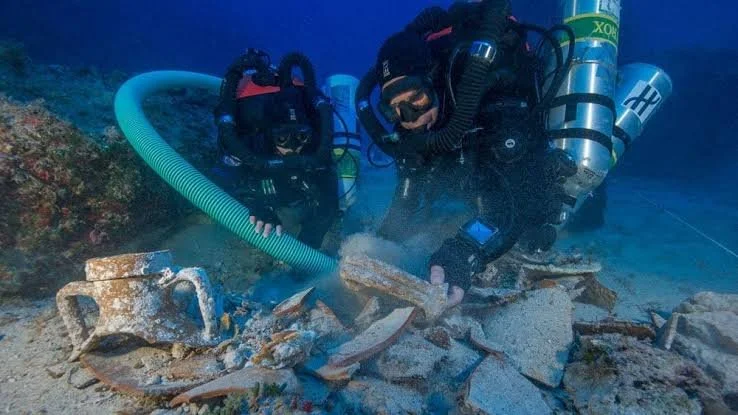
The waters around the island preserve evidence of ancient maritime commerce, and the famous Peristera shipwreck demonstrates the remarkable archaeological potential of the region.
The specific Hellenistic shipwreck described by this title could not be verified as a documented 2026 discovery in the sources located for this article.
The archaeological background, however, is firmly established.
The Peristera Wreck
The most famous underwater archaeological site near Alonissos is the Peristera shipwreck.
The wreck dates to the late fifth century BCE, around 430–420 BCE.
Research on the wreck identified thousands of commercial amphoras, including vessels associated with Mende and Peparethos. Archaeological reports also record bronze objects, including a bronze bucket and a ladle.
The wreck transformed archaeological understanding of ancient Greek maritime transport.
Why the Shipwreck Was Important
The quantity of amphoras demonstrated that ancient Greek merchant ships could carry enormous cargoes.
Earlier assumptions about the size of ancient merchant vessels were challenged by the evidence.
The Peristera wreck therefore became important not simply because it contained artifacts but because the ship itself provided evidence about ancient naval architecture and commercial logistics.
Bronze Tools on a Ship
Bronze tools or implements found aboard a ship can be especially informative.
They might indicate:
ship maintenance;
cargo handling;
cooking;
navigation;
trade;
personal possessions;
workshop activities.
However, identifying a bronze object as a "tool" requires careful analysis.
Its shape alone may not reveal its function.
Wear patterns and contextual associations can be more informative.
Why Underwater Context Matters
On land, archaeological layers can be disturbed by construction, agriculture, erosion, and later settlement.
Shipwrecks can preserve an archaeological moment in time.
A vessel sinks.
Its cargo settles.
Objects may remain where they fell.
The surrounding sediments can protect organic material.
This creates a kind of archaeological snapshot.
Dating a Wreck
A shipwreck is rarely dated using one artifact alone.
Researchers combine:
pottery;
amphora typology;
coins;
wood analysis;
radiocarbon dating;
ship construction;
cargo origins.
Amphoras can be particularly valuable because their forms changed over time and because their production centers can sometimes be identified.
What Bronze Objects Can Tell Us
Metallurgical analysis can identify the composition of bronze.
Researchers can study:
copper;
tin;
lead;
trace elements.
Manufacturing techniques may reveal casting, hammering, finishing, and repair.
The distribution of objects can also show whether they were cargo or equipment.
Maritime Trade in the Northern Aegean
The Northern Sporades occupied important routes.
Ships moving between mainland Greece, the islands, Macedonia, Thrace, and the wider Aegean could pass through these waters.
Wine was one important commodity.
But ancient ships transported much more than wine.
Cargoes could include:
olive oil;
grain;
ceramics;
metals;
luxury goods;
building materials.
The Underwater Museum
The archaeological importance of the region is reflected in the creation of the Alonissos Underwater Museum around the Peristera wreck.
The site became accessible to divers, creating an unusual opportunity to experience archaeological remains in their underwater environment.
This approach also highlights the need for conservation.
Visitors must avoid touching or removing objects.
What a New Hellenistic Wreck Would Add
A securely dated Hellenistic wreck could extend our understanding beyond the Classical period.
The Hellenistic Mediterranean was characterized by large political states and extensive commercial networks.
Ships moved through increasingly interconnected economies.
A wreck could reveal:
cargo distribution;
shipbuilding;
trade routes;
commercial relationships;
technological practices;
maritime risks.
Conclusion
The specific Hellenistic shipwreck described in the title should not be treated as a confirmed 2026 discovery without archaeological documentation.
But Alonissos already provides one of the most important underwater windows into ancient Greek maritime life.
The Peristera wreck demonstrates the scale of Classical trade and the sophistication of ancient merchant shipping.
A future Hellenistic wreck containing bronze tools could build upon this evidence by revealing how maritime commerce and shipboard life evolved during the centuries after Alexander the Great.