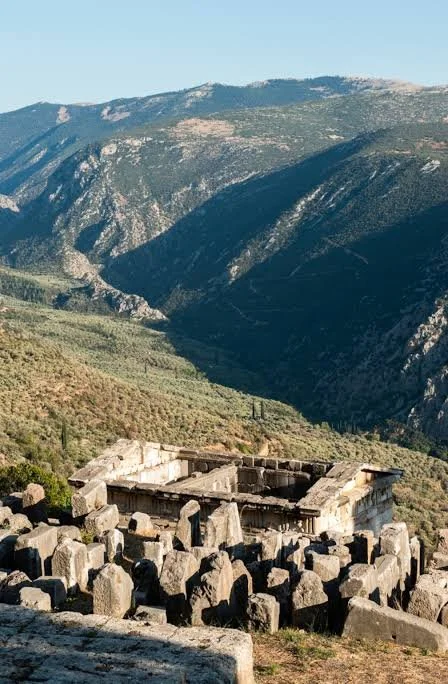
Delphi is one of the most famous archaeological landscapes in Greece.
Its sanctuary of Apollo, theater, stadium, treasuries, and Temple of Athena Pronaia have made it synonymous with ancient Greek religion and the oracle.
Yet Delphi was not frozen in the Classical period.
The archaeological record demonstrates that the settlement continued to develop during the Roman period and into Late Antiquity.
The official archaeological site notes substantial Late Roman remains, including baths, a peristyle house, the Roman Agora, a large cistern, and a major private residence known as the Southeastern Mansion.
This raises an intriguing question:
What other Roman domestic structures may still be hidden beneath the surrounding landscape?
The specific discovery of "subterranean Roman villas" along forgotten trails could not be verified as a distinct recent archaeological discovery. But the existence of substantial Roman residences and infrastructure around Delphi is firmly documented.
Delphi Was More Than an Oracle
The popular image of Delphi centers on the oracle.
Pilgrims came to consult Apollo.
Cities built treasuries.
Visitors dedicated offerings.
Religious festivals brought people together.
But Delphi was also a living settlement.
People had to eat.
They needed housing.
Merchants needed shops.
Workers needed workshops.
Water had to be supplied.
Waste had to be managed.
The city therefore possessed an urban infrastructure extending beyond the sanctuary itself.
Delphi Under Roman Rule
Roman political control did not immediately end Delphi's importance.
Instead, the city adapted.
The sanctuary continued to exist, although its role changed over time.
Roman visitors participated in the religious and cultural traditions of the site.
Wealthy inhabitants built substantial houses.
Public and private architecture continued to develop.
The Southeastern Mansion
One of the most important Late Roman discoveries at Delphi is the Southeastern Mansion.
According to the official archaeological site, the building possessed a façade approximately 65 meters long and extended across four different levels. It included private baths and four triclinia, or dining rooms, several of which ended in niches.
This is far removed from the image of Delphi as merely a collection of Classical ruins.
It demonstrates that wealthy people continued to live at Delphi centuries after the height of the Classical sanctuary.
Luxury in Late Roman Delphi
Archaeologists recovered large storage jars and luxury objects from the mansion.
Among the unusual finds was a small leopard made of mother-of-pearl, apparently of eastern provenance and possibly connected with Sasanian Persia.
Such an object demonstrates that long-distance connections continued during Late Antiquity.
The Roman Mediterranean was not culturally isolated.
Goods could travel enormous distances.
Private Baths
Private baths are important indicators of wealth.
Bathing required:
water;
heating;
specialized architecture;
fuel;
maintenance.
A private bath therefore represents considerable investment.
The presence of baths in the Southeastern Mansion suggests that its inhabitants possessed substantial resources.
Triclinia and Social Life
The dining rooms are equally important.
A triclinium was not simply a dining room.
Roman dining was a social activity.
The arrangement of couches, tables, serving vessels, and decorative spaces could communicate status.
Guests were positioned according to social relationships.
Food and wine became part of elite display.
A large villa therefore reveals social organization as much as domestic architecture.
What Does "Subterranean" Mean?
A structure can become partly subterranean without originally being designed as an underground villa.
Buildings may be:
constructed into slopes;
built over earlier structures;
buried through later accumulation;
preserved below modern ground levels.
Delphi's steep topography makes terraced architecture particularly important.
A building constructed into a slope could appear partially underground centuries later.
The Landscape Around Delphi
Delphi sits on the slopes of Mount Parnassus.
The terrain is steep and complex.
Roads and paths historically connected the sanctuary to surrounding communities.
Some ancient routes have been altered, abandoned, or covered by later landscapes.
This means archaeological remains can survive outside the most famous excavated areas.
Forgotten Trails as Archaeological Corridors
Ancient roads are valuable archaeological evidence.
They connect:
sanctuaries;
settlements;
farms;
cemeteries;
ports;
administrative centers.
A villa beside an ancient road was not randomly located.
Its position could provide access to transportation routes and nearby resources.
Survey archaeology can therefore reveal relationships that individual excavations cannot.
Water Infrastructure
Water was essential to Roman domestic architecture.
The official Delphi archaeological record includes a large Roman cistern among the city's Late Roman monuments.
Water infrastructure could support:
houses;
baths;
workshops;
fountains;
sanitation.
A newly discovered residence could therefore potentially be connected to a wider hydraulic network.
Villas and the Rural Landscape
Roman villas could have multiple functions.
Some were primarily residences.
Others were connected to agricultural production.
Some represented elite retreat spaces.
The term "villa" therefore covers a range of building types.
A structure near Delphi might have served as an elite residence associated with the city rather than as a large agricultural estate.
Delphi After the Oracle
One of the most interesting aspects of Delphi's later history is that life continued even after the sanctuary's traditional religious role declined.
The official Delphi archaeological site explains that a decree issued by Theodosius I in 394 CE banned the pagan oracles, but archaeological evidence demonstrates that Delphi continued as a living settlement for several centuries afterward.
The site contained Late Roman and early Christian structures.
A fifth-century Christian basilica has been identified.
The city therefore underwent transformation rather than simply disappearing.
A City That Changed Function
The history of Delphi illustrates a broader archaeological principle.
Cities rarely vanish instantly.
They change.
A sanctuary becomes surrounded by houses.
Public buildings are reused.
Old stones become building materials.
Industrial activities move into abandoned spaces.
Religious landscapes become residential landscapes.
At Delphi, the archaeological evidence documents precisely this kind of transformation.
Why Hidden Villas Matter
If future surveys identify additional Roman domestic complexes near Delphi, they could help reconstruct the city's residential districts.
Researchers could investigate:
household size;
wealth distribution;
food consumption;
trade;
architecture;
bathing;
craft production;
religious change.
The evidence would complement the spectacular monuments of the sanctuary.
Archaeological Survey
Finding buried buildings does not necessarily require immediate excavation.
Modern archaeology increasingly uses non-invasive methods.
These include:
ground-penetrating radar;
magnetometry;
electrical resistivity;
drone photography;
LiDAR;
GIS mapping.
Such techniques can identify anomalies without destroying the archaeological layers.
Conclusion
The specific discovery of subterranean Roman villas along forgotten Delphi trails has not been independently verified as a recent archaeological find.
But the broader idea is strongly supported by the existing archaeological record.
Delphi contained substantial Roman and Late Roman domestic architecture, including the impressive Southeastern Mansion, private baths, dining rooms, storage facilities, and luxury objects.
The existence of these buildings changes how we understand Delphi.
It was not simply the home of an ancient oracle.
It was a living city.
Its inhabitants built houses, consumed imported goods, entertained guests, managed water, practiced crafts, and adapted to enormous political and religious changes.
The most exciting archaeological discoveries around Delphi may therefore not always be another famous temple or statue.
They may be the ordinary houses and hidden infrastructure that reveal how people actually lived beside one of the most famous sanctuaries in the ancient Mediterranean.