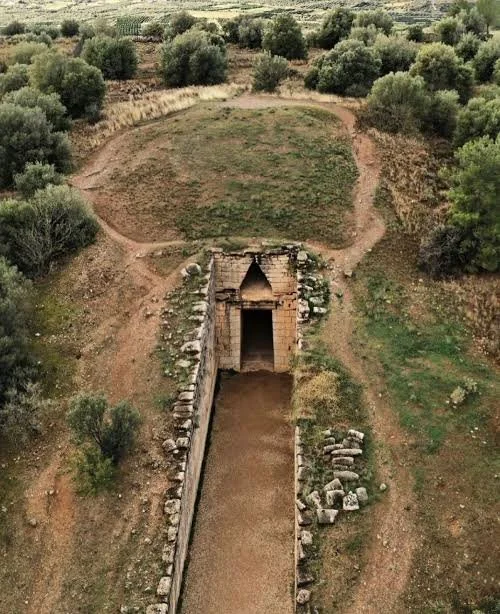
Across the hills and valleys of the western Peloponnese stand some of the most extraordinary funerary monuments of the Mycenaean world.
Known as tholos tombs, these monumental structures consist of a circular burial chamber covered by a corbelled stone roof and usually approached through a long entrance passage known as a dromos.
Their architecture is simple in concept but monumental in execution.
The largest examples demonstrate the organizational abilities of Late Bronze Age societies and reveal a world in which burial, political authority, wealth, ancestry, and landscape were closely connected.
What Is a Tholos Tomb?
The Greek word tholos refers to a circular structure.
In Mycenaean archaeology, the term generally describes a monumental circular tomb built into or against a hillside.
A typical tomb contains three major components:
the dromos, or approach passage;
the stomion, or entrance doorway;
the tholos, or circular burial chamber.
The chamber was usually constructed from carefully arranged stone blocks.
The roof was created through corbelling, in which successive courses of stone projected slightly inward until the opening at the top could be closed.
The result created a beehive-like interior.
Monumental Architecture for the Dead
Tholos tombs were not merely practical burial spaces.
Their scale required considerable labor.
Large stones had to be quarried, transported, shaped, and positioned.
The dromos had to be excavated.
The entrance had to be constructed carefully.
In some cases, the exterior was covered by an earthen mound.
Such projects imply coordination.
That coordination tells archaeologists something about Mycenaean society.
A community capable of constructing monumental tombs possessed systems for mobilizing labor and resources.
The Western Peloponnese
Western Greece contains some of the most important evidence for Mycenaean civilization.
The region around Pylos was dominated by the palace at Ano Englianos, commonly known as the Palace of Nestor.
The wider landscape contained settlements, cemeteries, agricultural areas, roads, and monumental tombs.
Messenia's archaeological record demonstrates the existence of powerful elites who controlled resources and participated in extensive networks.
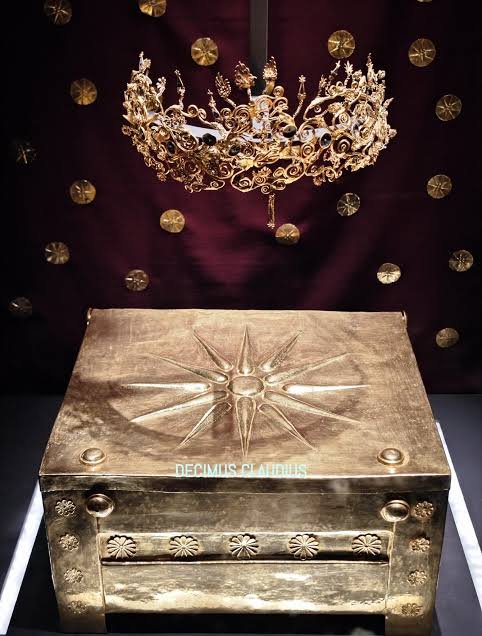
The Archaeological Service of Messenia specifically identifies the Mycenaean tholos tombs of Peristeria as important sources of gold funerary material.
The Tomb of the Warrior and the Rise of Elite Burial
Mycenaean funerary archaeology reveals enormous social differences.
Some graves contained modest possessions.
Others contained weapons, jewelry, gold objects, imported materials, and elaborate personal equipment.
This suggests that status was expressed through burial.
Funerary archaeology therefore provides one of the most important ways to reconstruct Mycenaean social hierarchy.
Why Were Tombs Built?
The precise meaning of Mycenaean monumental tombs remains debated.
Several interpretations have been proposed.
They may have functioned as:
elite family tombs;
ancestral monuments;
symbols of political authority;
places for repeated burial;
ritual spaces;
statements of territorial ownership.
These explanations are not necessarily mutually exclusive.
A tomb could have served as a burial place while simultaneously reinforcing the identity of a ruling family.
The Importance of Reuse
Some Mycenaean tombs were used repeatedly.
This is particularly significant.
A single tomb could contain individuals who died at different times.
Such reuse suggests that burial places could maintain social importance across generations.
The tomb therefore became more than a container for one body.
It could become a physical representation of ancestry.
Gold and Symbolic Wealth
The appearance of gold in elite burials demonstrates the importance of visible wealth.
Gold objects were sometimes extremely thin.
Craftworkers could hammer gold into sheets and create decorative motifs.
Some objects were attached to clothing.
Others were placed directly with the dead.
The Archaeological Service of Messenia notes that many Mycenaean gold objects were sewn onto garments and carried religious symbolism.
Tombs and Political Geography
Monumental tombs can also help archaeologists reconstruct political landscapes.
A tomb positioned prominently near a settlement may have served as a visible statement of authority.
Its location could connect an elite lineage with agricultural territory, roads, waterways, or settlements.
In this sense, the architecture of death could influence how the living understood the landscape.
What the Tombs Cannot Tell Us
Despite their importance, tombs do not provide a complete historical narrative.
They rarely tell us the names of the people buried inside.
Even when objects are spectacular, their exact meanings can remain uncertain.
A gold ornament may have had religious significance, social significance, or both.
A weapon may have represented military identity without proving that the individual was a professional warrior.
Archaeologists must therefore avoid turning every artifact into a simple biography.
Scientific Archaeology and New Discoveries
Modern research has transformed the study of Mycenaean tombs.
Archaeologists can now combine:
osteological analysis;
DNA research;
isotope analysis;
residue studies;
ceramic analysis;
metallurgical examination;
spatial analysis.
Strontium isotopes, for example, can sometimes provide evidence about geographical mobility.
Ancient DNA can potentially illuminate biological relationships.
Microscopic analysis can reveal manufacturing techniques invisible to the naked eye.
Conclusion
The tholos tombs of the western Peloponnese are among the clearest monuments of Mycenaean elite society.
Their enormous stone chambers demonstrate engineering.
Their grave goods reveal wealth.
Their repeated use reveals the importance of ancestry.
Their locations reveal relationships between people and landscapes.
Most importantly, they remind us that Mycenaean civilization cannot be understood solely through palaces and Linear B tablets.
The dead were part of the political and social world of the living.
A tholos tomb was therefore not simply a place where a person was buried.
It was a monument through which communities remembered identity, ancestry, status, and power.