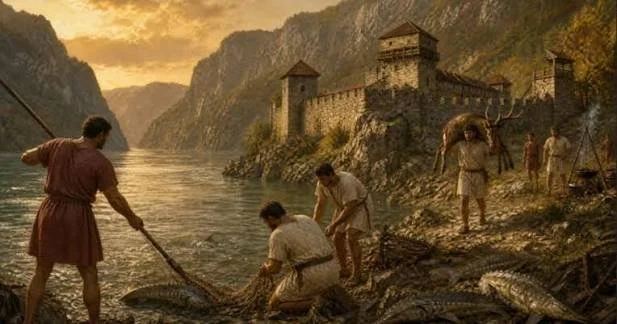
The image of a Roman emperor hunting in the mountains of Greece combines imperial power with the ancient aristocratic tradition of the hunt.
Hunting was far more than recreation in the Roman world.
It could demonstrate:
physical courage;
military skill;
elite status;
mastery over nature;
imperial magnificence.
The Pindus Mountains, with their forests, valleys, and rugged terrain, would have offered an environment suitable for hunting large game.
However, the specific claim that Roman emperors maintained "private hunts" in the Pindus forests should be treated carefully. Individual emperors participated in hunting, but evidence for a dedicated imperial hunting estate in the Pindus is much less straightforward.
Hunting and Roman Elite Culture
Roman aristocrats frequently hunted.
The activity had Greek precedents.
Ancient Greek elites associated hunting with education, masculinity, warfare, and status.
Roman rulers inherited many of these traditions.
A successful hunt demonstrated qualities that also mattered in military leadership.
The Emperor as Hunter
Roman emperors were expected to embody physical and military virtues.
Hunting provided a controlled demonstration of those qualities.
An emperor who killed a dangerous animal could present himself as:
courageous;
physically capable;
disciplined;
victorious.
Imperial hunting scenes therefore appear in Roman art.
The Pindus Mountains
The Pindus range forms the mountainous spine of mainland Greece.
Its forests historically supported diverse wildlife.
Mountain valleys provided routes through difficult terrain.
For Roman travelers, the region was far more challenging than the cultivated plains of southern Greece.
A hunting expedition there would require substantial logistical preparation.
Hunting Was Logistically Difficult
An imperial hunting party could involve:
attendants;
soldiers;
guides;
cooks;
animal handlers;
horses;
hunting dogs.
Food had to be transported.
Temporary camps might be established.
Roads or tracks had to be usable.
This means that a large imperial hunting expedition could itself become a significant logistical operation.
Hunting and Military Training
The connection between hunting and warfare was ancient.
Hunters learned:
tracking;
movement through difficult terrain;
weapons handling;
coordination;
patience.
Roman military culture valued similar abilities.
For emperors, hunting could therefore reinforce the image of the ruler as warrior.
The Difference Between Hunting and Private Leisure
Imperial hunting could be called private in the sense that it was not a public military campaign.
But an emperor rarely traveled without a substantial entourage.
The distinction between private and political life was therefore less clear than it is today.
The emperor's activities remained politically meaningful.
Greek Landscapes in Roman Culture
Roman elites were fascinated by Greece.
The region was associated with:
Classical education;
philosophy;
literature;
art;
religious traditions.
Travel to Greece could therefore have cultural significance.
An emperor hunting in Greece could simultaneously participate in Roman aristocratic culture and appropriate the prestige of the Greek landscape.
Archaeological Evidence
A hunting expedition is difficult to identify archaeologically.
Researchers might find:
temporary camps;
animal bones;
hunting equipment;
inscriptions;
roads;
elite villas.
But proving that an emperor personally hunted at a particular site requires documentary evidence.
A villa containing hunting imagery is not enough.
Imperial Villas
Roman emperors and elites possessed estates throughout the empire.
Some were designed for leisure.
Others combined agricultural and residential functions.
A villa near a forest could provide access to hunting grounds.
Yet identifying an imperial owner is difficult without inscriptions or literary evidence.
Hunting and Imperial Propaganda
Hunting could also be represented symbolically.
Imperial art frequently showed rulers defeating animals.
The image communicated control.
A ruler defeating a lion or boar could symbolically resemble a ruler defeating enemies.
The hunt therefore had a political language.
Conclusion
There is good historical reason to investigate imperial hunting culture in the Greek mountains.
The Roman elite valued hunting, and the Pindus landscape provided an environment in which large-game hunting could occur.
But the specific claim of a Roman emperor maintaining a private hunting base in the Pindus requires stronger evidence.
The most useful historical interpretation is to place the Pindus within the wider Roman culture of aristocratic hunting.
For Roman rulers, the hunt was never merely about killing an animal.
It could communicate courage, authority, military competence, elite identity, and mastery over the natural world.