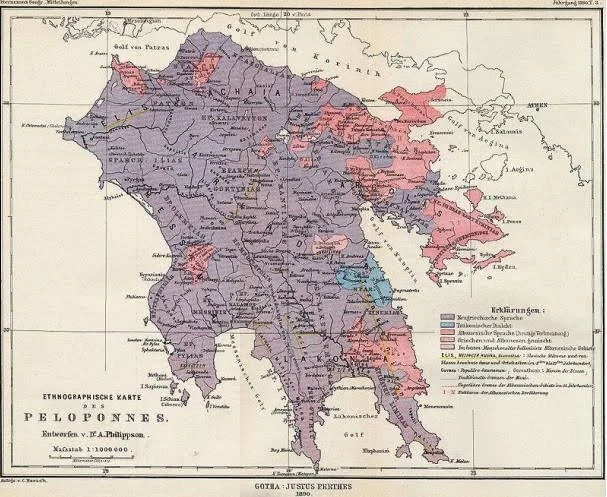
The history of the fifteenth-century Peloponnese cannot be fully understood without examining the migration and settlement of Albanian-speaking communities.
Their arrival transformed the demographic, military, agricultural, and political landscape of the peninsula.
The subject has sometimes been obscured by later national narratives.
Medieval evidence presents a more complicated picture involving Byzantine rulers, the Despotate of the Morea, Venetian authorities, local communities, military recruitment, pastoralism, and migration.
Modern scholarship documents Albanian settlement in the Peloponnese beginning in the later fourteenth century, followed by further migration during the fifteenth century.
Who Were These Communities?
Medieval sources use different terms for Albanian-speaking populations.
In Greek historical contexts, the term Arvanites is frequently encountered.
They were not a single centralized kingdom.
They consisted of different groups, families, and communities.
Many practiced pastoralism and maintained mobile or semi-mobile patterns of life.
Their organization could also have military dimensions.
Why Did They Move?
The migration of Albanian communities into the Peloponnese occurred within a period of major demographic and political disruption.
The fourteenth century brought:
warfare;
plague;
population decline;
political fragmentation;
labor shortages;
military competition.
Rulers needed people.
Land needed cultivation.
Armies needed soldiers.
Migration therefore became politically useful.
Byzantine Settlement Policies
The Despotate of the Morea actively encouraged settlement.
A modern scholarly study notes that Albanian groups moved from Thessaly into the Peloponnese in the late fourteenth century with permission from Theodore I Palaiologos, ruler of the Despotate of the Morea. The settlement helped address demographic and economic problems and strengthened the military resources available to the despots.
This is important.
The migration was not simply an uncontrolled movement.
At least some groups were invited or permitted to settle.
Land and Military Service
Land was one of the principal incentives.
A ruler could grant access to:
pasture;
agricultural land;
villages;
tax privileges.
In return, settlers could provide military service.
This arrangement was useful in frontier regions.
Settlers became part of the political defense system.
The Peloponnese in the Fifteenth Century
The Morea was politically divided.
The Byzantine Despotate controlled parts of the peninsula.
Venice controlled important coastal territories.
Latin rulers remained present in Achaea.
Ottoman pressure increased.
Local elites competed for power.
Within this environment, Albanian settlers became valuable military and agricultural communities.
The Scale of Migration
A scholarly study of the period notes a significant influx of Albanian settlers and identifies a particularly important settlement movement during the reign of Theodore I Palaiologos. By the early 1460s, Ottoman taxation records distinguished Greek and Albanian settlements across the Peloponnese.
This is extremely important evidence.
The Ottoman cadastral records demonstrate that Albanian communities were not merely isolated bands of soldiers.
They had established settlements.
Albanian Communities and the Despotate
The relationship between Albanian settlers and Byzantine rulers was not always peaceful.
Military service could create political leverage.
Settlers possessed weapons.
They controlled territory.
They could rebel when dissatisfied.
The fifteenth century therefore witnessed both cooperation and conflict.
The Rebellion of 1453
Albanian communities played a significant role in the political disturbances of the Morea.
A 2022 scholarly study specifically examines the participation of Albanian groups in the political events of the Despotate during the first half of the fifteenth century and their role in the rebellion of 1453.
This demonstrates that they were political actors, not simply passive migrants.
Venice and Albanian Settlers
Venetian authorities also recognized the military and demographic value of Albanian communities.
Research on late medieval settlement notes that Venetians could offer land, pasture, and tax advantages to Albanian settlers in depopulated territories because they needed both colonists and soldiers.
This demonstrates the strategic value of population movement.
Pastoralism
Pastoralism was particularly important.
Mountainous landscapes provided grazing.
Communities could move livestock seasonally.
Sheep and goats were important sources of:
meat;
milk;
wool;
hides.
Pastoral communities could therefore occupy lands that were less attractive to intensive agriculture.
Cultural Transformation
The settlement of Albanian-speaking communities contributed to the linguistic and cultural diversity of the Peloponnese.
Place names changed.
Languages interacted.
Intermarriage occurred.
Communities adapted to their neighbors.
Over the following centuries, many communities became deeply integrated into Greek society while retaining elements of their distinctive linguistic and cultural heritage.
Why They Became "Forgotten"
The historical memory of the Peloponnese has often been dominated by:
Classical Greece;
Byzantium;
Ottoman conquest;
the Greek War of Independence.
The medieval migrations that occurred between these major periods can receive less attention.
Yet demographic change during the fourteenth and fifteenth centuries shaped the population of the region long before the modern Greek state existed.
Conclusion
The Albanian communities of the fifteenth-century Peloponnese were not marginal figures.
They became farmers, shepherds, soldiers, settlers, and political actors.
Their migration was encouraged at different times by Byzantine and Venetian authorities seeking to repopulate territories and strengthen military defenses.
By the early Ottoman period, administrative records clearly distinguished Albanian and Greek settlements in the peninsula.
Their story demonstrates how migration can transform a region without producing a single dramatic moment of conquest.
Population movement changed the Peloponnese village by village, valley by valley, and generation by generation.