The history of Jewish communities in Venetian Crete offers a remarkable example of how minority communities participated in Mediterranean commerce.
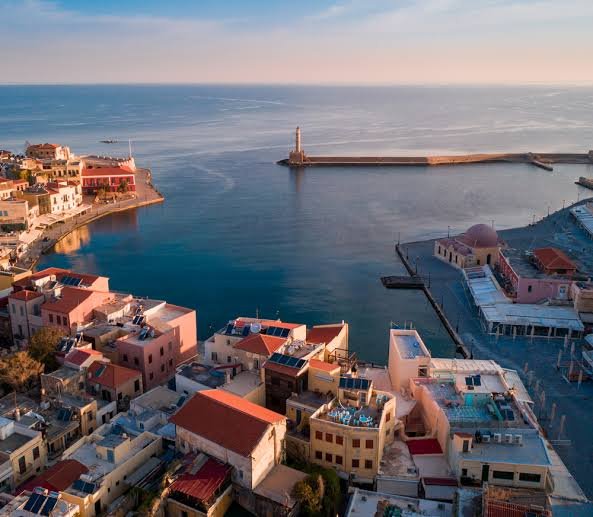
Chania, known in Venetian times as La Canea, was one of Crete's major ports.
Its location made it a natural point of contact between the island, Venice, the Aegean, the eastern Mediterranean, and North Africa.
Jewish merchants participated in this wider economic world.
The word "secret" in the title, however, should be interpreted carefully.
There is substantial documentary evidence for Jewish economic activity in Venetian Crete. The evidence does not require the existence of a hidden or clandestine trading system.
Jews in Venetian Crete
Venice conquered Crete after the Fourth Crusade.
The island became one of the most important territories of the Venetian maritime empire.
A substantial Jewish population lived on Crete, particularly in the major urban centers.
The Jewish community of Candia, modern Heraklion, is particularly well documented.
Research by Rena Lauer shows that the Jewish community of Venetian Crete was economically active and maintained complex relationships with Venetian authorities.
Chania and Candia
Candia was the administrative capital of Venetian Crete.
Chania was another major port.
Both were connected to maritime trade.
Merchants could operate across several cities.
A Jewish merchant living in Chania could potentially maintain relationships with:
Candia;
Venice;
Alexandria;
Constantinople;
other Mediterranean ports.
This is the essence of a trading network.
What Did Merchants Trade?
Mediterranean commerce involved enormous variety.
Products could include:
textiles;
spices;
grain;
wine;
olive oil;
metals;
leather;
luxury goods.
Merchants did not necessarily specialize in one commodity.
Their businesses depended on changing prices, political conditions, and access to ships.
Jewish Commercial Networks
Jewish communities were connected through family, religious, and commercial relationships.
These networks could make it easier to identify trusted business partners.
Letters could travel with merchants.
Financial arrangements could cross political borders.
Marriage could connect families in different ports.
Religious institutions could help maintain communal relationships.
Documentary Evidence
One of the strongest features of the history of Venetian Crete is the survival of documents.
Research on sixteenth-century Cretan Jews draws upon Venetian State Archive materials, including records of the Duke of Crete and notarial documents. These records contain economic transactions, complaints, taxation matters, lawsuits, and other evidence of Jewish participation in Cretan public life.
This is extraordinarily valuable.
It means Jewish economic activity is not merely inferred.
It can be studied through actual documentation.
Jewish-Christian Relations
Jewish merchants operated within a Christian-dominated Venetian colonial system.
Their relationships with Christian neighbors were complicated.
There could be cooperation in business.
There could also be legal disputes, taxation conflicts, social tensions, and religious discrimination.
Historical reality was therefore neither complete isolation nor complete integration.
Economic Importance
The Jewish community had sufficient economic significance to appear repeatedly in official documentation.
A scholarly study notes that Jewish people appear frequently in Venetian records because of their economic role, including financial transactions and legal cases.
This demonstrates that the community was integrated into the functioning of the port economy.
The Port as a Meeting Place
A harbor is more than a place where ships dock.
It is an information network.
Merchants learn:
prices;
political developments;
shipping conditions;
wars;
crop failures;
market demand.
Information can be as valuable as cargo.
Jewish merchants, like other commercial groups, could use port networks to exchange information across the Mediterranean.
The Role of Family
Family networks were particularly important in premodern commerce.
A merchant could send goods to a relative in another city.
A trusted partner could collect payment.
A family member could negotiate with authorities.
This reduced some risks associated with long-distance trade.
The Jewish Quarter
Urban Jewish communities often maintained their own communal institutions.
Synagogues, schools, charitable structures, and communal leadership helped organize community life.
But the community was not economically isolated.
Jewish neighborhoods were embedded within wider cities.
Chania's Mediterranean Connections
Chania's geographical position placed it within routes connecting Crete with western and eastern Mediterranean markets.
Venetian ships connected the island to Venice.
Other ships connected it with the Levant and Aegean.
This created opportunities for merchants from many communities.
The Fall of Venetian Crete
Venetian rule ended after the long Cretan War, culminating in the Ottoman conquest of Candia in 1669.
This transformed the political environment in which Cretan Jewish communities operated.
Commercial networks did not simply disappear.
They adapted to the new Ottoman system.
Why the Networks Can Appear "Secret"
Premodern commercial networks often leave fragmented evidence.
A single merchant might appear in a notarial document.
Another appears in a tax record.
A third appears in a court case.
When historians connect these fragments, a network becomes visible.
To someone reading only one document, the wider system may appear hidden.
But "hidden" does not necessarily mean clandestine.
Conclusion
Jewish merchants were important participants in the economic life of Venetian Crete.
The strongest documentary evidence comes from Candia, where archival sources preserve detailed information about taxation, commerce, legal disputes, and community organization.
Chania's position as a major harbor makes it an important setting for studying these wider commercial networks.
The historical significance lies not in an imagined secret trading empire but in the real networks of trust, family, credit, shipping, law, and information that allowed Jewish merchants to participate in the Mediterranean economy.
Their story is a reminder that medieval and early modern ports were extraordinarily diverse places.
Ships carried goods.
Merchants carried information.
And communities connected distant cities through relationships that could survive political borders, religious differences, and changing empires.