Introduction
Mount Parnassus rises in central Greece and is associated with dramatic mountain scenery, limestone formations, deep valleys, and a long cultural history. The region is also famous for its connection with Delphi, one of the most important religious centers of the ancient Greek world.
Its geological landscape offers opportunities to investigate caves, mineral formations, and the processes that shape underground environments.
The idea of crystal caves in remote Parnassus gorges is visually compelling, but a specific cave containing unusual crystal formations should not be presented as a documented discovery without geological confirmation. The region's limestone geology makes certain cave processes plausible, yet the types and extent of mineral formations vary from one location to another.
The Geology of Mount Parnassus
The Parnassus region contains substantial limestone formations. Limestone develops from carbonate sediments that accumulate in marine environments and later become consolidated into rock.
Over geological time, tectonic forces uplifted and deformed these rocks. Fractures, joints, and faults created pathways through which water could move.
Where groundwater containing dissolved carbon dioxide passes through limestone, it can gradually dissolve the rock. This process contributes to the development of caves, underground passages, and other karst features.
How Caves Form
Karst caves develop when water dissolves soluble rocks, especially limestone. Rainwater absorbs carbon dioxide from the atmosphere and soil, forming a weakly acidic solution.
As this water moves through fractures, it gradually enlarges openings in the rock. Over long periods, small cracks can become connected passages and chambers.
The shape of a cave depends on the geology, water flow, and history of the landscape. Some caves contain narrow passages, while others develop large chambers.
Not every gorge contains caves, and not every cave contains visible crystal formations.
What Are Cave Crystals?
Many cave formations consist of calcite, a mineral made primarily of calcium carbonate.
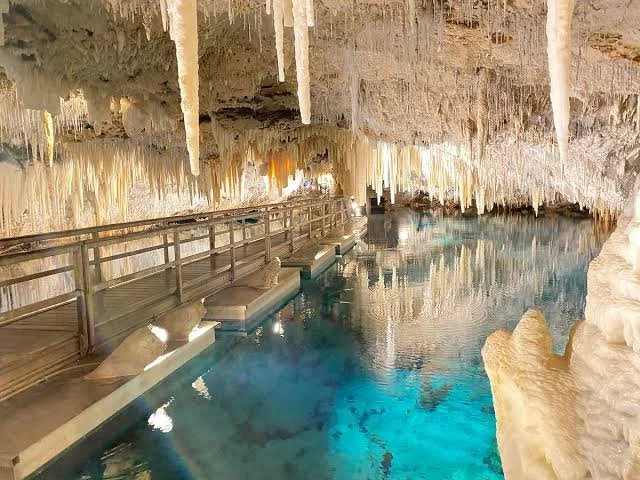
When mineral-rich water enters a cave and loses carbon dioxide or evaporates, it can deposit calcite on surfaces. Over time, these deposits may form stalactites hanging from ceilings and stalagmites rising from floors.
Other formations can include flowstone, curtains, and delicate crystalline surfaces.
The term "crystal cave" can refer to caves containing visibly crystalline minerals, but it is often used loosely in popular descriptions. A cave with ordinary calcite formations is not necessarily a rare mineral deposit.
Conditions for Crystal Growth
Crystal growth depends on the chemistry of the water, temperature, pressure, evaporation, and the availability of space.
Different minerals require different conditions. Calcite is common in limestone caves, while gypsum and other minerals occur in suitable environments elsewhere.
Large or unusual crystals may develop when conditions remain stable over long periods.
The discovery of a particular mineral in Parnassus would require mineralogical analysis and documentation of the cave in which it occurs.
Remote Gorges and Geological Exploration
Mountain gorges can expose layers of rock and provide access to fractured limestone. They may also contain springs, streams, and cave entrances.
However, remote terrain makes fieldwork challenging. Steep slopes, loose rock, flooding, and unstable cave passages can create serious hazards.
Professional geological surveys use maps, field observations, and appropriate safety procedures to document cave systems.
Exploration should not involve entering unstable or restricted passages simply because a location is described as hidden or unexplored.
Cave Ecosystems
Caves support specialized organisms adapted to darkness, limited food, and stable environmental conditions.
Some species depend on organic material carried in by water or animals. Others occupy cave entrances where sunlight and outside resources are more available.
Human visitors can affect these ecosystems through disturbance, artificial lighting, contamination, and changes in airflow.
Cave conservation therefore involves protecting both geological formations and biological communities.
Cultural Associations with Parnassus
Parnassus occupies an important place in Greek cultural history because of its association with Delphi and ancient traditions involving Apollo and the Muses.
The mountain's dramatic terrain contributed to its symbolic significance.
However, ancient mythology should not be confused with geological evidence. A cave described in a legend may be a literary or religious setting rather than a documented mineralogical site.
Modern interpretations should distinguish between mythological associations and the physical characteristics of an actual cave.
Conservation of Mineral Formations
Cave formations can take thousands of years to develop. Touching them may transfer oils or contaminants that alter their surfaces, while breaking a formation can destroy a feature that cannot be replaced on a human timescale.
Visitors should follow site regulations and avoid collecting minerals from protected caves.
Where a cave has not been formally assessed, responsible management should prioritize safety and prevent unnecessary disturbance.
Conclusion
Crystal caves in Parnassus's remote gorges provide a compelling theme for exploring karst geology, mineral formation, and the ecological value of underground environments. The limestone landscape makes cave development plausible, but claims about specific crystal chambers require verified geological evidence. Field mapping, mineral analysis, and careful conservation can reveal the actual features of Parnassus caves while protecting their fragile formations and the environments around them.