Introduction
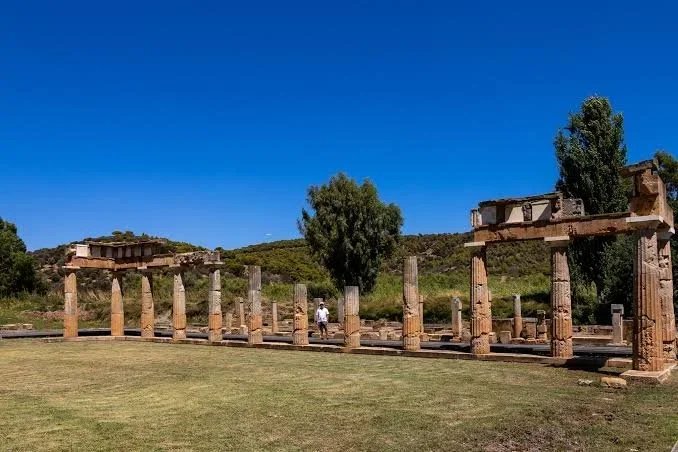
The Amarynthos area on the island of Euboea has attracted archaeological interest because of its connection with the sanctuary of Artemis Amarysia. Excavations in the region have contributed to the study of ancient Greek religious practice, sanctuary architecture, and the relationship between sacred sites and local communities.
Fertility was an important theme in ancient religion. Agricultural production, childbirth, animal reproduction, and the continuity of families were central concerns for communities whose lives depended on seasonal resources.
The idea of fertility rites in the fields around Amarynthos provides an opportunity to examine how religious ceremonies related to agriculture and community life. However, the existence of an Artemis sanctuary does not establish that particular fertility rituals took place in nearby fields.
Artemis Amarysia
Artemis was worshipped throughout the Greek world under many local titles and forms.
In Euboea, Artemis Amarysia was associated with an important sanctuary in the Amarynthos area. The site has been investigated through archaeological research, including excavations that have helped clarify the sanctuary's location and historical development.
Sanctuaries dedicated to Artemis could serve multiple purposes. They might be connected with the protection of young people, hunting, local identity, civic festivals, and transitions in life.
The precise functions of an individual sanctuary must be established through its inscriptions, offerings, architecture, and historical context.
Fertility in Ancient Greek Religion
Fertility was not a single religious concept. It could refer to the growth of crops, the reproduction of livestock, childbirth, marriage, or the continuation of a community.
Different deities were associated with these concerns in different ways.
Demeter and Persephone were closely connected with agriculture and seasonal renewal. Artemis had associations with young people, childbirth, and transitions in life, although these relationships varied across regions and periods.
Religious practice was therefore diverse rather than governed by one universal fertility ritual.
Fields and Sacred Landscapes
Agricultural fields were central to the economy of ancient communities.
Farmers depended on rainfall, soil quality, irrigation, labor, and seasonal timing. Rituals could express hopes for favorable harvests or offer thanks for agricultural success.
Sacred landscapes might include sanctuaries near fields, springs, roads, and settlement boundaries.
Nevertheless, a sanctuary located near agricultural land does not automatically mean that field-based fertility rites occurred there.
Archaeological evidence is needed to establish a connection between a particular location and a specific ritual practice.
Offerings and Ritual Activity
Ancient Greek sanctuaries contain a wide range of votive offerings.
These may include figurines, pottery, jewelry, weapons, animal remains, and inscriptions.
The type of offering can help researchers understand how worshippers approached a deity, although the meaning of an object is not always obvious.
For example, a figurine associated with a female figure cannot automatically be interpreted as a fertility offering. Its function depends on archaeological context, iconography, and comparison with other finds.
Festivals and Community Identity
Public festivals could bring together people from different settlements. Processions, sacrifices, competitions, communal meals, and other activities helped reinforce social relationships.
An important sanctuary could therefore function as a religious center and a place where regional identity was expressed.
The cult of Artemis Amarysia may be examined within this broader framework of local worship and community organization.
The exact sequence of ceremonies, however, should be reconstructed from historical and archaeological evidence rather than assumed from general Greek practice.
Agricultural Archaeology
Archaeobotanical evidence can help researchers understand ancient farming in the Amarynthos region.
Seeds, pollen, plant remains, animal bones, and soil deposits can reveal which crops were cultivated and how agricultural practices changed over time.
Landscape archaeology may identify ancient field boundaries, terraces, irrigation structures, and routes connecting settlements with sanctuaries.
These findings can help establish the relationship between farming and religious institutions without requiring unsupported assumptions about ritual activity.
Interpreting Fertility Traditions
The term "fertility rite" is sometimes used too broadly in archaeological interpretation.
A ritual involving a female deity, a figurine, or agricultural offerings may have several possible meanings. Fertility might be one interpretation, but protection, gratitude, civic identity, or personal devotion may also be relevant.
Researchers should explain the evidence supporting each interpretation and acknowledge alternative explanations.
Conclusion
Amarynthos provides a valuable setting for studying ancient Greek religion, agricultural landscapes, and the role of Artemis in regional identity. Fertility was an important concern in ancient communities, but specific rites in the valley's fields must be supported by archaeological or documentary evidence. Combining sanctuary archaeology with environmental research can reveal how farming, religious devotion, and community life interacted in ancient Euboea.