Introduction
Pontic Greek communities developed distinctive cultural traditions around the southern and eastern shores of the Black Sea. Their history includes regional languages, music, dance, religious life, food traditions, craftsmanship, and migration.
Textiles and embroidery can be particularly important expressions of cultural identity because they combine practical skill with visual symbolism. Decorative patterns may be transmitted through family teaching, workshops, trade, marriage, and the preservation of heirlooms.
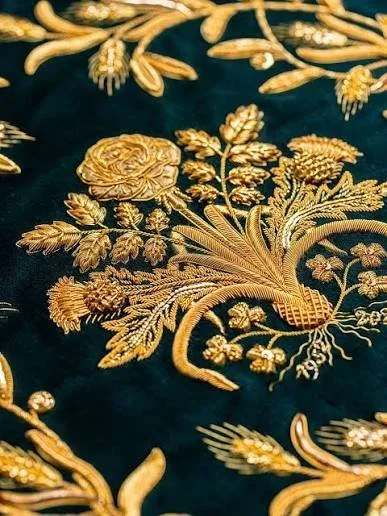
Gold embroidery associated with Pontic Greek heritage provides a valuable subject for studying craftsmanship, family memory, and cultural transmission. However, an embroidered pattern cannot be assigned a specifically Pontic origin solely because it contains gold-colored thread or resembles a design found in another region.
The Pontic Greek Cultural World
Pontic Greek communities developed over centuries in a region connecting Anatolia, the Caucasus, and the Black Sea.
Their cultural traditions were shaped by local environments and interactions with neighboring populations. Communities participated in agriculture, trade, crafts, education, and religious life.
Migration also played an important role. Political upheaval and changing circumstances during the nineteenth and twentieth centuries contributed to the movement of Pontic Greeks to other regions, including mainland Greece and other countries.
Cultural practices could be preserved in new environments while also adapting to new materials and social conditions.
Embroidery as a Craft
Embroidery involves decorating fabric through stitches made with thread, silk, metallic strands, or other materials.
Gold-colored and metal-wrapped threads have been used in many textile traditions. Depending on the period and place, they could communicate wealth, ceremonial importance, religious devotion, or social status.
Embroidery might decorate garments, household textiles, ceremonial clothing, religious objects, or special gifts.
The materials and techniques used can reveal information about trade, economic resources, and the skill of the maker.
What Makes a Pattern Pontic?
A design may be associated with a Pontic community through documented ownership, family records, oral testimony, workshop history, or comparison with securely identified regional textiles.
Geometric forms, flowers, birds, vines, and repeated borders are widespread across Eurasia. Their presence alone does not establish a unique cultural origin.
A reliable identification therefore requires more than visual resemblance.
Researchers should document the textile's provenance, date, materials, stitching techniques, and history of use.
Heirlooms and Family Memory
Heirloom textiles can preserve stories that are absent from official historical records.
A garment may have been worn at a wedding, carried during migration, presented as a gift, or inherited through several generations.
The object becomes meaningful not only because of its design but also because of the people who owned and used it.
Oral histories can help reconstruct these relationships, particularly when several family members independently recall the object's background.
Gold Thread and Material Analysis
Technical analysis can distinguish different kinds of metallic thread.
Some historical textiles used strips of metal wrapped around a core, while others used metallic-looking materials or later substitutes.
Microscopic examination can reveal construction methods and wear patterns. Chemical analysis may help identify metal composition, although conservation requirements must be considered before sampling.
The results can contribute to dating and understanding the textile's manufacturing history.
Migration and Cultural Adaptation
When Pontic Greek families migrated, textile traditions could travel with them.
Makers might preserve older designs while adapting to locally available materials. They could also adopt new motifs through interaction with neighboring communities.
This process does not necessarily diminish cultural authenticity. It demonstrates that traditions evolve as communities respond to changing circumstances.
Conservation of Embroidered Heirlooms
Textiles are vulnerable to light, humidity, pests, chemical deterioration, and mechanical damage.
Gold and metallic threads can corrode, while fabric fibers may weaken over time.
Proper conservation involves stable storage conditions, careful handling, and appropriate support during display.
Photographic documentation and detailed cataloguing can preserve information even when an object is too fragile for frequent exhibition.
Conclusion
Pontic gold embroidery offers a meaningful way to investigate craftsmanship, family memory, and the transmission of cultural identity. Heirloom textiles can preserve evidence of migration and social relationships that written documents overlook. However, specific patterns should be attributed to Pontic tradition only when their provenance and historical context support that conclusion. Through textile analysis, oral history, and conservation, researchers can better understand how embroidery connects material skill with community memory.