Introduction
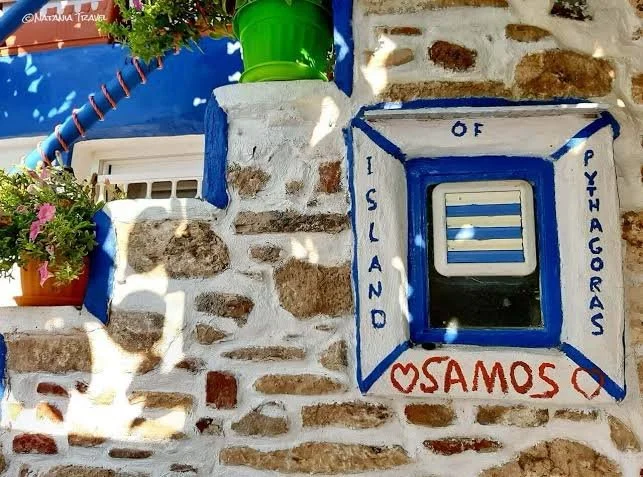
Samos, an island in the eastern Aegean, is closely associated with Pythagoras, the ancient Greek philosopher and mathematician traditionally believed to have been born there in the sixth century BCE. Pythagoras became famous for teachings concerning mathematics, music, harmony, the soul, and the organization of the cosmos.
The island's long history also includes Christian religious traditions, village churches, icons, and other forms of sacred art. Comparing Pythagorean symbols with the visual language of village icons offers an opportunity to investigate how symbols are interpreted across different periods.
However, there is no general basis for assuming that Pythagorean signs are deliberately embedded in Samos's Christian icons. Such claims require specific evidence and must account for the differences between ancient philosophy and later religious art.
Pythagoras and His Intellectual Tradition
Pythagoras lived during a period when Greek thinkers explored relationships between number, nature, music, and the structure of the universe.
The Pythagorean tradition became associated with mathematical proportions, musical intervals, disciplined ways of life, and ideas about the soul.
The historical Pythagoras is difficult to reconstruct because many accounts were written centuries after his lifetime. Later authors attributed a wide range of teachings and discoveries to him and his followers.
Consequently, researchers distinguish between evidence about the early Pythagorean community and traditions that developed much later.
Mathematics, Music, and Symbolism
Pythagorean thought gave mathematical relationships a special philosophical significance. Ratios between string lengths, for example, can produce recognizable musical intervals.
This relationship between number and harmony encouraged later thinkers to interpret mathematics as a key to understanding the cosmos.
The Pythagorean tradition is also associated with symbolic figures and numerical patterns. However, not every geometric design can be attributed to Pythagorean philosophy. Triangles, circles, stars, and repeated patterns appear in many cultures for practical, decorative, and religious reasons.
Christian Icons on Samos
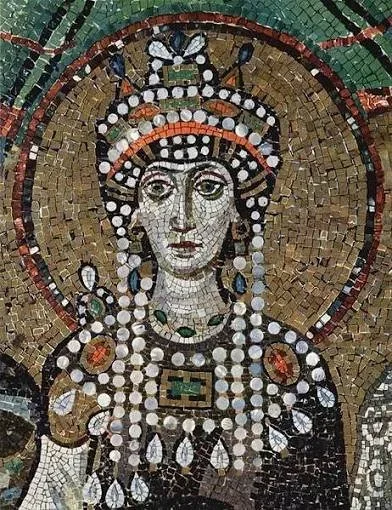
Christian icons are religious images used in Orthodox worship and devotion. They may depict Christ, the Virgin Mary, saints, biblical scenes, and major events in Christian history.
Their visual conventions developed over centuries. Colors, gestures, inscriptions, halos, clothing, and spatial arrangements can carry theological meanings.
A village icon may also reflect local patronage, workshop traditions, historical events, or the preferences of the people who commissioned it.
Understanding an icon therefore requires examining its religious context rather than interpreting every shape as a hidden philosophical code.
Possible Points of Comparison
Pythagorean philosophy and Christian iconography both engage with ideas about order, harmony, and the relationship between visible forms and deeper meaning. Yet broad thematic similarities do not demonstrate direct transmission.
A geometric composition in an icon may arise from artistic balance or established religious convention. It does not automatically represent a Pythagorean doctrine.
To establish a specific connection, researchers would need documentary evidence, an inscription, a known history of the icon's production, or a clearly identifiable symbol associated with a Pythagorean community.
Samos and Cultural Memory
Pythagoras has become an important part of Samos's cultural identity. His name appears in discussions of the island's history, education, philosophy, and tourism.
Local traditions may connect the philosopher with particular places or objects. Such associations can be valuable parts of cultural memory even when they cannot be verified as ancient facts.
The challenge is to distinguish the historical figure from later stories and symbolic interpretations.
How to Study Village Icons
A serious investigation would begin by documenting the icons' dates, inscriptions, materials, provenance, and restoration history.
Art historians could compare their compositions with other Byzantine and post-Byzantine works. Researchers could also examine whether particular geometric arrangements were common in the relevant artistic period.
Church archives and local records may identify patrons, painters, and the circumstances under which the images were commissioned.
Only after establishing this context would it be reasonable to investigate a possible philosophical influence.
Conclusion
Pythagoras's intellectual legacy and Samos's Christian artistic traditions are both important elements of the island's history. Their comparison can encourage thoughtful discussion about symbolism, harmony, and cultural memory. Nevertheless, claims that Pythagorean symbols are deliberately concealed in village icons should remain hypotheses unless supported by specific historical evidence. A careful study of inscriptions, artistic conventions, and provenance can reveal meaningful relationships without imposing unsupported interpretations on religious objects.