Introduction
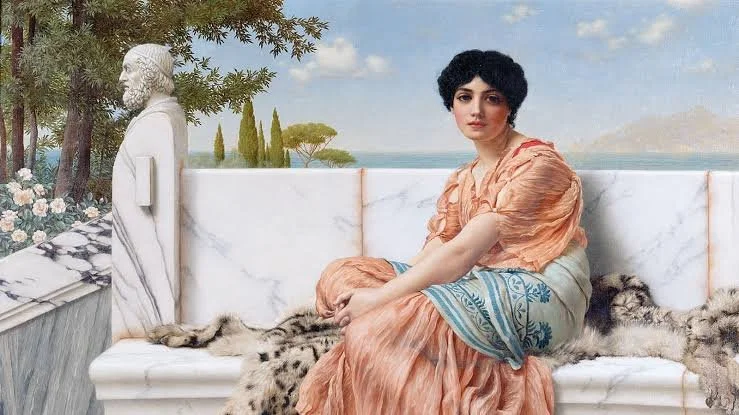
The island of Lesbos is internationally associated with Sappho, the archaic Greek poet whose surviving fragments explore desire, beauty, memory, friendship, and the emotional intensity of human relationships.
Sappho lived during the late seventh and early sixth centuries BCE, although the details of her life remain uncertain. Much of her poetry survives only in quotations and fragments preserved by later writers or recovered from ancient papyri.
The idea of "poet codes" hidden in Lesbos's oral tales raises questions about literary memory, oral transmission, and the ways communities reinterpret famous historical figures. However, no general evidence establishes that a secret code created by Sappho has survived in the island's folk narratives.
Sappho's Historical Importance
Sappho's poetry belongs to the lyric tradition of archaic Greece. Unlike epic poetry focused on large-scale heroic narratives, lyric poetry often expressed personal emotion, ritual themes, social relationships, and moments of reflection.
Her surviving verses demonstrate remarkable control of language and imagery.
Sappho's poetry also provides evidence for the cultural environment of archaic Lesbos, although it does not provide a complete account of the island's society.
Later writers admired her work, and she eventually became one of the most famous poets of antiquity.
Oral Poetry in Ancient Greece
Oral performance was central to many forms of Greek poetry.
Songs could be transmitted through performance, memorization, musical accompaniment, and repeated adaptation.
Written texts gradually became important, but the relationship between oral and written traditions remained complex.
A poem might survive through performance before being recorded in writing. Conversely, written poetry could influence later performances.
This makes oral transmission a plausible subject of study, but it does not establish the uninterrupted survival of a particular ancient poem.
What Might a "Code" Mean?
The word "code" can refer to a hidden message, a symbolic system, a repeated literary pattern, or a set of cultural meanings understood by a particular community.
Sappho's poetry contains imagery involving flowers, garlands, beauty, divinity, and desire. Researchers can investigate how such imagery influenced later literature.
However, identifying a repeated symbol in a modern folk tale does not prove that it originated with Sappho.
A convincing claim would require a clear textual parallel, a documented history of transmission, or evidence connecting the tale with a known ancient poetic tradition.
Lesbos and Cultural Memory
Sappho has become an important symbol of Lesbos's literary heritage.
Her name appears in discussions of ancient literature, women's writing, poetic expression, and the history of sexuality.
Local communities may preserve stories about the poet, her life, and the places associated with her.
Such traditions can be valuable expressions of cultural memory even when they developed long after the archaic period.
Poetry, Gender, and Interpretation
Sappho's poetry has attracted extensive scholarly debate because of its treatment of relationships between women, religious devotion, and emotional intimacy.
Modern interpretations must account for the fragmentary nature of the texts and the differences between ancient and modern concepts of identity.
The poet's work should not be reduced to a single biographical narrative. Her poems were literary creations that operated within specific artistic and social conventions.
Researching Oral Tales
Researchers studying Lesbos's oral traditions could record stories, songs, proverbs, and local narratives through ethical fieldwork.
They would need to document the date and circumstances of each recording, compare different versions, and identify possible literary influences.
Historical texts and local archives could help establish whether a tale was recorded before or after modern interest in Sappho developed.
This is especially important because communities can consciously reinterpret ancient figures as part of cultural revival.
Conclusion
Sappho's poetry remains one of the most influential literary legacies of ancient Greece, and Lesbos's oral traditions provide a valuable context for exploring how the past is remembered. The idea of hidden Sapphic codes can inspire literary investigation, but it should not be treated as an established historical discovery. Careful comparison of poetry, oral narratives, and documentary evidence can reveal genuine relationships between ancient literature and modern cultural memory while avoiding unsupported claims of secret transmission.