Introduction
Samothrace, an island in the northern Aegean, was one of the most important religious destinations of the ancient Greek world. Its sanctuaries attracted visitors from across the Mediterranean, including people seeking initiation into religious rites associated with the island's distinctive cult traditions.
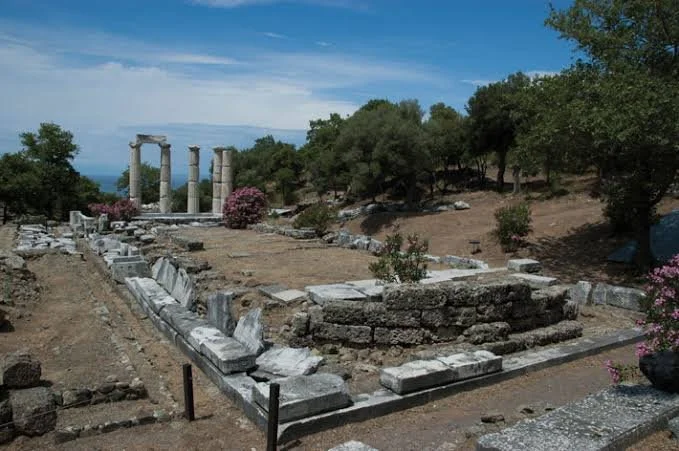
Samothrace is particularly famous for the Sanctuary of the Great Gods. The sanctuary was connected with mysteries whose exact ceremonies remain partly unknown. Because the island lies near Thrace and maintained connections with neighboring regions, its religious history must be understood within a broader network of Aegean and Balkan traditions.
The phrase "Thracian cult sites on Samothrace peaks" raises questions about local religion, sacred landscapes, and cross-cultural exchange, but individual mountain sites must be identified through archaeological evidence.
Samothrace and the Great Gods
The Sanctuary of the Great Gods was a major religious center. Its cult was associated with initiation rites, protection, and the religious identity of the island.
Unlike some Greek sanctuaries dominated by one clearly defined deity, the Samothracian mysteries involved a group of divine figures whose identities and relationships remain difficult to reconstruct fully.
Ancient sources reveal that initiation could carry considerable prestige. Visitors included individuals from powerful families and political institutions.
The Meaning of Mystery Cults
Mystery cults involved religious experiences that were not fully disclosed to outsiders. Initiation could create a sense of belonging among participants and establish relationships with divine powers.
Secrecy makes these cults difficult to reconstruct. Archaeologists can study sanctuary architecture, offerings, inscriptions, and ritual equipment, but these materials do not necessarily reveal the complete content of ceremonies.
Researchers must avoid filling gaps in the evidence with unsupported stories.
Thracian Connections
Thrace, the region north of the Aegean, contained diverse religious traditions involving local deities, heroic figures, animal symbolism, and sacred landscapes.
Interactions between Greek and Thracian communities occurred through trade, warfare, migration, colonization, and political alliances.
Religious practices could move across cultural boundaries. A deity might be identified with a foreign counterpart, or a sanctuary might incorporate artistic styles and ritual objects from neighboring regions.
However, cultural similarities do not automatically establish that a sanctuary was exclusively Thracian or that a particular cult originated in Thrace.
Mountains and Sacred Landscapes
Mountains could be meaningful religious environments because they were associated with height, isolation, springs, caves, unusual rock formations, and views across the surrounding landscape.
Sacred places might be established near mountain summits, caves, springs, or routes used by travelers.
Yet a high-altitude location is not necessarily a cult site. Archaeologists look for evidence such as votive offerings, inscriptions, constructed platforms, ritual deposits, or repeated patterns of human activity.
Archaeological Investigation
Researchers investigating possible cult sites on Samothrace can examine surface finds, building remains, ceramics, coins, inscriptions, and environmental evidence.
Survey methods may identify patterns of occupation that are not visible through monumental architecture.
Dating is essential because sacred places can be reused across many centuries. A location may have served a prehistoric, Greek, Roman, or later function.
Religious Exchange
Samothrace's location made it a point of contact between the Aegean islands, the Greek mainland, and the Balkans.
Visitors brought different cultural backgrounds and religious expectations. Initiation could therefore operate as a shared institution that connected people from different communities.
Such religious networks reveal that ancient identities were not fixed within modern national boundaries.
Conclusion
Samothrace's religious landscape demonstrates the complexity of ancient ritual and cultural exchange in the northern Aegean. The Sanctuary of the Great Gods is well established archaeologically, while claims about particular Thracian cult sites on mountain peaks require site-specific evidence. By examining inscriptions, votive offerings, architecture, and regional connections, researchers can better understand how sacred landscapes linked communities across the Aegean and the Balkans.