The Birth of the Cosmos: Decoding Hesiod’s Theogony and the War of the Gods
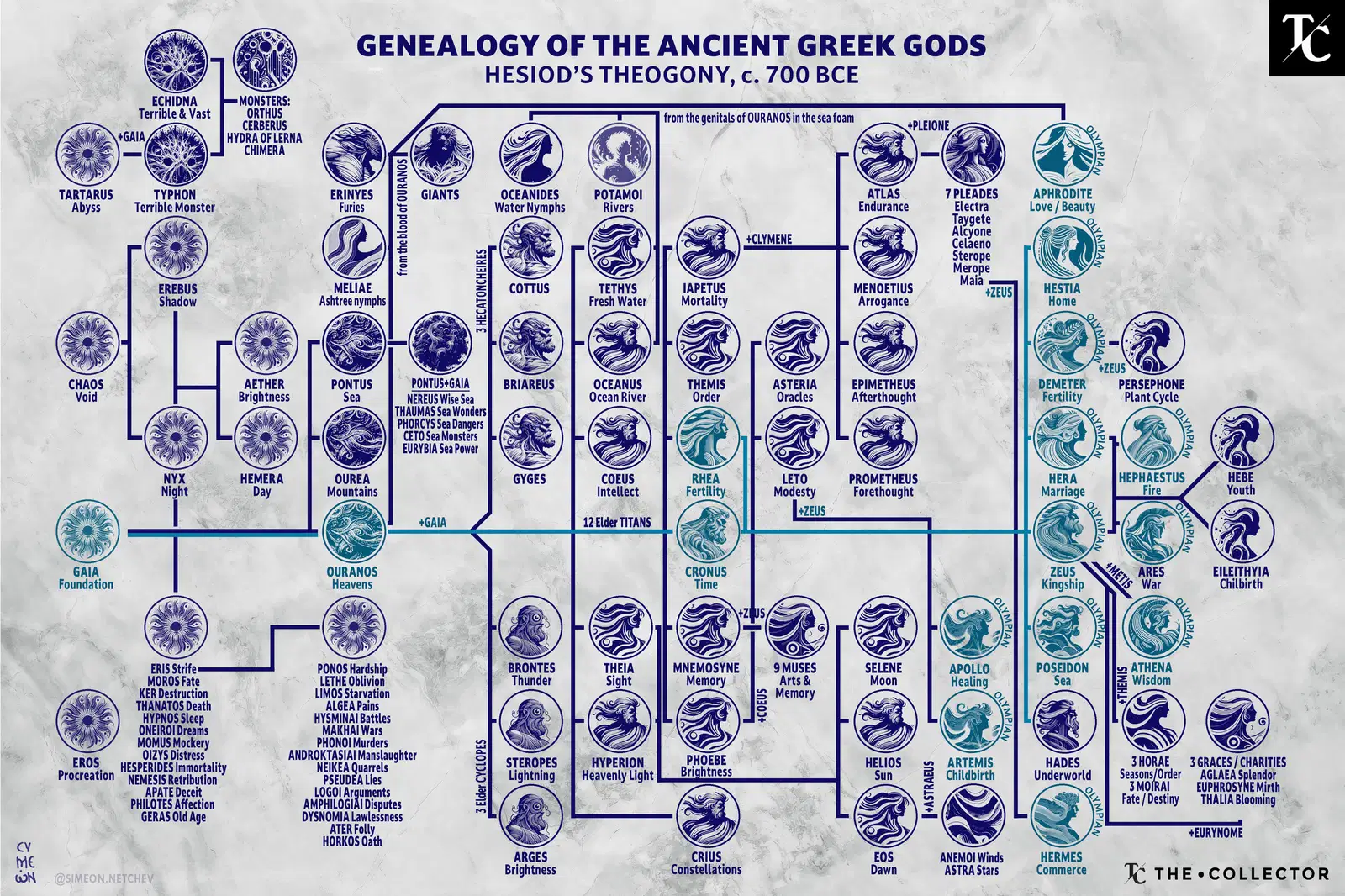
While Homer was the poet of heroes, Hesiod (c. 700 BCE) was the poet of the origins. His masterpiece, the Theogony, serves as the definitive "genealogy of the gods," transforming a chaotic mess of regional myths into a structured, chronological history of the universe. It is an academic treasure trove that explains how the Greeks moved from a world of primordial forces to the ordered, albeit dramatic, reign of the Olympians.
1. The Primordial Void and the First Generation
Hesiod begins not with a creator, but with a state of being: Chaos (a yawning gap or void). From this void, the first entities spontaneously emerged without sexual union:
Gaia (Earth): The foundation of all things.
Tartarus: The gloomy pit beneath the earth.
Eros (Desire): The force that drives procreation.
Erebus (Darkness) and Nyx (Night).
Gaia then gave birth to Ouranos (the Sky), who covered her on all sides. Their union produced the first true generation of deities: the twelve Titans, the one-eyed Cyclopes, and the hundred-handed Hecatoncheires.
2. The Succession Myth: A Cycle of Violence
The core of the Theogony is the "Succession Myth," a brutal cycle where sons overthrow their fathers to prevent their own suppression.
The Castration of Ouranos
Ouranos hated his children and hid them away within the depths of Gaia (the earth). In agony, Gaia fashioned a flint sickle and called upon her children for help. Only the youngest Titan, Cronus, was brave enough. He castrated his father, and from the blood that fell upon the earth, the Furies and Giants were born. From the foam in the sea emerged Aphrodite, the goddess of love.
Cronus and the Great Swallowing
Cronus became the new ruler but, fearing a prophecy that he too would be overthrown, he swallowed each of his children as they were born from his wife, Rhea. These children included Hestia, Demeter, Hera, Hades, and Poseidon.
When the sixth child, Zeus, was born, Rhea tricked Cronus by handing him a stone wrapped in swaddling clothes. Zeus was hidden in Crete, grew to maturity, and eventually forced Cronus to vomit up his siblings.
3. The Titanomachy: The War for the Universe
The Theogony reaches its epic climax with the Titanomachy, a ten-year war between the older Titans and the younger Olympians led by Zeus.
Hesiod describes the battle in terrifying, cosmic terms. Zeus eventually won by releasing the Hecatoncheires and the Cyclopes from Tartarus. The Cyclopes gifted Zeus his signature weapon: the thunderbolt. The defeated Titans were imprisoned in the depths of Tartarus, guarded by the hundred-handed giants.
4. The Rise of Zeus and the Order of the World
Unlike his father and grandfather, Zeus secured his throne not just through violence, but through intelligence and alliance.
Metis (Wisdom): Zeus’s first wife. To avoid being overthrown by a son from her, Zeus swallowed Metis herself, incorporating her wisdom into his own being (leading to the birth of Athena from his head).
Distribution of Powers: Zeus wisely distributed honors and roles among the other gods, ensuring their loyalty.
Hesiod uses this genealogy to justify the status quo of the Greek world. Under Zeus, the universe shifted from a place of raw, monstrous power to a world governed by Dike (Justice) and Themis (Divine Law).
The Birth of the Cosmos: Decoding Hesiod’s Theogony and the War of the Gods
While Homer was the poet of heroes, Hesiod (c. 700 BCE) was the poet of the origins. His masterpiece, the Theogony, serves as the definitive "genealogy of the gods," transforming a chaotic mess of regional myths into a structured, chronological history of the universe. It is an academic treasure trove that explains how the Greeks moved from a world of primordial forces to the ordered, albeit dramatic, reign of the Olympians.
1. The Primordial Void and the First Generation
Hesiod begins not with a creator, but with a state of being: Chaos (a yawning gap or void). From this void, the first entities spontaneously emerged without sexual union:
Gaia (Earth): The foundation of all things.
Tartarus: The gloomy pit beneath the earth.
Eros (Desire): The force that drives procreation.
Erebus (Darkness) and Nyx (Night).
Gaia then gave birth to Ouranos (the Sky), who covered her on all sides. Their union produced the first true generation of deities: the twelve Titans, the one-eyed Cyclopes, and the hundred-handed Hecatoncheires.
2. The Succession Myth: A Cycle of Violence
The core of the Theogony is the "Succession Myth," a brutal cycle where sons overthrow their fathers to prevent their own suppression.
The Castration of Ouranos
Ouranos hated his children and hid them away within the depths of Gaia (the earth). In agony, Gaia fashioned a flint sickle and called upon her children for help. Only the youngest Titan, Cronus, was brave enough. He castrated his father, and from the blood that fell upon the earth, the Furies and Giants were born. From the foam in the sea emerged Aphrodite, the goddess of love.
Cronus and the Great Swallowing
Cronus became the new ruler but, fearing a prophecy that he too would be overthrown, he swallowed each of his children as they were born from his wife, Rhea. These children included Hestia, Demeter, Hera, Hades, and Poseidon.
When the sixth child, Zeus, was born, Rhea tricked Cronus by handing him a stone wrapped in swaddling clothes. Zeus was hidden in Crete, grew to maturity, and eventually forced Cronus to vomit up his siblings.
3. The Titanomachy: The War for the Universe
The Theogony reaches its epic climax with the Titanomachy, a ten-year war between the older Titans and the younger Olympians led by Zeus.
Hesiod describes the battle in terrifying, cosmic terms. Zeus eventually won by releasing the Hecatoncheires and the Cyclopes from Tartarus. The Cyclopes gifted Zeus his signature weapon: the thunderbolt. The defeated Titans were imprisoned in the depths of Tartarus, guarded by the hundred-handed giants.
4. The Rise of Zeus and the Order of the World
Unlike his father and grandfather, Zeus secured his throne not just through violence, but through intelligence and alliance.
Metis (Wisdom): Zeus’s first wife. To avoid being overthrown by a son from her, Zeus swallowed Metis herself, incorporating her wisdom into his own being (leading to the birth of Athena from his head).
Distribution of Powers: Zeus wisely distributed honors and roles among the other gods, ensuring their loyalty.
Hesiod uses this genealogy to justify the status quo of the Greek world. Under Zeus, the universe shifted from a place of raw, monstrous power to a world governed by Dike (Justice) and Themis (Divine Law).
5. Key Themes: Evolution and Power
PhaseDominant ThemeRepresentative DeityPrimordialElemental ExistenceGaia / OuranosTitan EraRaw Force & HungerCronusOlympian EraRationality & OrderZeus
The Significance of the Muses
Interestingly, Hesiod begins the Theogony with an encounter with the Muses on Mount Helicon. They tell him, "We know how to speak many false things as though they were true; but we know, when we will, to utter true things." This suggests that Hesiod viewed his work as a divine revelation—a factual account of the divine hierarchy that governed Every Greek's life.
Hesiod’s Theogony remains the bedrock of Greek mythology. It provides the "scientific" backbone to the poetic stories of Homer, turning a collection of myths into a sophisticated system of cosmic evolution.