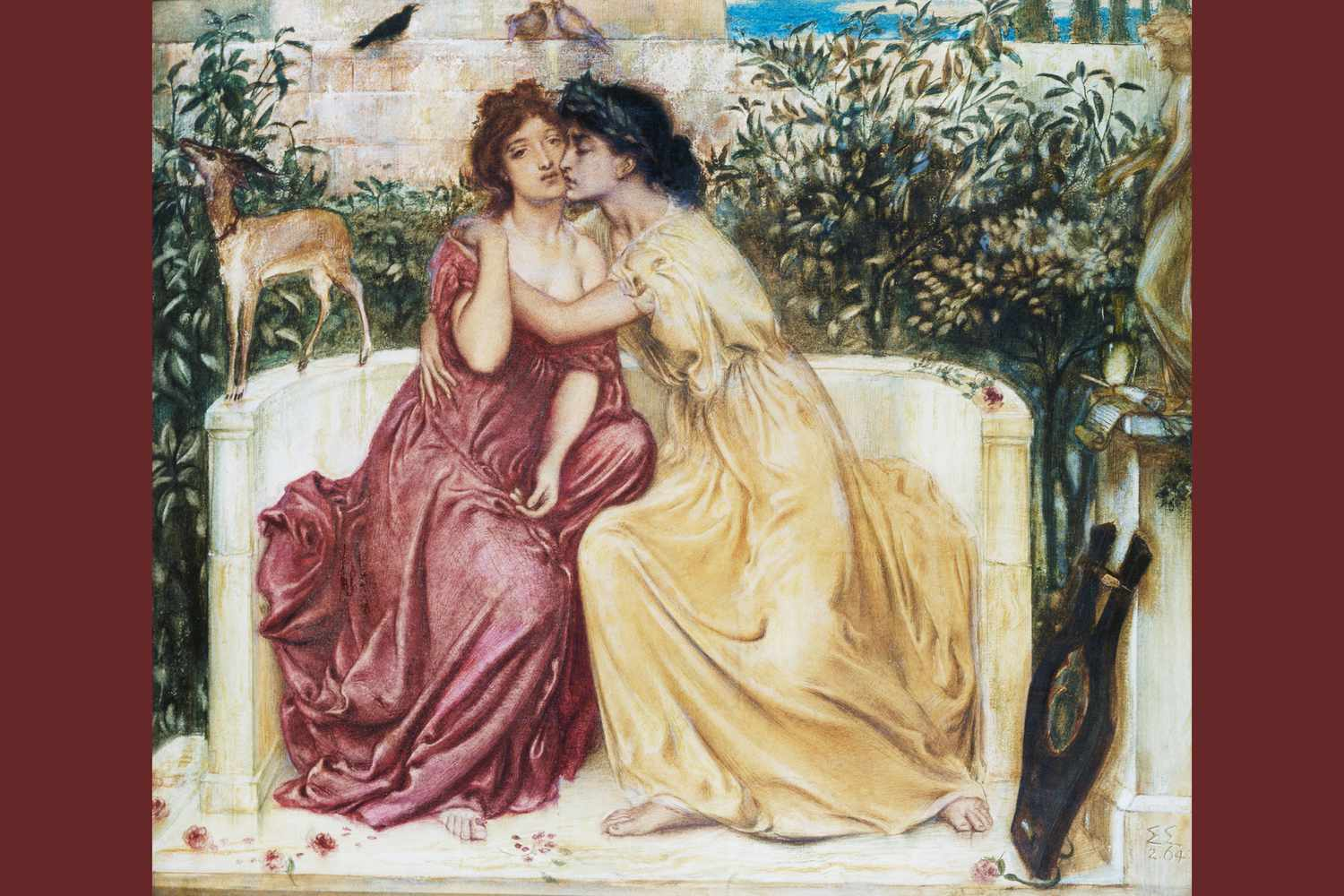
The Tenth Muse: Unveiling the Lyrical Brilliance and Legacy of Sappho
In the male-dominated intellectual landscape of archaic Greece, one voice rose with such clarity and emotional intensity that Plato himself reportedly dubbed her "The Tenth Muse." Sappho of Lesbos (c. 630–570 BCE) was a revolutionary who pivoted away from the epic, blood-soaked battlefields of Homer to the internal, sun-drenched landscapes of the human heart. To study Sappho is to study the birth of Lyric Poetry—a genre defined not by the deeds of kings, but by the private "I."
1. Life on the Isle of Lesbos
While historical records from the 7th century BCE are sparse, we know Sappho was born into an aristocratic family in Mytilene on the island of Lesbos. This was a time of great political upheaval, and Sappho was reportedly exiled to Sicily twice due to her family’s involvement in local power struggles.
The Thiasos and Education
Sappho is often associated with the thiasos—a social and religious circle of young women. Academics debate whether she was a formal teacher, a priestess of Aphrodite, or simply a leader of an informal salon. Regardless of the official title, her poetry suggests a world where women engaged in sophisticated musical education, weaving, and the celebration of beauty, ritual, and desire.
2. The Sapphic Stanza: A Technical Innovation
Sappho didn't just write poems; she invented a new rhythm. She is the namesake of the Sapphic Stanza, a specific meter that creates a rolling, melodic pace perfect for the lyre (the stringed instrument from which "lyric" is derived).
The stanza consists of three long lines followed by a short fourth line (the Adonic). This structure allows for a sudden, poignant "drop" at the end of each verse, often used to emphasize a sharp emotional realization or a sudden shift in perspective.
3. Themes: The "Bitter-Sweet" Nature of Eros
Sappho’s poetry is the first in Western history to explore the physical and psychological symptoms of desire. She famously coined the term glukupikron (bittersweet) to describe the dual nature of love.
The Subjective Perspective: While Homer might describe a woman’s beauty in terms of the "thousand ships" launched because of her, Sappho describes beauty through the eyes of the lover. In her famous Fragment 16, she argues that the most beautiful thing on earth is "whatever one loves."
The Presence of Aphrodite: For Sappho, the Goddess of Love was not a distant figure but a personal confidante. In her only complete surviving poem, Ode to Aphrodite, she invokes the goddess as a "battle-ally" in her romantic pursuits.
Sensory Detail: Her work is lush with the scent of violets, the sound of water through apple branches, and the physical sensation of "fire running under the skin."
4. The Tragedy of the Fragments
Perhaps the most haunting aspect of Sappho’s legacy is what we have lost. In antiquity, she was credited with nine books of poetry. Today, we possess only one complete poem and hundreds of fragments—some as short as a single word ("moon," "honey-voiced," "pain").
How was her work lost?
The Shift in Dialect: Sappho wrote in the Aeolic dialect, which became difficult for later Greeks (who spoke Attic or Koine) to read.
Religious Censorship: Later Christian authorities in the medieval era often viewed her homoerotic themes as scandalous, leading to a lack of preservation in monastery libraries.
Recent Discoveries: In 2014, a "New Sappho" poem (The Brothers Poem) was discovered on a fragment of papyrus used as cartonnage for an Egyptian mummy, proving that there is still hope for future recoveries.
5. Legacy and the Term "Lesbian"
The modern terms "lesbian" and "sapphic" both derive from the poet and her home island. While the nature of her relationships remains an academic debate—some viewing her as a platonic educator and others as an icon of female-centered desire—her influence on the history of sexuality and gender is undeniable. She gave a voice to a population that was largely silenced, proving that the intimate experiences of a woman could be as profound and enduring as the fall of Troy.
Sappho’s work reminds us that while empires fall and languages evolve, the physical ache of longing remains unchanged. She remains the "Tenth Muse" because she discovered a truth that the great philosophers would later spend centuries trying to define: that our internal world is a landscape worth exploring.