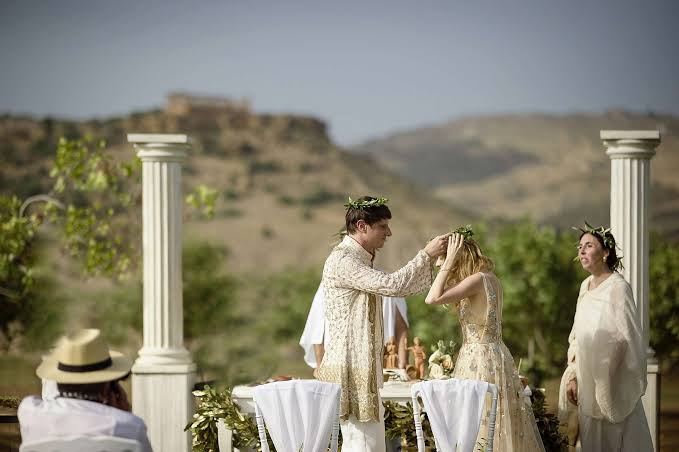
A wedding (gamos) in ancient Greece was not a romantic union or a private celebration of love; it was a highly formal, binding socio-political transaction between two families, designed to legally transfer a woman from her father’s household (oikos) to that of her new husband, ensuring the legitimate lineage of the civic polis. This transformation was enacted through an elaborate, multi-stage ritual framework that spanned three distinct days, saturated with symbolic acts of passage.
 [ THE THREE DAYS OF THE GAMOS ]

 [DAY 1: PROAULIA] ───► Sacred pre-wedding sacrifices + Dedication of childhood toys
                                   │
                           (The Midnight Transition)
                                   │
                                   ▼
 [DAY 2: GAMOS]     ───► Loutrophoros bath + Torchlit chariot procession to new home
                                   │
                             (The Awakening)
                                   │
                                   ▼
 [DAY 3: EPAULIA]   ───► Presentation of domestic gifts + Legal finalization of union
The ritual sequence began with the Proaulia (Day 1), a day of emotional preparation held at the bride's paternal home. The young bride made solemn sacrifices to Artemis, Aphrodite, and Hera, offering up her childhood toys, clothing, and locks of her hair to signify the definitive end of her girlhood and her transition into the realm of adult womanhood.
The core of the wedding took place on the Gamos (Day 2). It opened with a sacred ritual bath using water fetched in a specialized, long-necked ceramic vessel called a loutrophoros.
The bride was then dressed in an exquisite veil and a fine chiton tied with a specialized knot—the knots of virginity—which only the groom was permitted to untie.
As night fell, a dramatic torchlit procession formed. The bride was placed in a horse-drawn chariot between her groom and his best man, and escorted through the streets accompanied by musicians playing wedding hymns (hymenaioi). Crowds threw dried fruits and nuts (katachysmata) over the couple as they arrived at the groom’s house, symbolizing fertility and immediate economic prosperity.
The final stage was the Epaulia (Day 3). This was the day of awakening, where the bride was formally introduced as the new mistress of the household. Her father, relatives, and friends arrived at the home to present practical domestic gifts, including woven textiles, bronze mirrors, fine furniture, and jewelry.
Most importantly, this day marked the formal transfer of the proix (the marriage dowry) from the bride's father to the groom, legally sealing the financial and social contract between the two houses and integrating the bride into her new civic and domestic role.
A wedding (gamos) in ancient Greece was not a romantic union or a private celebration of love; it was a highly formal, binding socio-political transaction between two families, designed to legally transfer a woman from her father’s household (oikos) to that of her new husband, ensuring the legitimate lineage of the civic polis. This transformation was enacted through an elaborate, multi-stage ritual framework that spanned three distinct days, saturated with symbolic acts of passage.
The ritual sequence began with the Proaulia (Day 1), a day of emotional preparation held at the bride's paternal home. The young bride made solemn sacrifices to Artemis, Aphrodite, and Hera, offering up her childhood toys, clothing, and locks of her hair to signify the definitive end of her girlhood and her transition into the realm of adult womanhood.
The core of the wedding took place on the Gamos (Day 2). It opened with a sacred ritual bath using water fetched in a specialized, long-necked ceramic vessel called a loutrophoros.
The bride was then dressed in an exquisite veil and a fine chiton tied with a specialized knot—the knots of virginity—which only the groom was permitted to untie.
As night fell, a dramatic torchlit procession formed. The bride was placed in a horse-drawn chariot between her groom and his best man, and escorted through the streets accompanied by musicians playing wedding hymns (hymenaioi). Crowds threw dried fruits and nuts (katachysmata) over the couple as they arrived at the groom’s house, symbolizing fertility and immediate economic prosperity.
The final stage was the Epaulia (Day 3). This was the day of awakening, where the bride was formally introduced as the new mistress of the household. Her father, relatives, and friends arrived at the home to present practical domestic gifts, including woven textiles, bronze mirrors, fine furniture, and jewelry.
Most importantly, this day marked the formal transfer of the proix (the marriage dowry) from the bride's father to the groom, legally sealing the financial and social contract between the two houses and integrating the bride into her new civic and domestic role.