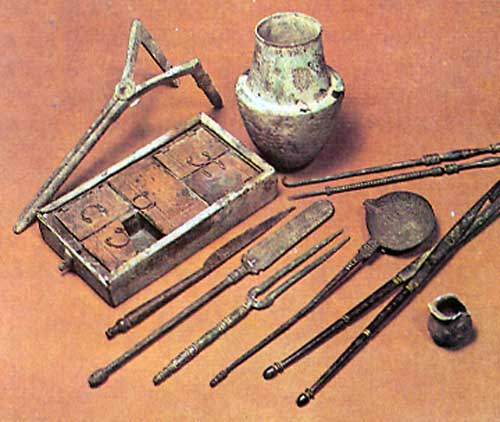
The preservation of Greek philosophy, literature, and administrative records relied on an array of specialized, locally sourced and imported writing utensils adapted for specific mediums.
The Reed Pen (Kalamos): For writing with fluid ink on flexible materials, scribes utilized the kalamos, a pen fashioned from sturdy river reeds dried and sharpened to a fine point. The tip was split down the middle—exactly like a modern fountain pen nib—to allow a controlled, capillary flow of ink onto the page.
The Iron Stylus (Graphis): For daily notations, accounting, school exercises, and drafts, Greeks used wooden folding tablets coated with a layer of blackened beeswax. Scribes wrote on these using a graphis—a pointed metal or bone stylus. The tool featured a sharp point on one end for scratching letters into the wax and a flat, spatula-like wedge on the opposite end used to smooth the wax flat, acts that functioned as an ancient eraser.
The Ink Recipe: Greek black ink (melan) was incredibly stable. It was created by mixing fine carbon soot (collected from oil lamps or burned resin) with water and gum arabic (hardened sap from the acacia tree). The gum arabic acted as a suspension agent and binder, ensuring the ink bound permanently to the writing surface without running or fading.