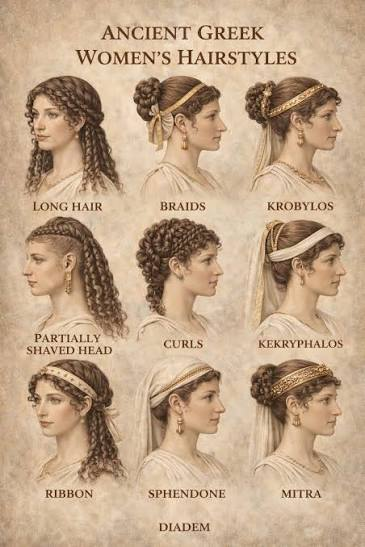
In the highly visual, honor-bound culture of ancient Greece, hair was never a casual aesthetic choice. It acted as an instantaneous public marker of an individual's biological age, legal status, gender, and political affiliation.
Male Rites of Passage: Archaic Greek men proudly wore their hair long as a sign of aristocratic freedom. However, by the Classical era, Athenian men cut their hair short upon reaching adulthood and joining the military. Young boys grew long locks, which they ritually sheared and dedicated to the gods (especially Apollo) during the Apaturia festival, marking their official transition into citizenship. A mature citizen was expected to have neatly trimmed hair and a well-groomed beard; being clean-shaven was initially mocked as effeminate until Alexander the Great popularized the trend for military reasons.
Female Status and Restraint: Unmarried girls wore their hair long and loose or elegantly braided. Upon marriage, women transitioned to complex, bound hairstyles, pinning their hair up in chignons, nets (sakkos), or tiaras to signal modesty and domestic control.
The Hair of Marginalization: Hair was also used to mark social outcasts. Slaves were legally forced to cut their hair into harsh, uniform short cropped styles to ensure they were immediately identifiable in public. Similarly, women in intense mourning cut their hair close to the scalp, temporarily stepping outside normal social beauty standards to broadcast their grief.