The Pleiades are among the most famous groups of stars in the night sky, and their story demonstrates one of the clearest connections between Greek mythology and astronomy.
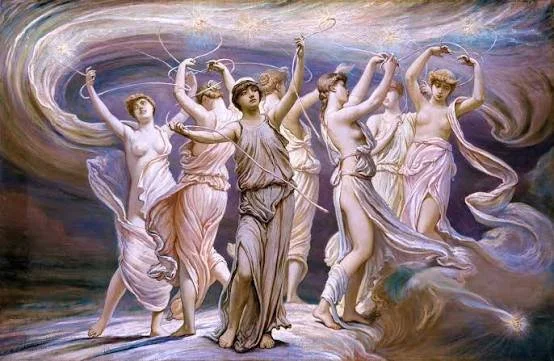
In Greek mythology, the Pleiades were seven sisters, daughters of the Titan Atlas and the sea-nymph Pleione. Their names were Maia, Electra, Taygete, Alcyone, Celaeno, Sterope, and Merope.
According to the most familiar tradition, the sisters were transformed into stars after being pursued by the hunter Orion.
Their transformation explains the presence of the Pleiades star cluster in the night sky.
Yet the myth is more complicated than the simple story of seven women becoming stars. Different traditions provide different explanations for the transformation, while one of the sisters—Merope—occupies a particularly interesting position because she is often described as the faintest of the seven visible stars.
Who Were the Pleiades?
The Pleiades were daughters of Atlas, the Titan condemned to hold up the heavens, and Pleione, a sea-nymph.
Their names were:
Maia
Electra
Taygete
Alcyone
Celaeno
Sterope
Merope
The sisters belonged to the generation of mythological beings associated with the ancient cosmic order.
They were not Olympian goddesses, but their identities became immortalized through their placement among the stars.
The Seven Sisters and Their Parents
Their father Atlas was one of the Titans.
After the Titanomachy, Atlas was punished by Zeus and forced to bear the heavens.
Their mother Pleione was a daughter of Oceanus and Tethys in traditions that connect her to the Oceanids.
The Pleiades therefore combine two important mythological genealogies:
Titanic ancestry through Atlas
and
water-related ancestry through Pleione.
Their eventual transformation into stars continues the connection between terrestrial mythology and the celestial realm.
The Pleiades and Orion
The most famous version of the myth concerns the giant hunter Orion.
Orion became attracted to the sisters and pursued them.
The sisters attempted to escape.
According to one tradition, Zeus transformed them into stars so that they could escape Orion's pursuit.
But Orion himself was also placed among the stars.
As a result, the constellation Orion appears to pursue the Pleiades across the night sky.
The astronomical arrangement therefore becomes a visual myth.
The stars seem to reproduce the story.
Maia
Maia was the eldest or most prominent of the sisters in several traditions.
She became particularly important because she was the mother of Hermes.
According to the Homeric Hymn to Hermes, Maia lived in a cave on Mount Cyllene and gave birth to Hermes after Zeus visited her.
Hermes' birth connects the Pleiades directly to the Olympian gods.
Maia therefore stands apart from her sisters because she became the mother of one of the major Olympian deities.
Electra
Electra is another important member of the group.
She was traditionally the mother of Dardanus, an important ancestor in Trojan genealogy.
Through Dardanus, Electra became connected to the royal ancestry of Troy.
This gives the Pleiades a direct relationship with one of the most important mythological cities in Greek literature.
The sisters are therefore not merely celestial figures.
Their descendants appear throughout Greek heroic mythology.
Alcyone
Alcyone is another major member of the group.
She became the mother of several figures through her association with Poseidon.
The name Alcyone is also connected with another important mythological tradition involving the halcyon bird.
This similarity can cause confusion between the Pleiad Alcyone and the separate mythological character Alcyone who was transformed into a halcyon.
Greek mythology contains many repeated names, making genealogical context essential.
Taygete
Taygete was associated with Zeus in several traditions.
Her name became especially connected with the region of Sparta and Mount Taygetus.
The mountain range known as Taygetus in the Peloponnese preserves her mythological name.
This is another example of mythology influencing geographical naming.
Celaeno
Celaeno's name is associated with darkness or dark coloring in Greek terminology.
She is generally less prominent in surviving myths than Maia or Electra.
Nevertheless, she appears in genealogical traditions and remains one of the seven stars of the Pleiades.
Sterope
Sterope, sometimes called Asterope, is another member of the group whose mythological biography varies depending on the source.
Her identity demonstrates the uneven survival of ancient mythology.
Some sisters received extensive genealogical traditions.
Others survived primarily through their names and astronomical identity.
Merope: The Faintest Sister
Merope is perhaps the most famous of the Pleiades from an astronomical perspective.
In many traditions, Merope is the only sister who married a mortal man.
She married Sisyphus, king of Corinth.
Because her sisters had divine or heroic relationships, Merope was ashamed of her mortal marriage.
One tradition explains that she became faint or partially invisible because of this shame.
The faintness of the star Merope was therefore explained mythologically.
Modern astronomy, of course, explains the difference in brightness through physical properties of the stars rather than divine shame.
Nevertheless, the myth demonstrates how ancient people interpreted visible differences in the sky through narrative.
The Pleiades as an Astronomical Object
The Pleiades are not merely seven stars.
They are an open star cluster located in the constellation Taurus.
To the unaided eye, several stars are visible, and under good conditions more can be seen.
The cluster is relatively young on astronomical timescales and lies hundreds of light-years from Earth.
Its appearance is so distinctive that many civilizations developed stories about it.
The Greeks called the group the Pleiades.
The mythological identity of seven sisters therefore became attached to a real astronomical formation.
Why Seven?
The traditional number is seven, even though not all seven stars are equally bright.
This creates the famous "Seven Sisters" concept.
The discrepancy between the number of named sisters and the number of easily visible stars likely contributed to the story of Merope becoming faint.
Myth therefore provided an explanation for an astronomical observation.
The Pleiades and Navigation
The Pleiades were also practically important.
Ancient Mediterranean sailors could use the appearance and disappearance of certain star groups to understand seasonal changes and assist with navigation.
The Pleiades therefore existed simultaneously as:
mythological sisters,
a recognizable astronomical cluster,
and a practical celestial marker.
This demonstrates the close relationship between mythology and ancient observational astronomy.
The Pleiades and Agriculture
The rising and setting of the Pleiades were also associated with agricultural calendars.
Ancient societies paid close attention to seasonal astronomical cycles because farming depended upon predictable changes in weather and daylight.
The stars therefore became part of the practical organization of the year.
Their mythological significance reinforced their cultural importance.
Orion and the Eternal Chase
One of the most beautiful aspects of the Pleiades myth is the idea that the celestial arrangement preserves a story.
Orion appears in the night sky.
The Pleiades appear nearby.
Their relationship creates the visual impression of an eternal chase.
The sisters escaped their pursuer in life, but the story continues in the heavens.
This is characteristic of Greek mythology's treatment of constellations.
The sky becomes a permanent stage for myth.
The Meaning of the Pleiades
The story of the Pleiades contains several recurring mythological themes:
Transformation: mortal or divine figures become stars.
Family: the sisters remain connected even after transformation.
Escape: celestial transformation provides protection.
Mortality: Merope's mortal marriage distinguishes her from her sisters.
Memory: the stars preserve the sisters forever.
Astronomy: myth provides a narrative explanation for a real celestial object.
The Pleiades in Modern Culture
The Pleiades remain internationally recognized.
The cluster has been studied extensively by astronomers, photographed by modern telescopes, and incorporated into popular culture.
Its mythological identity remains equally powerful.
The fact that the Pleiades are visible without sophisticated equipment helps explain their ancient importance.
People thousands of years ago could look into the night sky and see the same cluster visible today.
The stars therefore create a direct connection between ancient observers and modern humanity.
Conclusion
The story of the Pleiades is ultimately a story about permanence.
The sisters escape pursuit by leaving the human world and entering the heavens.
Their transformation gives them a form of immortality.
They cannot grow old.
They cannot disappear from memory.
They remain together as stars.
The Pleiades therefore demonstrate one of Greek mythology's most enduring ideas: the heavens can preserve stories that human life cannot.