Voting in ancient Greece is most famously associated with democracy at Athens.
However, Greek political systems varied considerably.
Not every Greek city-state was democratic, and even Athenian democracy was very different from modern representative democracy.
Direct Democracy
Classical Athens practiced a form of direct democracy.
Eligible male citizens could participate personally rather than electing representatives to make most political decisions for them.
The Assembly
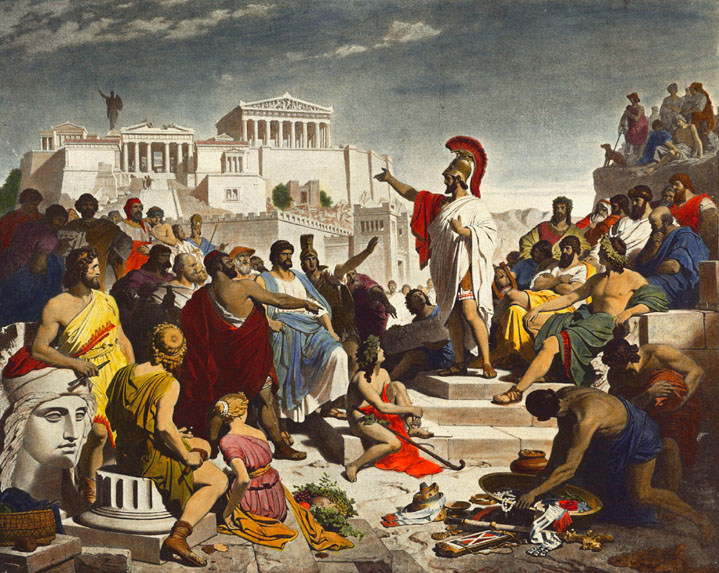
The Ekklesia, or Assembly, was central.
Citizens gathered to debate and decide political matters.
Subjects could include:
war;
peace;
laws;
finances;
foreign policy;
and other civic issues.
Who Could Vote?
Athenian democracy excluded many residents.
Women, enslaved people, and resident foreigners did not possess the same political rights as male citizens.
This is essential when evaluating ancient democracy.
Voting Methods
Different decisions could use different voting procedures.
Voting might involve:
show of hands;
physical positioning;
tokens;
or secret ballots.
Ostracism
One famous Athenian procedure was ostracism.
Citizens could vote to exile a politically influential individual for a period.
They wrote the person's name on a piece of broken pottery called an ostrakon.
Jury Voting
Athenian courts also used citizen jurors.
Jurors could cast ballots to determine:
guilt;
innocence;
or penalties.
Council of 500
The Boule was a council of 500 citizens.
Members were selected through a system of sortition, meaning selection by lot.
This was considered an important democratic mechanism.
Offices by Lot
Many political offices were also filled by lot.
The idea was that government should not become permanently controlled by wealthy or powerful families.
Elected Officials
Some positions, especially those requiring specialized expertise, were elected.
The strategoi, or generals, were notable examples.
Political Participation
Political life required citizens to attend meetings and understand public affairs.
Rhetoric and public speaking were therefore extremely important.
Conclusion
Ancient Greek Voting Systems and Procedures demonstrate that democracy existed in multiple forms.
Athens developed an unusually participatory political system, but participation was restricted to a defined citizen population.
Its use of assemblies, voting, juries, selection by lot, and ostracism created a political culture that profoundly influenced later ideas about democracy.