Amphipolis was an important ancient city in northeastern Greece.
Situated near the Strymon River in a strategically valuable region of Macedonia, the city became an important center for trade, military activity, and political competition.
Today it is especially famous for the monumental Lion of Amphipolis and the impressive Kasta Tomb.
Strategic Geography
Amphipolis was located near the Strymon River and close to important routes connecting the Aegean with the interior Balkans.
The surrounding region was rich in resources.
Nearby mountains contained valuable mineral deposits, while the river provided transportation opportunities.
Athenian Interest
Athens recognized the region's importance.
The Athenians attempted to establish control there during the fifth century BCE.
The city's strategic position made it valuable for access to:
timber;
metals;
agricultural land;
and trade routes.
Spartan Conquest
During the Peloponnesian War, the Spartan commander Brasidas captured Amphipolis in 424 BCE.
The loss was politically damaging to Athens.
Macedonian Rule
Philip II of Macedon later incorporated Amphipolis into the Macedonian kingdom.
Under Macedonian control, the city remained economically and strategically significant.
Alexander the Great
Amphipolis became part of the Macedonian world associated with Alexander the Great.
The city contributed resources and personnel to Macedonian military expansion.
The Lion Monument
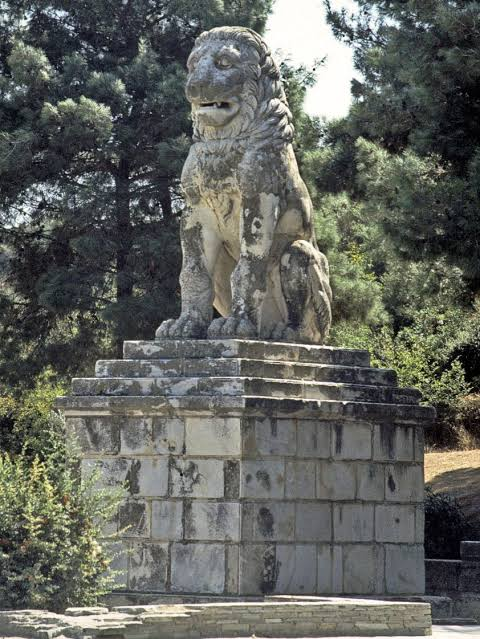
The Lion of Amphipolis is one of the most recognizable ancient monuments in the region.
The enormous marble lion originally formed part of a funerary monument.
Its exact historical association remains debated.
Symbolism of the Lion
The lion traditionally represented:
strength;
courage;
military power;
and elite status.
Its placement above a tomb would have communicated the importance of the deceased.
The Kasta Tomb
The enormous Kasta Tomb was discovered near Amphipolis.
It is a monumental fourth-century BCE funerary complex.
The tomb contains:
marble sphinxes;
a monumental entrance;
caryatid sculptures;
mosaic decoration;
and elaborate architectural elements.
Who Was Buried There?
The identity of the individual or individuals buried in the monument remains uncertain.
Various theories have connected it with important Macedonian figures.
However, there is no definitive evidence identifying the occupant as Alexander himself or another famous individual.
Roman Amphipolis
The city continued to exist during Roman rule.
Its location along major routes maintained its importance.
Archaeological Evidence
Excavations have revealed:
city walls;
houses;
sanctuaries;
public buildings;
coins;
sculptures;
tombs;
and inscriptions.
Conclusion
Amphipolis: Home of Alexander's Lion illustrates the strategic importance of northeastern Greece throughout antiquity.
From Athenian and Spartan competition to Macedonian expansion and Roman administration, Amphipolis occupied a valuable position at the crossroads of major political and economic networks.
Its monumental tombs and sculptures provide a dramatic archaeological record of the city's wealthy and powerful inhabitants.