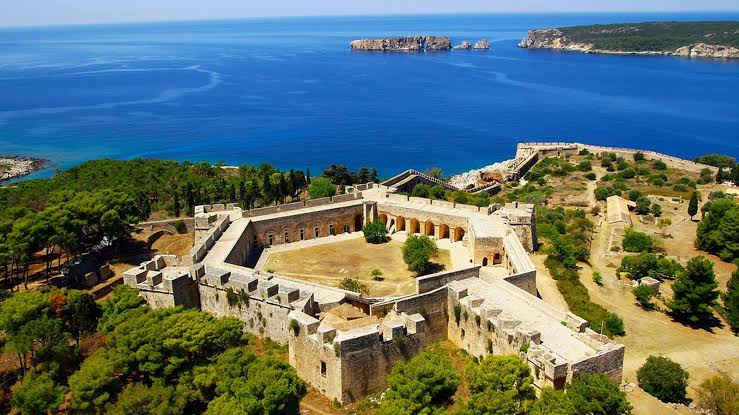
The Palace of Nestor at Pylos is one of the most important archaeological discoveries associated with Mycenaean Greece.
Located near modern Pylos in the southwestern Peloponnese, the palace provides extraordinary evidence for Bronze Age political administration, economy, religion, warfare, and daily life.
Unlike many archaeological sites known primarily from later literary traditions, Pylos has yielded large quantities of written administrative records.
The Historical Nestor
The palace is traditionally associated with Nestor, the elderly king who appears in Homer's Iliad and Odyssey.
However, the Homeric Nestor belongs to the world of epic tradition.
The palace itself existed centuries before the historical period represented by the classical Greek world.
Discovery
The site was excavated extensively beginning in the twentieth century.
Archaeologists uncovered a large palace complex containing numerous rooms and administrative areas.
Linear B Tablets
One of the greatest discoveries was a large archive of Linear B tablets.
Linear B is an early form of written Greek used by Mycenaean administrators.
The tablets recorded economic information.
What the Tablets Recorded
Records include information about:
livestock;
agricultural goods;
workers;
textiles;
offerings;
weapons;
and other resources.
These documents provide direct evidence of how the palace administration functioned.
The Megaron
The palace's central architectural space was the megaron.
It included:
a large central hearth;
columns;
decorated floors;
and surrounding rooms.
The space likely served important ceremonial and administrative functions.
Frescoes
The palace contained painted plaster decoration.
Frescoes depict aspects of Mycenaean visual culture.
Images could include:
animals;
people;
landscapes;
and decorative patterns.
The Throne Room
A central room is commonly interpreted as a throne room.
Its elaborate decoration indicates that the space had ceremonial importance.
Palace Economy
The palace functioned as an administrative center controlling resources.
Agricultural production was organized through administrative systems.
The palace received goods and redistributed them.
Agriculture
The surrounding region was suitable for agriculture.
Products likely included:
grain;
olives;
grapes;
livestock;
and other agricultural resources.
Religion
The Linear B records contain names of deities recognizable from later Greek religion.
These include figures such as:
Zeus;
Hera;
Poseidon;
and others.
This provides important evidence for the development of Greek religious traditions.
Destruction
The palace was destroyed by fire around the end of the Mycenaean palace period.
The destruction helped preserve many objects and documents.
The tablets were baked by the fire, making them more durable.
Archaeological Importance
Pylos offers a rare glimpse into Bronze Age Greece because it combines:
architecture;
written records;
artwork;
artifacts;
and environmental evidence.
Conclusion
The Palace of Nestor at Pylos is an exceptional window into Mycenaean civilization.
Its Linear B tablets reveal a highly organized administrative system, while the palace architecture demonstrates the ceremonial and political power of the ruling elite.
Although the archaeological palace cannot simply be identified with Homer's legendary kingdom, the site helps explain the Bronze Age world that later Greek epic traditions may have remembered in transformed form.