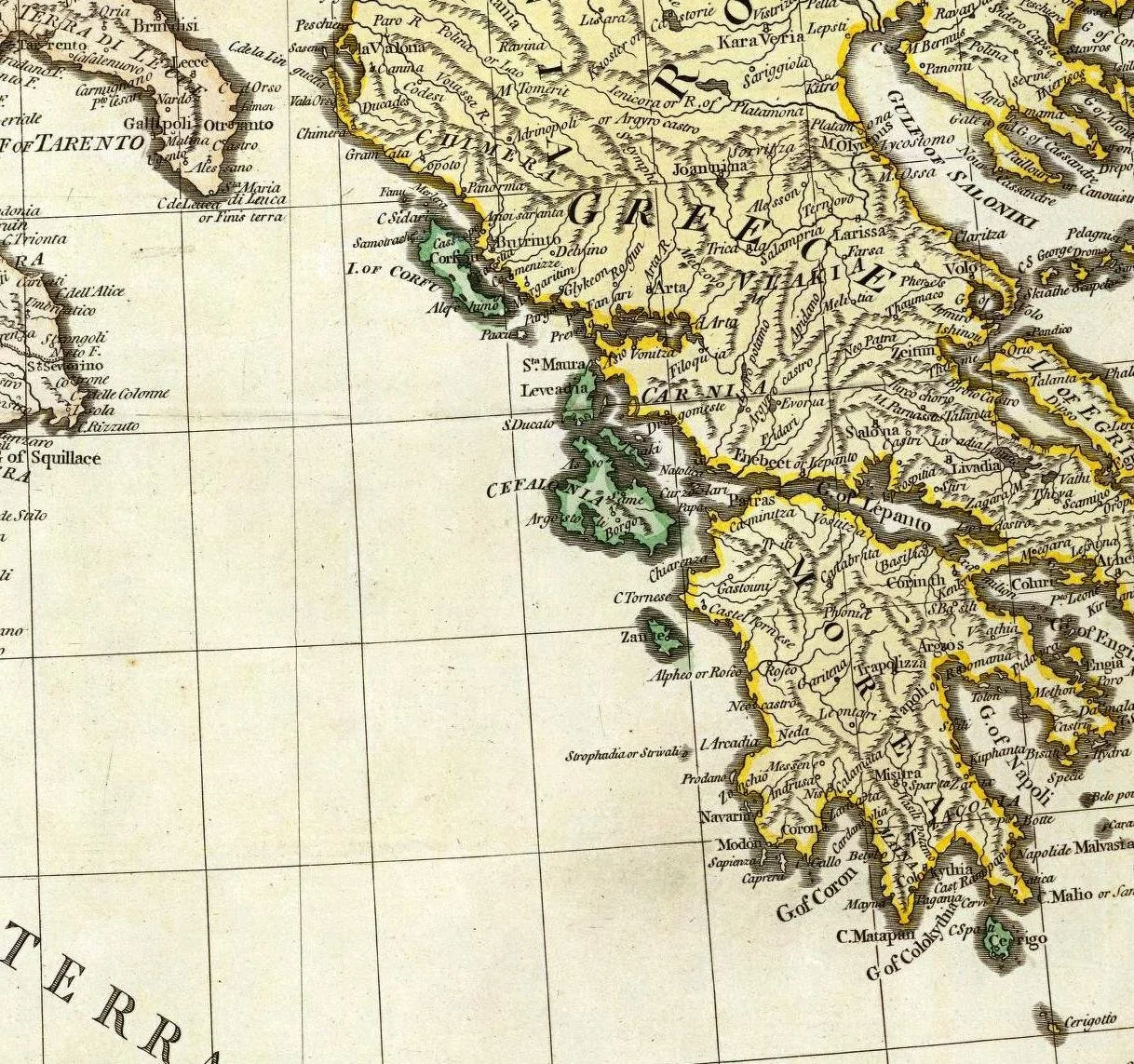
Ancient Corinth occupied one of the most strategically important locations in the Greek world. Situated on the narrow Isthmus of Corinth, the city controlled an important land connection between mainland Greece and the Peloponnese while also possessing access to two seas. This exceptional geographical position helped Corinth become a major center of commerce, manufacturing, maritime activity, colonization, and political influence.
Unlike many Greek cities whose importance depended primarily on agriculture or military power, Corinth developed an economy strongly connected to international trade.
Geography and Strategic Importance
Corinth stood approximately halfway between northern and southern Greece.
The Isthmus of Corinth formed a narrow land bridge connecting the Peloponnese with mainland Greece. To the west was the Gulf of Corinth, providing access toward the Ionian Sea, while to the east was the Saronic Gulf, opening routes toward the Aegean.
This position gave Corinth an extraordinary commercial advantage.
Merchants traveling between different parts of Greece could use Corinth as a stopping point, while ships could reach either side of the Greek mainland from its territory.
The Diolkos
One of Corinth's most remarkable features was the Diolkos, an ancient paved trackway across the Isthmus.
It was designed to facilitate the movement of goods and, under certain circumstances, ships or ship cargo between the two gulfs.
Rather than forcing ships to sail around the entire Peloponnese, which could be dangerous and time-consuming, merchants could potentially use the land route.
The Diolkos demonstrates how Greek communities developed infrastructure to overcome geographical obstacles.
Corinthian Harbors
Corinth benefited from two principal harbor areas.
Lechaion served the western side, while Cenchreae served the eastern side.
Together, these ports connected Corinth to different maritime networks.
Goods arriving from Italy and the western Mediterranean could reach Corinth through western routes, while eastern connections linked the city with the Aegean and beyond.
Corinthian Pottery
Corinth became famous for its pottery.
Corinthian ceramic workshops produced vessels decorated with animals, mythical creatures, geometric patterns, and narrative scenes.
During the Archaic period, Corinthian pottery was exported widely.
Archaeological discoveries of Corinthian ceramics across the Mediterranean demonstrate the reach of the city's commercial networks.
Manufacturing
Corinth was not simply a redistribution center.
Its artisans produced valuable goods.
Industries included:
pottery;
metalworking;
sculpture;
textiles;
and other crafts.
The city's artisans developed sophisticated techniques and distinctive artistic styles.
Colonization
Corinth also established important colonies.
Two particularly famous examples were Corcyra, modern Corfu, and Syracuse in Sicily.
These colonies extended Corinthian influence far beyond mainland Greece.
Syracuse eventually became one of the most powerful Greek cities in the western Mediterranean.
Religion
Religion was another major aspect of Corinthian life.
The city was associated with several important sanctuaries.
The Temple of Apollo was one of its most recognizable ancient structures.
The sanctuary of Poseidon at Isthmia, located near Corinth, hosted the Isthmian Games.
The Isthmian Games
The Isthmian Games were one of the major athletic festivals of the Greek world.
They were dedicated primarily to Poseidon.
Athletes competed in events including:
running;
wrestling;
boxing;
pankration;
and equestrian competitions.
The games attracted competitors and spectators from across the Greek world.
Corinth and the Roman World
Corinth was destroyed by the Roman general Lucius Mummius in 146 BCE during Rome's conflict with the Achaean League.
The city was later refounded as a Roman colony by Julius Caesar in 44 BCE.
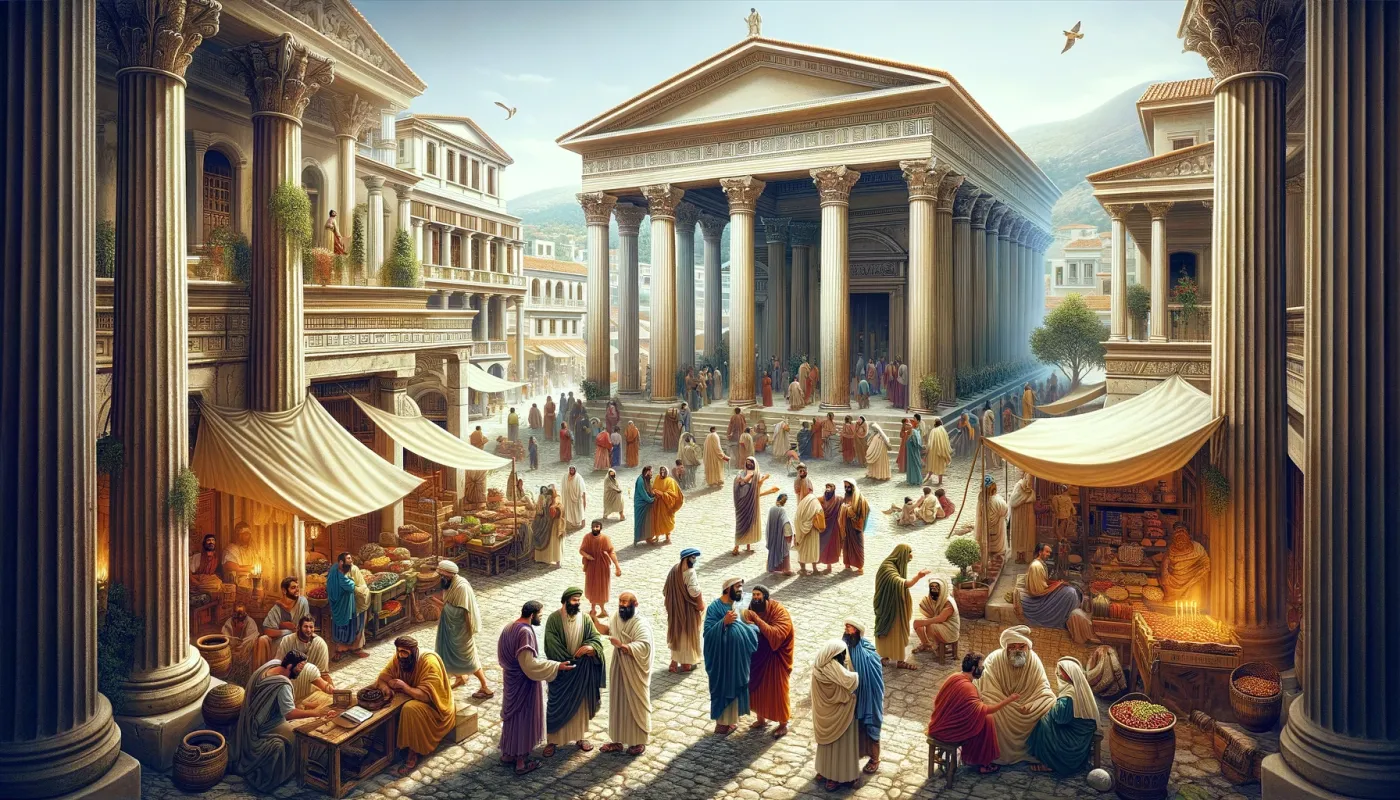
Roman Corinth became an important administrative and commercial center.
Christianity in Corinth
Corinth later became important in early Christian history.
The apostle Paul visited Corinth during the first century CE and established a Christian community there.
The New Testament's First and Second Epistles to the Corinthians are traditionally associated with this community.
Archaeological Corinth
Modern archaeological excavations have revealed:
temples;
fountains;
roads;
marketplaces;
workshops;
houses;
inscriptions;
sculptures;
and pottery.
These discoveries demonstrate how deeply commerce and urban life were integrated.
Conclusion
Ancient Corinth: Trade Capital of Greece represents one of the clearest examples of geography driving economic development.
Its position between two seas, combined with its control of the Isthmus, gave Corinth access to extraordinary commercial opportunities.
Through trade, pottery production, colonization, athletics, religion, and maritime connections, Corinth became one of the most influential cities of the ancient Mediterranean.