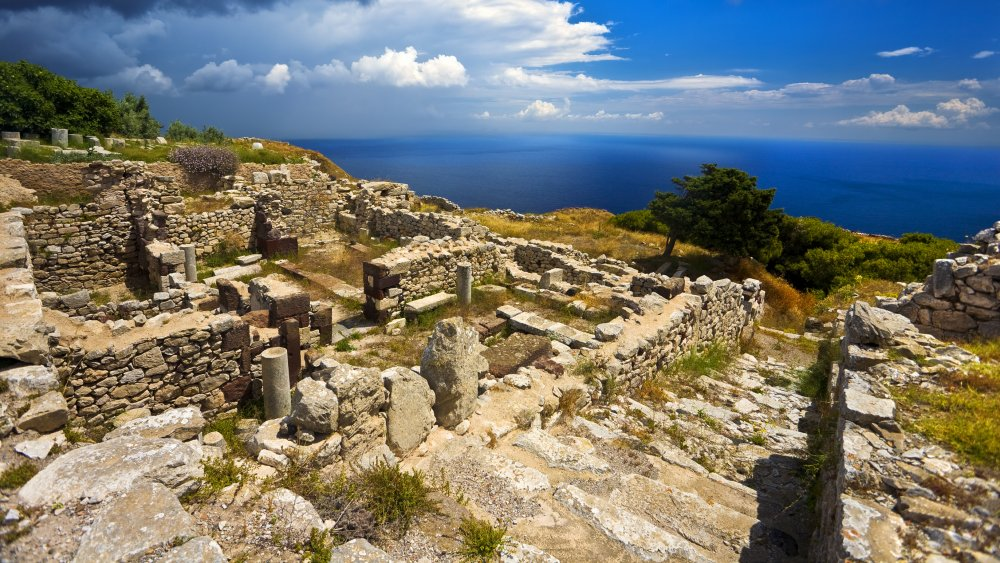
Ancient Thera is an extraordinary archaeological site located on the island of Santorini.
Perched high on the dramatic volcanic landscape of the island, the city preserves evidence of centuries of settlement.
The nickname “Pompeii of the Aegean” emphasizes its archaeological value, although the site's history differs substantially from that of Pompeii.
The Volcanic Landscape
Santorini was shaped by enormous volcanic activity.
The island's dramatic cliffs and caldera are remnants of one of the most significant volcanic events of the ancient Mediterranean.
The volcanic environment preserved archaeological layers in unusual ways across the island.
The Minoan Eruption
The massive eruption of Thera during the Bronze Age had profound consequences for the Aegean world.
The exact date remains debated, although scientific dating generally places it in the seventeenth or sixteenth century BCE.
The eruption buried the settlement of Akrotiri, not Ancient Thera itself.
This distinction is important.
The Foundation of Ancient Thera
The city known as Ancient Thera was established much later.
It was founded by Dorian Greeks, traditionally associated with Sparta, around the early first millennium BCE.
Strategic Location
The city occupied the steep Mesa Vouno mountain.
The location provided excellent defensive advantages.
It also offered broad views across the surrounding sea.
Urban Layout
Ancient Thera contained:
streets;
houses;
public buildings;
sanctuaries;
baths;
theaters;
and administrative structures.
The Agora
The Agora served as an important public area.
It functioned as a civic and social space.
The Theater
The city contained a theater used for performances and public gatherings.
The theater demonstrates the importance of dramatic and civic culture within Greek urban life.
Religious Buildings
Several sanctuaries existed throughout the city.
Deities and religious traditions represented at the site included:
Apollo;
Dionysus;
Artemis;
and Egyptian-associated cults.
This diversity reflects the city's position within broader Mediterranean networks.
The Ptolemaic Period
Ancient Thera became particularly important during the Hellenistic period.
The island's strategic location made it useful to larger powers.
The city was occupied by forces connected with the Ptolemaic kingdom of Egypt.
Military Importance
Its location made Thera valuable for monitoring maritime routes.
Military installations and administrative structures reveal the strategic dimension of the settlement.
Everyday Life
Archaeological remains provide evidence of ordinary activities.
Researchers can study:
pottery;
architecture;
coins;
inscriptions;
household objects;
and religious artifacts.
Conclusion
Ancient Thera: The Pompeii of the Aegean is one of Santorini's most important archaeological landscapes.
Its long history—from Dorian settlement to Hellenistic strategic center—shows how communities adapted to the extraordinary volcanic environment of the island.
The site's combination of dramatic geography, architecture, inscriptions, religious buildings, and everyday objects makes it an invaluable source for understanding ancient Aegean society.