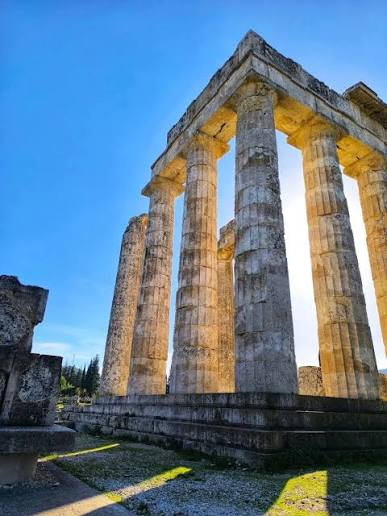
Nemea was an important religious and athletic center in the northeastern Peloponnese.
Its sanctuary was dedicated primarily to Zeus, and it became famous for the Nemean Games, one of the major athletic festivals of ancient Greece.
The site demonstrates how religion, athletics, architecture, and regional identity were closely interconnected.
The Sanctuary of Zeus
The sanctuary was located in the valley of Nemea.
Its most prominent monument was the Temple of Zeus.
The temple was constructed in the fourth century BCE and represented an important stage in Greek architectural development.
The Nemean Games
The Nemean Games formed part of the prestigious cycle of major Greek athletic competitions.
Together with the:
Olympic Games;
Pythian Games;
and Isthmian Games,
they contributed to the broader tradition later known as the Panhellenic Games.
Athletic Competitions
Events included:
running;
wrestling;
boxing;
pankration;
and pentathlon.
Equestrian competitions could also form part of major Greek festivals.
The Crown of Victory
Victors received a crown made from local vegetation rather than valuable precious metals.
At Nemea, the prize was associated with wild celery.
The symbolic value of victory was more important than the monetary value of the crown.
The Stadium
Nemea possesses a remarkably preserved ancient stadium.
The track was approximately 178 meters long, corresponding roughly to the traditional Greek stadion measurement.
The stadium could accommodate large numbers of spectators.
The Starting Line
The stadium preserves a sophisticated starting system.
Athletes could stand behind a stone starting mechanism designed to help ensure a fair beginning.
This illustrates the Greeks' concern with organized competition.
The Hero Opheltes
Nemea was also connected with the myth of Opheltes.
According to mythology, the infant Opheltes was killed by a serpent while his nurse was distracted.
The episode became connected with the origins of the Nemean Games.
Heracles and the Nemean Lion
Nemea is also strongly associated with Heracles.
According to mythology, his first labor was to defeat the Nemean Lion.
The lion's hide was supposedly impervious to ordinary weapons.
Heracles eventually strangled it and wore its skin as armor.
Water and the Sanctuary
The sanctuary included important water facilities.
Water was essential for athletes and visitors.
The famous Baths of the Sanctuary demonstrate the practical infrastructure required to host large gatherings.
Religion and Athletics
Athletic competitions were not secular sporting events in the modern sense.
They were part of religious festivals.
Athletes competed in honor of the gods, and victories brought prestige to individuals and their communities.
Political Importance
Panhellenic festivals also encouraged interaction between otherwise independent city-states.
Competitors from different poleis could meet under religious protection.
Archaeological Discoveries
Excavations have revealed:
temples;
stadium structures;
baths;
houses;
inscriptions;
coins;
pottery;
and athletic equipment.
Conclusion
Nemea: Sanctuary of Zeus and Athletic Games demonstrates how ancient Greek athletics were inseparable from religion and civic identity.
The sanctuary honored Zeus while simultaneously bringing athletes and spectators together in one of the most important competitive traditions of the Greek world.