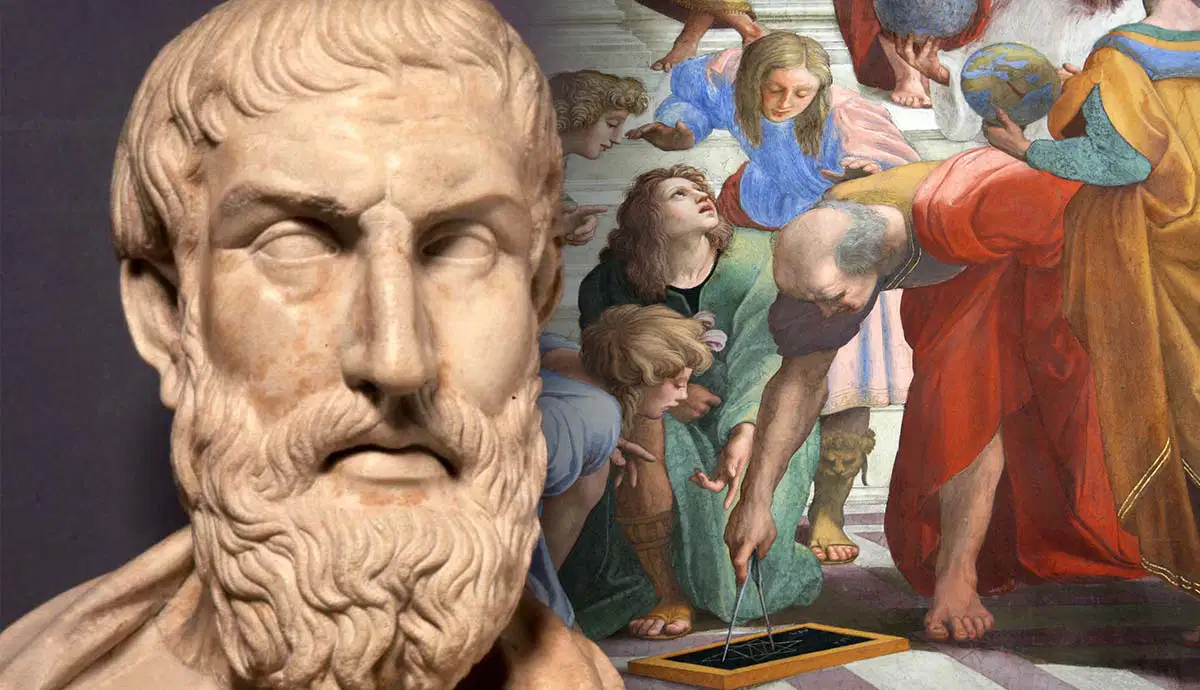
Ancient Greek philosophy transformed the way people in the Mediterranean world thought about nature, knowledge, morality, politics, and the meaning of human existence. Beginning with early thinkers who questioned traditional explanations of the natural world, Greek philosophers gradually developed competing schools of thought that examined nearly every aspect of life.
These philosophical schools were not simply collections of abstract ideas. They often represented distinct approaches to education, ethics, politics, personal discipline, and the search for truth. Their influence eventually spread throughout the Hellenistic world and the Roman Empire and continues to shape modern philosophy.
The Pre-Socratic Philosophers
The earliest Greek philosophers are commonly called the Pre-Socratics, because they lived and worked before or around the time of Socrates.
Rather than relying exclusively on myths to explain the universe, these thinkers attempted to identify rational principles behind natural phenomena.
Thales of Miletus
Thales is traditionally regarded as one of the earliest Greek philosophers.
He proposed that water was the fundamental substance underlying nature.
Although his conclusion was incorrect according to modern science, his method was historically important. He attempted to explain the world through a natural principle rather than simply attributing every phenomenon to divine action.
Anaximander
Anaximander proposed the concept of the apeiron, an indefinite or boundless principle from which things originated.
His cosmological ideas demonstrated the increasing sophistication of early Greek speculation about the structure of the universe.
Heraclitus
Heraclitus of Ephesus emphasized change.
He is famously associated with the idea that reality is characterized by continual transformation.
Fire served as an important symbol in his philosophy.
Pythagoreanism
The followers of Pythagoras developed a philosophical tradition centered heavily on mathematics, harmony, discipline, and the nature of the soul.
Pythagorean thinkers believed numerical relationships were fundamental to reality.
Their interest in mathematical ratios also influenced their understanding of musical harmony.
The Sophists
The Sophists were professional teachers who traveled between Greek cities.
They taught subjects such as:
rhetoric;
argumentation;
political skills;
language;
and civic education.
They became especially influential in democratic Athens, where persuasive public speaking was essential.
Socrates
Socrates did not establish a philosophical school in the institutional sense, but his influence became enormous.
He focused heavily on ethical questions.
His method involved asking questions and examining assumptions.
The Socratic method encouraged people to recognize contradictions in their beliefs.
Plato and the Academy
Plato, a student of Socrates, established the Academy in Athens.
His philosophy explored:
justice;
knowledge;
education;
politics;
metaphysics;
and the nature of reality.
Plato's theory of Forms proposed that the visible world does not represent the highest level of reality.
Aristotle and the Lyceum
Aristotle, who studied under Plato, later established the Lyceum.
His interests were extraordinarily broad.
He studied:
biology;
physics;
ethics;
politics;
logic;
rhetoric;
metaphysics;
and literary theory.
Aristotle's systematic approach profoundly influenced later European and Islamic intellectual traditions.
Cynicism
The Cynics emphasized simplicity and independence from conventional social values.
Antisthenes is commonly associated with the origins of Cynicism, while Diogenes of Sinope became its most famous representative.
Cynics rejected excessive wealth, status, and luxury.
Epicureanism
Epicurus founded Epicureanism.
Contrary to the modern meaning of “epicurean,” Epicurean philosophy did not simply advocate luxury.
Epicurus argued that the best life involved tranquility, friendship, moderation, and freedom from unnecessary fear.
Stoicism
Zeno of Citium founded Stoicism.
Stoic philosophy emphasized living according to reason and accepting what cannot be controlled.
Later Stoic thinkers included:
Seneca;
Epictetus;
and Marcus Aurelius.
Skepticism
Skeptical philosophers questioned whether humans could attain certain knowledge.
They encouraged suspension of judgment when evidence was insufficient.
Conclusion
Greek Philosophical Schools and Their Founders created an extraordinary intellectual tradition.
From Thales' natural philosophy to Plato's metaphysics, Aristotle's systematic investigations, Epicurus' pursuit of tranquility, and Stoicism's emphasis on reason and self-control, Greek philosophy established questions that remain central to intellectual life today.