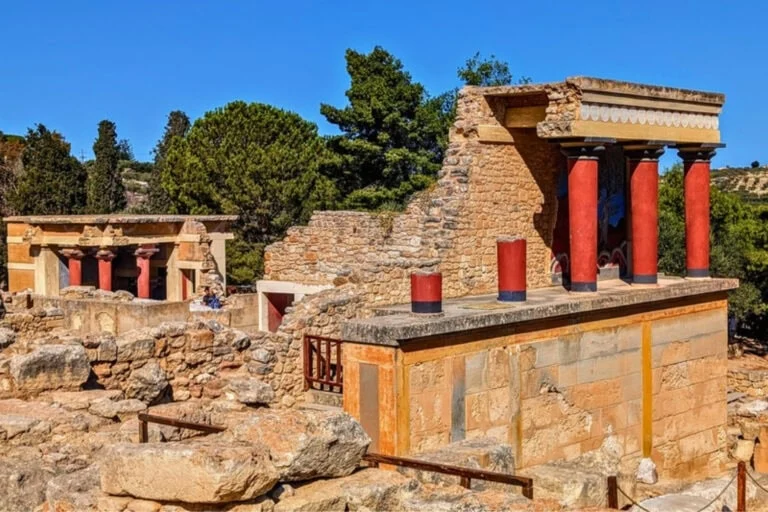
Knossos is one of the most important archaeological sites in the Aegean.
Located on the island of Crete, it was the center of a major Bronze Age settlement associated with the Minoan civilization.
The site is famous for its monumental palace, elaborate frescoes, sophisticated infrastructure, and connection with the later Greek myth of the Minotaur.
The Minoan Civilization
The Minoan civilization flourished primarily during the Bronze Age.
Its major centers included:
Knossos;
Phaistos;
Malia;
and Zakros.
The Minoans developed complex administrative, religious, artistic, and commercial systems.
The Palace of Knossos
Knossos is dominated by its enormous palace complex.
Rather than being simply a royal residence, the palace appears to have served multiple purposes.
It included:
storage rooms;
workshops;
ceremonial spaces;
administrative areas;
religious facilities;
and residential quarters.
Complex Architecture
The palace contained a maze-like arrangement of rooms, corridors, staircases, courtyards, and storage areas.
This complex layout may have contributed to later stories about the Labyrinth.
However, there is no archaeological evidence proving that the palace itself was the historical Labyrinth of myth.
Frescoes
Knossos is famous for colorful frescoes.
They depict:
bulls;
plants;
marine animals;
people;
processions;
and ceremonial scenes.
The artwork provides important evidence about Minoan visual culture.
Bull Symbolism
Bulls appear repeatedly in Minoan art and religious imagery.
The famous bull-leaping scenes show human figures interacting with bulls.
The exact meaning of these scenes remains debated.
They may have had religious or ceremonial significance.
Writing Systems
The Minoans used several writing systems.
Linear A remains largely undeciphered.
Later Linear B, used at Knossos during the Mycenaean period, represents an early form of Greek writing.
Trade
Crete occupied a strategic position in the eastern Mediterranean.
Minoan communities traded with:
mainland Greece;
Cyprus;
Anatolia;
Egypt;
and the Levant.
Religion
Minoan religious practices remain partly mysterious.
Archaeologists have found evidence of:
ritual vessels;
sacred symbols;
figurines;
shrines;
and ceremonial spaces.
The Myth of the Minotaur
Later Greek mythology connected Crete with King Minos and the Minotaur.
According to the myth, the Minotaur was a creature with the body of a man and head of a bull.
It lived in the Labyrinth.
These stories were created and transmitted long after the height of Minoan civilization.
Arthur Evans
Archaeologist Arthur Evans excavated Knossos beginning in the early twentieth century.
His reconstruction work helped bring Minoan civilization to international attention.
However, some of his reconstructions incorporated interpretations that remain controversial among modern archaeologists.
Minoan Decline
The transformation of Minoan civilization involved multiple factors.
The eruption of Thera, earthquakes, changes in political organization, and increasing Mycenaean influence have all been discussed.
The archaeological evidence suggests a complex transition rather than one simple catastrophic event.
Conclusion
Knossos and the Minoan Legacy represent one of the foundational chapters of Aegean prehistory.
The palace, frescoes, writing systems, religious artifacts, and international trade connections reveal a sophisticated Bronze Age society.
The later myths of Minos, the Minotaur, and the Labyrinth transformed the memory of Crete into one of the most enduring traditions of Greek mythology.