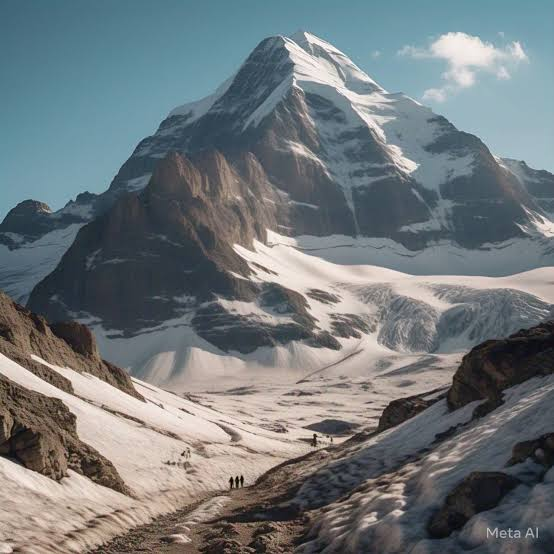
Mount Ossa, known in modern Greek as Kissavos, rises in Thessaly near the Aegean coast.
Although it never matched Mount Olympus in religious importance, Ossa occupies a memorable position in Greek mythology because ancient stories connected it with the Gigantomachy, the legendary struggle between the gods and the Giants.
The mountain therefore became part of one of Greek mythology's most dramatic explanations of divine power.
The Geography of Ossa
Mount Ossa lies between the Pineios River valley and the Aegean coast.
Its proximity to Mount Olympus made the two mountains particularly prominent in the landscape.
The nearby Tempe Valley separates Olympus from Ossa.
The Giants
Greek mythology tells of the Giants, powerful beings who challenged the Olympian gods.
Their rebellion represented a threat to divine order.
The gods eventually defeated them.
The Mountains of the Giants
Some versions of the myth describe the Giants attempting to pile mountains upon one another to reach Olympus.
Mount Ossa was supposedly placed upon Mount Olympus.
In other traditions, Ossa and Pelion were stacked together.
The myth explains the extraordinary visual relationship between the mountains through supernatural storytelling.
Olympus as the Divine Home
Mount Olympus was traditionally regarded as the home of the Olympian gods.
Zeus ruled from the summit.
Ossa's association with Olympus therefore placed the mountain within a mythological landscape of divine conflict.
The Myth of Otus and Ephialtes
Another important myth involving Ossa and Pelion concerns the Aloadae, the giant brothers Otus and Ephialtes.
They attempted to reach the heavens by piling mountains upon one another.
The story illustrates a recurring Greek mythological theme: mortal or semi-divine beings attempting to challenge cosmic boundaries.
Natural Landscape and Myth
Greek mythology frequently incorporated dramatic landscapes.
Mountains, caves, springs, rivers, and islands were assigned mythological identities.
Ossa demonstrates how geographical features could become integrated into stories explaining the structure of the divine world.
The Tempe Valley
The nearby Tempe Valley was itself associated with Greek mythology and religion.
Its fertile landscape and river environment made it both geographically and culturally important.
Historical Thessaly
Beyond mythology, the region surrounding Ossa was an important agricultural area.
Thessaly was known for:
fertile plains;
horse breeding;
agriculture;
and strategic routes.
Conclusion
Mt. Ossa: The Rival of Olympus demonstrates how Greek mythology transformed the natural landscape into a theater of divine action.
The mountain's physical proximity to Olympus helped inspire stories about Giants attempting to scale the heavens.
Although Ossa never became the divine residence that Olympus represented, it remains an important part of the mythological geography of ancient Greece.
The Fortress of Acrocorinth
Acrocorinth is one of the most spectacular fortified sites in Greece.
Rising dramatically above ancient Corinth, the massive rocky hill provided extraordinary defensive advantages.
For thousands of years, successive civilizations recognized its strategic importance.
The fortress therefore preserves layers of Greek, Roman, Byzantine, Frankish, Venetian, and Ottoman history.
The Strategic Hill
Acrocorinth rises more than 500 meters above sea level.
Its steep slopes made direct assault difficult.
From the summit, defenders could monitor:
Corinth;
the Isthmus;
surrounding valleys;
and maritime approaches.
Ancient Corinth
Because Corinth controlled the Isthmus, Acrocorinth provided protection for one of the most strategically valuable cities in Greece.
Control of the fortress meant control of an important regional position.
The Spring of Peirene
The ancient site was associated with the Peirene spring.
Water was essential to the survival of a fortified population.
A reliable water source inside or near the fortress was therefore strategically significant.
Mythological Connections
Greek mythology connected Corinth with Sisyphus, the legendary king famous for his eternal punishment.
The region was also associated with Bellerophon and the winged horse Pegasus.
These traditions added mythological significance to the landscape.
The Temple of Aphrodite
Ancient Acrocorinth contained a sanctuary dedicated to Aphrodite.
The sanctuary became famous in ancient literary traditions.
Modern scholarship approaches some of the older claims about sacred prostitution cautiously because ancient sources may exaggerate or simplify complex religious practices.
Roman Period
After the Roman destruction and later refoundation of Corinth, Acrocorinth remained strategically important.
Byzantine Fortification
During the Byzantine period, the fortress was strengthened.
Its walls evolved as military technology and political circumstances changed.
Medieval Corinth
The fortress later came under the control of various powers.
The Franks, Byzantines, Knights, Venetians, and Ottomans all played roles in the region's later history.
The Gates
The fortress has multiple defensive gateways.
Approaching the summit required navigating steep terrain and fortified entrances.
This created a layered defensive system.
Water and Siege Warfare
A fortress could only survive a prolonged siege if it had adequate access to:
water;
food;
storage facilities;
and defensive manpower.
Acrocorinth's elevated position made it particularly valuable for controlling the surrounding countryside.
Archaeological Remains
Visitors can encounter:
ancient foundations;
medieval walls;
churches;
mosques;
towers;
cisterns;
and fortification structures.
Conclusion
The Fortress of Acrocorinth demonstrates the extraordinary strategic importance of geography in ancient and medieval warfare.
Its commanding position above Corinth allowed successive civilizations to use the mountain as a defensive stronghold.
Few Greek fortresses illustrate so clearly how one location could remain militarily valuable across thousands of years.