Delos is a small island in the central Aegean, but its historical importance far exceeds its size.
In ancient Greek religion, Delos was considered one of the most sacred places in the Aegean and was especially associated with Apollo and Artemis.
The island later became an important commercial and political center, creating a remarkable combination of religious and economic significance.
The Birthplace of Apollo and Artemis
According to Greek mythology, Delos was the birthplace of Apollo and Artemis.
Their mother, Leto, was said to have searched for a place where she could give birth while facing the hostility of Hera.
Delos eventually offered her refuge.
The Sacred Island
Because of its association with Apollo, Delos became a major religious destination.
Pilgrims traveled to the island to participate in religious ceremonies and festivals.
The Delian Festival
The island hosted major festivals dedicated to Apollo.
Athletic competitions, musical performances, dances, and religious ceremonies formed part of the celebrations.
The festival attracted visitors from different Greek communities.
The Sanctuary of Apollo
The sanctuary developed into an extensive religious complex.
It included:
temples;
altars;
treasuries;
monuments;
statues;
and sacred pathways.
The Terrace of the Lions
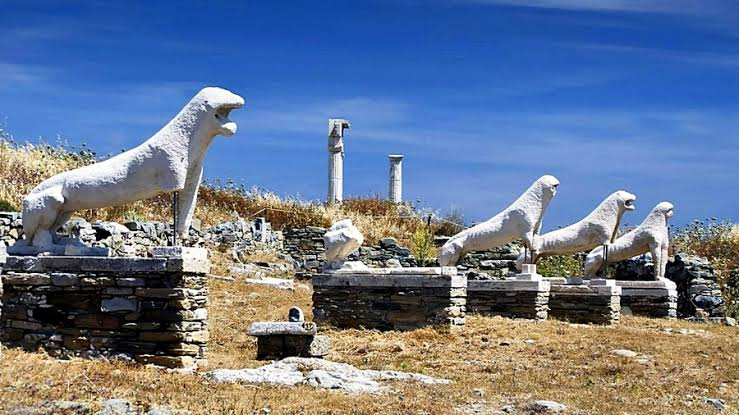
One of Delos' most famous monuments is the Terrace of the Lions.
A row of marble lions once guarded the sacred area.
The lions were dedicated by the people of Naxos.
Their presence demonstrates the competitive nature of religious monument-building among Greek communities.
Purification
Delos was subject to strict religious rules concerning ritual purity.
According to ancient traditions, births and deaths were restricted or prohibited within certain sacred areas.
These practices reinforced the island's special religious status.
The Delian League
Delos later acquired political importance.
In 478 BCE, Athens and its allies organized the Delian League as an alliance against Persia.
The league's treasury was originally located on Delos.
Eventually, Athens transferred the treasury to the Acropolis in 454 BCE.
Commercial Delos
During the Hellenistic period, Delos became one of the eastern Mediterranean's most important commercial centers.
Its location provided excellent access to maritime routes.
The Free Port
In 167 BCE, Delos was declared a free port by Rome.
This decision dramatically increased its commercial importance.
Merchants arrived from many parts of the Mediterranean.
International Population
Delos became a cosmopolitan center.
People from different regions lived and worked there.
Archaeologists have discovered evidence of communities associated with:
Greeks;
Italians;
Egyptians;
Syrians;
Phoenicians;
and other Mediterranean peoples.
Wealth and Slavery
Delos became involved in the Mediterranean slave trade.
Its commercial prosperity therefore cannot be separated from the darker economic structures of the ancient Mediterranean.
Decline
The island suffered major destruction during the first century BCE.
Political instability and military attacks damaged its commercial position.
Over time, Delos declined.
Archaeological Importance
Today the island contains extensive ruins.
Visitors can see:
temples;
houses;
marketplaces;
mosaics;
statues;
theaters;
sanctuaries;
and inscriptions.
Conclusion
The Island of Delos and Its Sacred Role reveals how religion could transform a small island into a major Mediterranean center.
Delos was simultaneously the mythological birthplace of Apollo, a Panhellenic sanctuary, a political meeting point, and eventually a major international marketplace.
Its archaeological remains preserve the extraordinary intersection of religion, commerce, migration, and political power in the ancient Aegean.