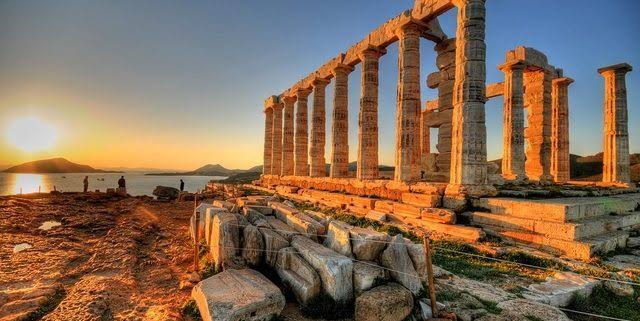
At the southernmost tip of Attica stands one of the most recognizable ancient Greek monuments: the Temple of Poseidon at Sounion.
Perched dramatically above the Aegean Sea, the sanctuary demonstrates the relationship between Greek religion, maritime culture, architecture, and landscape.
A Temple Above the Sea
Sounion occupies a rocky promontory overlooking major maritime routes.
For sailors approaching Attica from the Aegean, the cape was a significant landmark.
The location therefore had both religious and navigational importance.
Poseidon
Poseidon was the Greek god associated with:
the sea;
earthquakes;
horses;
and maritime power.
A sanctuary dedicated to him at Sounion was therefore particularly appropriate.
The Temple
The surviving temple was constructed in the fifth century BCE.
It followed the Doric architectural order.
Its columns supported an elaborate entablature and roof structure.
Marble Construction
The temple was constructed primarily from local marble.
The bright stone would have appeared striking against the blue sea and surrounding landscape.
The Sacred Precinct
The sanctuary was larger than the temple itself.
It included:
fortifications;
ritual spaces;
subsidiary structures;
and areas associated with offerings.
Military Significance
Sounion was strategically valuable.
Control of the cape helped Athens monitor maritime routes around southern Attica.
A fortified sanctuary could therefore have religious and defensive functions simultaneously.
Aegean Navigation
Ancient sailors relied heavily on recognizable landmarks.
A monumental temple at Sounion would have been visible from considerable distances under favorable conditions.
Myth and Literature
Sounion appears in ancient literary traditions.
The site is particularly associated with the myth of Theseus.
According to tradition, Theseus promised his father Aegeus that he would raise white sails if he survived his voyage to Crete.
He returned with dark sails, and Aegeus, believing his son dead, threw himself into the sea.
The Aegean was subsequently associated with his name.
Archaeological Discoveries
Archaeologists have recovered:
marble architectural fragments;
inscriptions;
pottery;
sculptures;
and votive offerings.
Some sculptures demonstrate the wealth of worshippers who visited the sanctuary.
Conclusion
Sounion and the Temple of Poseidon represent one of the most powerful combinations of architecture and natural landscape in Greece.
The temple honored the god of the sea while standing above the very waters with which Poseidon was associated.
Its location also reflected the practical importance of the cape for maritime navigation and Athenian defense.