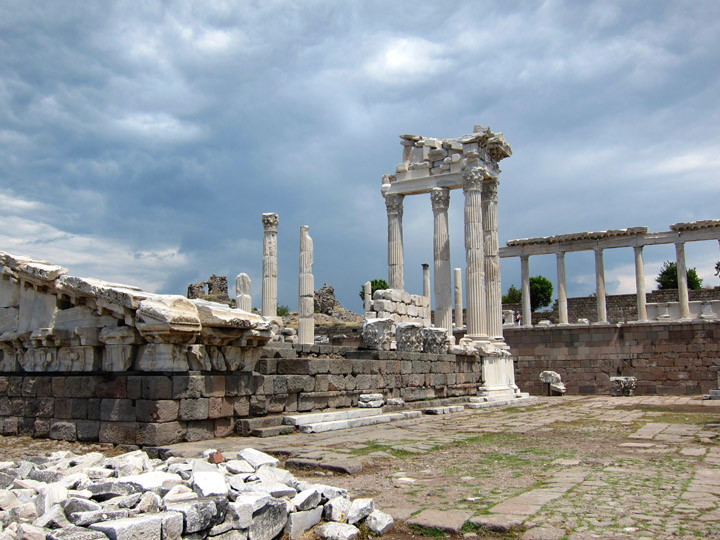
Pergamon was one of the great cultural and political centers of the Hellenistic world.
Located in western Anatolia, modern-day Turkey, the city became the capital of the Attalid dynasty and developed into a major center of architecture, scholarship, religion, and artistic production.
Its dramatic hilltop acropolis remains one of the most impressive archaeological landscapes in the ancient Mediterranean.
The Attalid Dynasty
Pergamon rose to prominence following the fragmentation of Alexander the Great's empire.
The Attalid dynasty established control over the region and developed Pergamon into a royal capital.
The Acropolis
The city's upper acropolis was built on a steep hill.
The elevation provided both defensive advantages and opportunities for monumental architecture.
The Altar of Zeus
One of Pergamon's most famous monuments was the enormous Great Altar of Zeus.
Its sculptural friezes depicted the mythological battle between the Olympian gods and the Giants.
The dramatic sculptures are among the greatest surviving achievements of Hellenistic art.
The Theater
Pergamon possessed a remarkably steep theater.
Its design took advantage of the natural slope of the hill.
The theater provided spectacular views across the surrounding landscape.
The Library
Pergamon developed a famous library.
Ancient writers associated it with a rivalry against the Library of Alexandria.
Pergamon became particularly associated with parchment, although the claim that parchment was invented there is probably an oversimplification.
The Asclepieion
Below the acropolis was the famous sanctuary of Asclepius, the god associated with healing.
The sanctuary functioned as a major healing center.
Visitors sought treatment through a combination of religious rituals and therapeutic practices.
Urban Planning
Pergamon's architecture included:
temples;
stoas;
theaters;
gymnasia;
fountains;
roads;
and residential areas.
Roman Pergamon
The city eventually became part of the Roman Empire.
Its cultural and religious importance continued.
Early Christianity
Pergamon is also mentioned in the Book of Revelation.
The text refers to the “throne of Satan,” a phrase interpreted in various ways by scholars.
The expression may relate to the city's monumental religious landscape, although its precise meaning remains debated.
Archaeological Legacy
Many sculptures and architectural fragments from Pergamon were removed during modern archaeological campaigns.
The Pergamon Altar is famously displayed today in Berlin.
Its modern history has itself become part of debates concerning archaeological ownership and cultural heritage.
Conclusion
The Ruins of Pergamon demonstrate the ambition of Hellenistic royal culture.
Its rulers used architecture, sculpture, libraries, sanctuaries, and urban planning to transform a regional settlement into a prestigious capital.
Pergamon remains one of the clearest examples of how political power and cultural patronage shaped the ancient Mediterranean city.