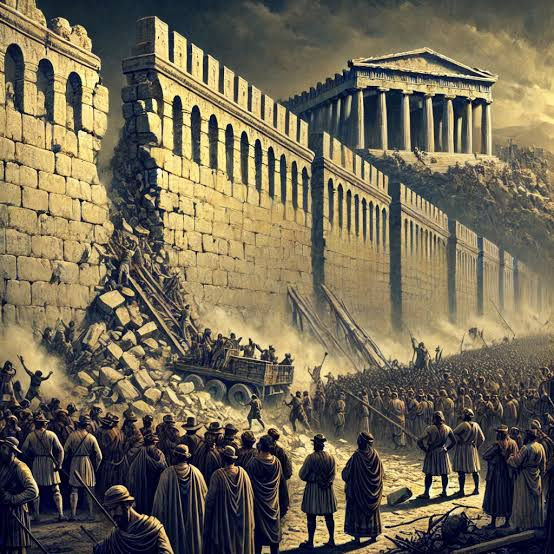
The Long Walls of Athens were among the most remarkable defensive structures of classical Greece.
They connected Athens with its major port of Piraeus and created a protected corridor between the city and the sea.
Their strategic purpose was simple but revolutionary: Athens could remain connected to its navy and maritime supply network even when its land territory was threatened.
Why Build the Walls?
Athens was surrounded by potential enemies.
Its greatest strategic advantage was its navy.
The city therefore needed to protect the connection between Athens and Piraeus.
Without such protection, an enemy could potentially isolate the city from its fleet and harbor.
Construction
The first walls connecting Athens and Piraeus were begun during the fifth century BCE.
The system was later expanded.
A third wall, commonly called the Phaleron Wall, was associated with the broader defensive system.
The Protected Corridor
The walls created a fortified route approximately several kilometers long.
The corridor contained roads and settlement areas.
It effectively transformed Athens and Piraeus into a single defended strategic zone.
Themistocles
The Athenian statesman Themistocles played a major role in developing Athens' naval strategy.
He recognized that the city's future security depended heavily on maritime power.
The Persian Threat
The walls were constructed in the aftermath of the Persian Wars.
Athenians understood that their city could be vulnerable to land invasion.
The navy provided an alternative source of strategic power.
The Peloponnesian War
The Long Walls became especially important during the Peloponnesian War.
Athens adopted a strategy that relied heavily on naval strength.
Rural populations from Attica could seek protection inside the fortified city system.
The Problem of Overcrowding
The strategy also created serious problems.
Large numbers of rural inhabitants moved inside the walls during Spartan invasions.
Overcrowding contributed to poor living conditions.
During the early years of the war, Athens suffered a devastating epidemic commonly called the Plague of Athens.
The disease killed large numbers of people, including Pericles.
Naval Supply
The walls allowed Athens to maintain access to Piraeus.
Ships could bring:
grain;
timber;
weapons;
luxury goods;
and other necessities.
Spartan Strategy
The Spartans and their allies understood the importance of the walls.
When Athens was defeated toward the end of the Peloponnesian War, the Long Walls were dismantled in 404 BCE as part of the peace settlement.
Reconstruction
The walls were later rebuilt.
The political and military importance of the Athens-Piraeus connection remained evident.
Engineering
The walls were massive structures.
They contained:
defensive towers;
gates;
roads;
and protected passages.
Their design was not simply architectural.
It represented a strategic system integrating:
urban defense;
naval power;
logistics;
and population protection.
Strategic Innovation
The greatest innovation was the integration of city and harbor.
Athens was no longer dependent exclusively on controlling surrounding farmland.
As long as its fleet remained powerful and supplies could enter Piraeus, the city could resist prolonged land pressure.
Conclusion
The Long Walls of Athens: Strategic Genius illustrates how military architecture can fundamentally transform political strategy.
By connecting Athens with Piraeus, the walls allowed the city to combine its population, economy, and navy into a single defensive system.
They were more than stone fortifications.
They were the physical expression of Athens' belief that control of the sea could compensate for vulnerability on land.
That strategic principle helped make Athens one of the most powerful states of the classical Greek world.