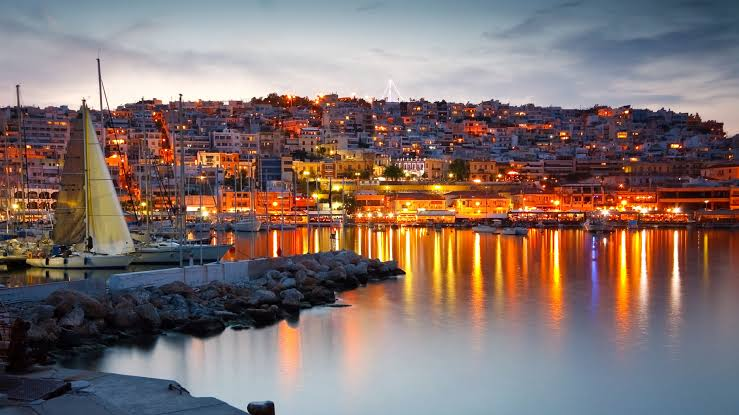
Piraeus was the maritime heart of ancient Athens.
Although modern Piraeus remains a major port city, much of its ancient landscape has been transformed by centuries of development.
The ancient harbor system, however, was extraordinary and played a crucial role in the economic and military power of Athens.
The Three Harbors
Ancient Piraeus contained three major harbor areas:
Kantharos;
Zea;
and Munichia.
Each served different functions.
Kantharos was particularly important for commercial shipping, while Zea and Munichia were strongly associated with the Athenian navy.
The Athenian Navy
The naval power of Athens depended heavily on Piraeus.
The city constructed large numbers of triremes, specialized warships powered primarily by oars.
Ship Sheds
The harbors contained enormous ship sheds.
These structures protected warships when they were not in use.
The scale of the naval infrastructure demonstrates the importance Athens placed on maritime warfare.
The Persian Wars
Athenian naval power played a decisive role during the Persian Wars.
The victory at the Battle of Salamis in 480 BCE demonstrated the importance of Athenian maritime strength.
The Long Walls
Piraeus was connected to Athens by the Long Walls.
These fortifications protected the road between the city and its harbor.
As long as Athens maintained control of the sea, the walls allowed the city to remain supplied even when its surrounding countryside was threatened.
Commercial Activity
Piraeus was not exclusively military.
It was one of the busiest commercial centers of the Greek world.
Merchants handled:
grain;
wine;
olive oil;
pottery;
timber;
metals;
textiles;
and luxury goods.
Foreign Merchants
The harbor attracted merchants from across the Mediterranean.
Resident foreigners, known as metics, played major roles in commercial activity.
The Agora
Piraeus possessed its own marketplace and civic infrastructure.
Commercial transactions required systems for:
taxation;
weighing;
storage;
contracts;
and dispute resolution.
Religious Diversity
The international character of the port contributed to religious diversity.
Different communities brought their own traditions and cults.
Why Is It “Lost”?
The ancient harbor has not literally disappeared.
Much survives archaeologically.
However, the ancient shoreline, ship sheds, warehouses, and urban landscape have been substantially transformed by later development.
Some ancient structures now lie beneath modern infrastructure or underwater.
Underwater Archaeology
Marine archaeology has helped researchers reconstruct ancient harbor facilities.
Submerged remains can reveal:
ancient shorelines;
harbor structures;
ship sheds;
breakwaters;
and changes in sea level.
Conclusion
The Lost Harbor of Piraeus represents one of the most important maritime landscapes of ancient Greece.
Piraeus was simultaneously a naval base, international marketplace, shipbuilding center, and gateway connecting Athens with the wider Mediterranean.
Without Piraeus, the extraordinary economic and military power of classical Athens would have been difficult to sustain.