War was deeply embedded in the political and social structure of ancient Greek communities.
Greek warfare was not simply a military activity separate from politics. Questions of citizenship, landownership, class, alliances, leadership, and constitutional government were all connected to military organization.
Understanding Greek warfare therefore requires understanding Greek society itself.
The Citizen-Soldier
In many Greek city-states, military service was closely connected to citizenship.
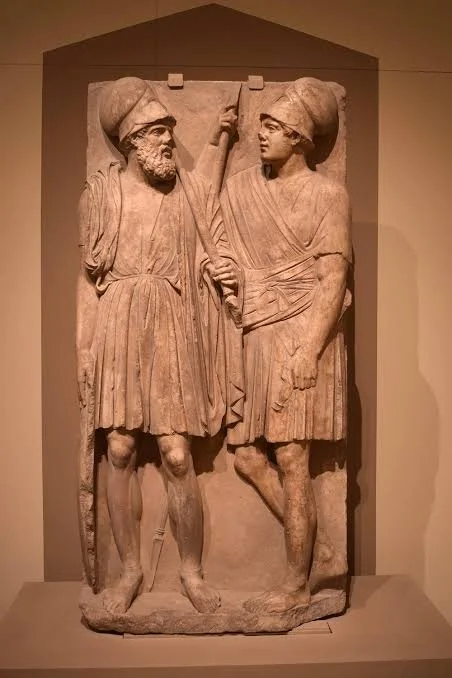
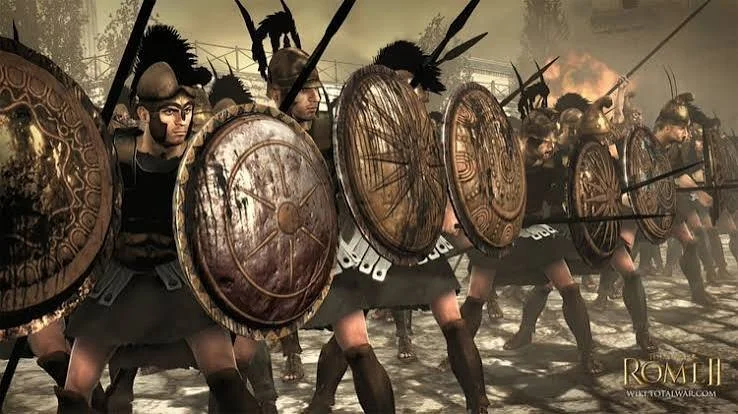
The hoplite was typically a heavily armed infantryman who supplied much of his own equipment.
This relationship between property and military service shaped political participation.
Those who possessed sufficient resources to equip themselves could participate as hoplites.
The Hoplite
A hoplite commonly carried:
Helmet
Shield
Body armor
Spear
Sword
The round shield, or aspis, was particularly important.
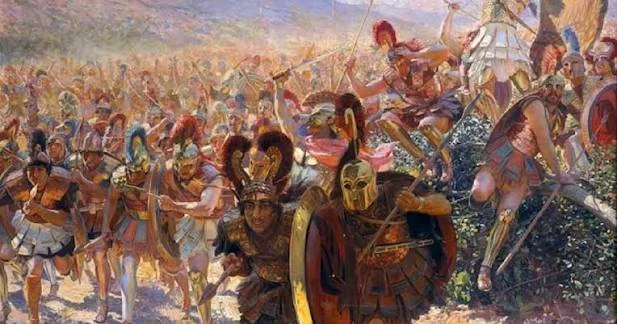
Hoplites fought in formations rather than as isolated individuals.
Political Consequences
Military organization could influence political development.
If ordinary citizens were expected to fight and risk their lives for the community, they could demand political recognition.
This relationship was not simple or universal, but military participation contributed to the development of civic identity.
Athens and Naval Power
Athens provides a different model.
Its navy became increasingly important during the fifth century BCE.
Large numbers of poorer citizens served as rowers.
Naval power therefore connected military service with the lower economic classes.
This strengthened the political importance of the Athenian democratic system.
Sparta
Sparta developed an unusually militarized social system.
Spartan citizens underwent the agoge and were expected to become professional-style warriors.
However, the Spartan system depended heavily upon the labor of populations who did not possess full Spartan citizenship.
This demonstrates that military power was inseparable from social hierarchy.
War and Alliances
Greek city-states rarely existed completely independently.
They formed alliances and leagues.
Two of the most important were:
The Peloponnesian League
The Delian League
These alliances eventually contributed to the enormous conflict between Athens and Sparta.
War and Diplomacy
Greek politics did not consist only of battlefield fighting.
States used:
Treaties
Hostages
Marriage alliances
Tribute
Embassies
Economic pressure
Religious diplomacy
Military power was one tool within a much larger political system.
Warfare and Identity
Victory in war could reinforce civic identity.
Defeat could destabilize governments.
Military disasters could produce:
Political revolutions
Exile
Economic crises
Changes in alliances
Consequently, warfare was one of the major forces shaping Greek political history.