The Greek phalanx is one of the most famous military formations of antiquity.
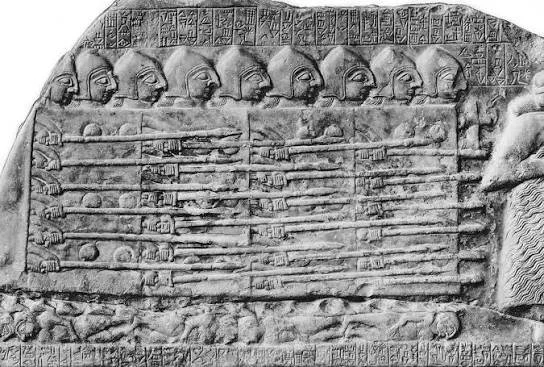
It consisted of heavily armed infantry arranged in dense ranks.
The effectiveness of the phalanx came not simply from the weapons carried by individual soldiers but from coordination, discipline, formation, and collective action.
Formation
Hoplites generally stood in several ranks.
The exact depth varied depending on circumstances.
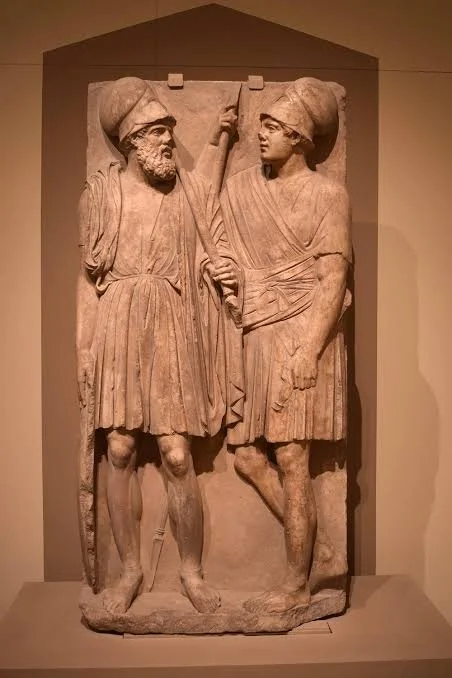
Soldiers carried large round shields and long spears.
The shields overlapped to create a degree of protection.
The Shield
The hoplite shield was essential to the formation.
Because it was relatively large and carried on the left arm, it protected the soldier's own body while also providing partial protection to the soldier beside him.
This encouraged close-order fighting.
The formation depended upon maintaining cohesion.
Advance
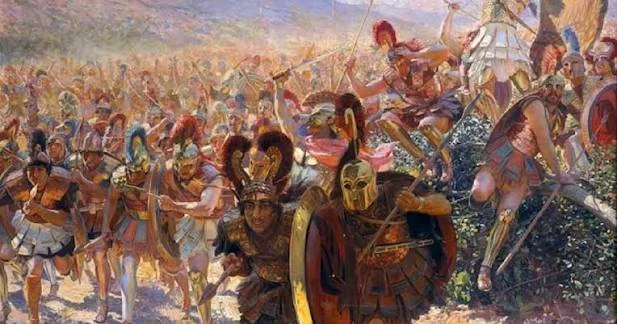
A phalanx could advance toward an enemy in formation.
Maintaining order was difficult.
Terrain could disrupt the ranks.
Dust, noise, fear, wounded soldiers, and uneven ground could create gaps.
The ability to preserve formation was therefore a major advantage.
The Battle of Marathon
The Battle of Marathon in 490 BCE demonstrated the effectiveness of Greek hoplite infantry against Persian forces.
The Athenians and their allies used heavy infantry in a successful attack against the Persian army.
The battle later became a symbol of Greek resistance.
The Battle of Leuktra
The traditional image of the phalanx as a rigid formation was challenged dramatically by Theban commander Epaminondas.
At Leuktra in 371 BCE, he used an unusually deep formation on one wing.
This concentrated force against the Spartan army.
The victory demonstrated that phalanx warfare could involve sophisticated tactical innovation.
Limitations
The phalanx was not invincible.
It was particularly vulnerable when:
Formation broke
Flanks were attacked
Terrain was unsuitable
Units became separated
Cavalry exploited exposed positions
Later Hellenistic armies developed increasingly complex combined-arms systems involving infantry, cavalry, missile troops, and specialized formations.
The Phalanx as a Social System
The phalanx also reflected Greek ideas about citizenship.
Soldiers depended on one another.
Courage was not simply an individual virtue.
A soldier who abandoned his position could endanger everyone around him.
Military discipline therefore reinforced ideals of collective responsibility.