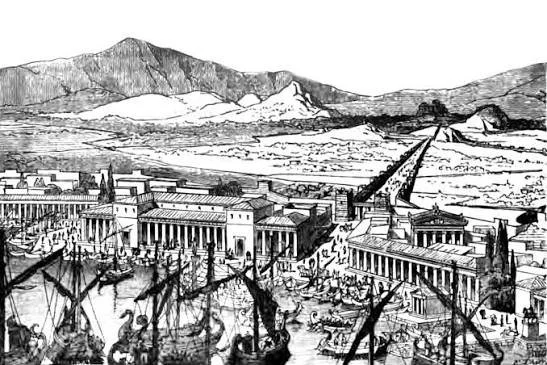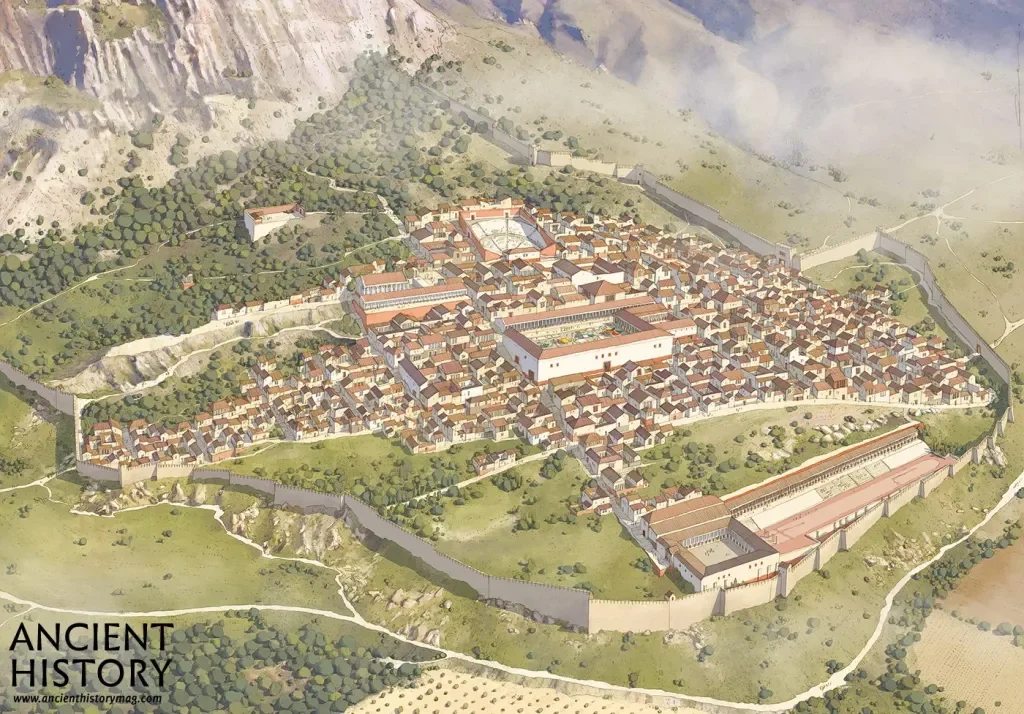
The ancient city of Priene provides one of the clearest examples of planned Greek urbanism.
Located in modern-day western Turkey, Priene was reorganized according to a highly structured street system associated with the ideas of the Hippodamian plan.
Its streets, houses, public buildings, and terraces demonstrate how Greek planners could impose geometric order upon challenging terrain.
A New Priene
The Priene visible today largely belongs to the Hellenistic period.
The city was relocated and rebuilt during the fourth century BCE.
Its position on the slopes of Mount Mycale required careful engineering.
Instead of allowing the terrain to determine the city completely, planners organized streets according to a geometric grid.
The Hippodamian Concept
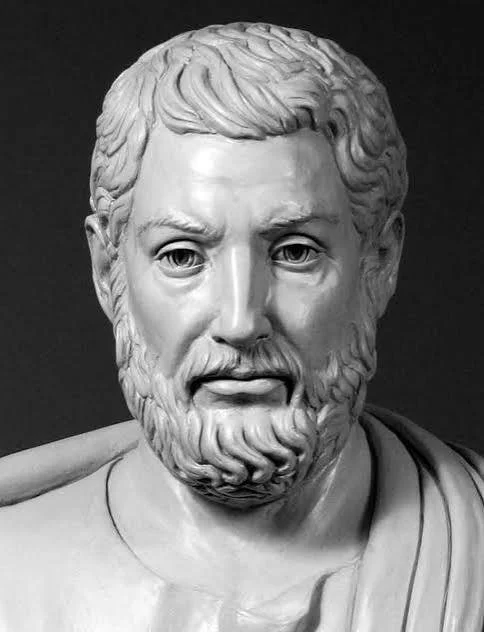
The Hippodamian system is associated with Hippodamus of Miletus, a fifth-century BCE thinker traditionally connected with rational urban planning.
The basic concept involved organizing cities using intersecting streets.
Major and minor roads could create regular blocks.
This arrangement offered several advantages:
Easier movement
Organized property divisions
Clearer infrastructure
Efficient urban expansion
However, actual Greek cities rarely followed a perfect grid.
Terrain, existing buildings, political decisions, and practical requirements often required modifications.
Building on a Mountain
Priene's greatest engineering challenge was its steep terrain.
The planners created terraces.
Streets followed carefully controlled routes, while retaining walls supported different levels.
This created a remarkable visual relationship between architecture and landscape.
The Agora
The agora served as the civic and commercial heart of the city.
It provided space for:
Markets
Political activity
Public meetings
Social interaction
The regular surrounding blocks demonstrate how urban planning integrated public and private spaces.
The Theater
Priene also possessed a theater.
Greek theaters were not simply entertainment venues.
They were important civic institutions.
Dramatic performances, religious festivals, political identity, and communal gatherings could all intersect within theater spaces.
Domestic Architecture
Priene's houses provide valuable evidence for everyday life.
Many followed courtyard-centered designs.
Rooms were arranged according to functions such as:
Cooking
Storage
Sleeping
Reception
The houses demonstrate that urban planning operated at the household level as well as the city level.
Why Priene Is Important
Priene shows that Greek urbanism could be highly rational without being entirely uniform.
The city combined geometry with topography.
Its planners created order while adapting to the mountain.
The result provides one of the best archaeological demonstrations of ancient Greek ideas concerning organized urban space.
The Colossus of Rhodes and Its Legacy
The Colossus of Rhodes was one of the most famous monuments of the ancient world.
A gigantic bronze statue dedicated to the sun god Helios, it symbolized the strength and independence of Rhodes.
Although the statue stood for only a few decades before an earthquake destroyed it, its reputation survived for centuries.
The Siege of Rhodes
The Colossus was constructed following the successful defense of Rhodes against the forces of Demetrius I of Macedon.
The siege occurred in 305–304 BCE.
Rhodes resisted.
After the attackers withdrew, the Rhodians decided to commemorate their victory with an enormous statue of Helios.
Construction
The sculptor Chares of Lindos is traditionally credited with the statue.
The monument was probably constructed around 292–280 BCE.
Its bronze exterior was supported by an internal framework.
Stone and iron formed parts of the internal structure.
The construction process would have required enormous quantities of metal.
How Tall Was It?
Ancient accounts suggest that the Colossus stood approximately 30 meters high or somewhat more.
Later traditions often claim that it stood astride the entrance to the harbor.
This image is almost certainly incorrect.
A statue spanning the harbor would have required an implausibly enormous structure and would have obstructed maritime traffic.
The statue was probably located near the harbor area but stood on land.
The Earthquake
Around 226 BCE, a major earthquake struck Rhodes.
The Colossus broke at the knees and collapsed.
The Rhodians chose not to rebuild it.
According to ancient traditions, an oracle may have discouraged reconstruction.
Its enormous fragments reportedly remained visible for centuries.
Legacy
The Colossus became one of the Seven Wonders of the Ancient World.
Its importance demonstrates that monuments do not need to survive physically to influence history.
The statue disappeared, but its reputation grew.
Later artists imagined increasingly dramatic versions of the monument.
The famous modern image of the Colossus standing across the harbor derives largely from medieval and modern artistic imagination rather than archaeological evidence.
Symbol of Rhodes
Helios was closely associated with Rhodes.
The statue therefore represented more than military victory.
It embodied:
Civic identity
Divine protection
Political independence
Artistic ambition
Economic strength
Its enormous size communicated the wealth and confidence of the Rhodian state.
Historical Importance
The Colossus illustrates the relationship between politics and monumental art in the Hellenistic world.
After Alexander the Great's death, successor kingdoms competed for power and prestige.
Monuments became tools for communicating authority.
Rhodes used the Colossus to express its own political identity.