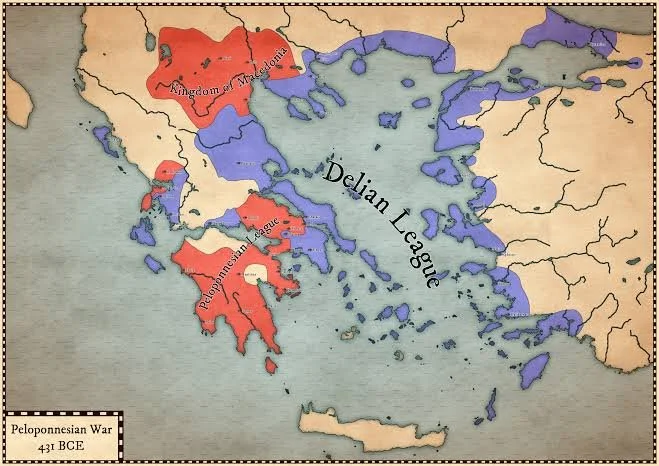
The Peloponnesian League and Delian League were two of the most important alliance systems in Classical Greece.
Their rivalry contributed significantly to the political tensions that eventually produced the Peloponnesian War.
The Peloponnesian League
The Peloponnesian League developed around Sparta.
Unlike a modern centralized state, it was an alliance of independent communities.
Members retained substantial autonomy but cooperated militarily.
Sparta exercised considerable leadership.
Important members included Corinth and several other Peloponnesian states.
The Delian League
The Delian League was formed after the Persian Wars.
Its original purpose was to continue the struggle against Persia and protect Greek communities in the Aegean.
Athens became its leading power.
The league's treasury was originally located on the sacred island of Delos.
Transformation into Empire
Over time, Athens increasingly dominated the alliance.
Member states were expected to contribute ships or money.
Some attempted to withdraw.
Athens sometimes used military force to prevent secession.
As a result, the Delian League gradually became what historians often describe as the Athenian Empire.
Sparta's Concern
The growth of Athenian power alarmed Sparta and its allies.
Athens possessed:
A powerful navy
Wealth
Walls
Overseas allies
Tribute income
Sparta possessed:
A formidable army
Influence in the Peloponnese
A network of allies
The two systems represented different forms of military power.
The Peloponnesian War
The war began in 431 BCE.
The conflict continued, with interruptions, until 404 BCE.
Athens initially relied heavily on its walls and navy.
Sparta relied on land invasions of Attica and eventually developed naval capabilities with Persian financial assistance.
The Sicilian Disaster
Athens' expedition against Syracuse between 415 and 413 BCE was catastrophic.
The destruction of the expedition weakened Athens enormously.
The war continued for several years.
Spartan Victory
Athens eventually surrendered in 404 BCE.
Sparta emerged as the leading Greek power.
However, Spartan dominance did not last indefinitely.
The Theban victory at Leuktra in 371 BCE demonstrated the instability of Greek interstate politics.
Historical Significance
The rivalry between the two leagues demonstrates how ancient Greece functioned as a competitive international system.
Greek city-states shared language, religion, and culture but frequently fought one another.
There was no single unified Greek state.
Political fragmentation was both a source of conflict and a major feature of Greek civilization.