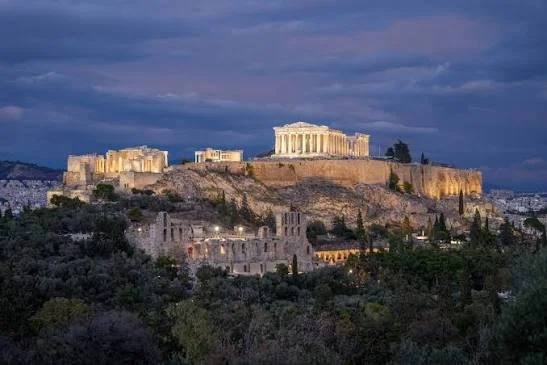
The Athenian Acropolis is one of the most recognizable archaeological landscapes in the world. Rising above the modern city of Athens, the rocky plateau has become almost synonymous with the Parthenon, yet the famous temple represents only one part of a much larger and more complicated sacred and political complex.
The Acropolis was shaped over thousands of years. Long before the classical monuments familiar today were constructed, the hill was occupied, fortified, and used for religious purposes. Its surviving buildings reflect successive periods of Mycenaean, Archaic, Classical, Hellenistic, Roman, Byzantine, Frankish, and Ottoman history.
Understanding the Acropolis therefore means looking beyond the Parthenon and examining the many structures, rituals, political messages, and historical transformations that made the hill one of the most important places in ancient Greece.
A Sacred Hill Before the Classical Period
The Acropolis, meaning essentially "upper city," occupies a naturally defensible limestone plateau approximately 150 meters above sea level.
Its elevated position made it useful for defense, but its importance eventually became overwhelmingly religious and symbolic.
Archaeological evidence indicates human activity on the Acropolis from prehistoric periods. During the Mycenaean period, the summit was fortified, and substantial defensive walls surrounded parts of the settlement.
The hill was associated particularly with Athena, the patron goddess of Athens.
Athena's relationship with the city became central to Athenian identity. According to mythology, she competed with Poseidon for possession of Attica. Athena offered the olive tree, while Poseidon produced a spring or saltwater source. The Athenians ultimately chose Athena's gift, and the olive tree became one of the city's most important symbols.
The Archaic Acropolis
Before the Persian Wars, the Acropolis already contained monumental temples dedicated to Athena.
The Athenians constructed large stone temples during the sixth century BCE, including buildings generally associated with the earlier architectural predecessors of the Parthenon.
These structures were destroyed when Persian forces captured Athens in 480 BCE.
The destruction became a defining event in Athenian memory.
After the Persian Wars, the Athenians rebuilt their city, but the Acropolis was transformed on an unprecedented scale during the fifth century BCE.
Pericles and the Classical Building Program
The rebuilding of the Acropolis was closely associated with the statesman Pericles.
Athens had become enormously wealthy and influential after the Persian Wars, partly through its leadership of the Delian League.
Funds from the Athenian-led alliance helped support ambitious construction projects.
The building program communicated several messages simultaneously:
Athens had survived the Persian invasion.
The city was militarily powerful.
Athena protected Athens.
Athenian democracy and imperial power were flourishing.
Athens regarded itself as the cultural center of the Greek world.
The Acropolis consequently became both a religious sanctuary and a monumental expression of Athenian political power.
The Parthenon
The Parthenon is the most famous building on the Acropolis.
Constructed primarily between 447 and 432 BCE, it was dedicated to Athena Parthenos, "Athena the Virgin."
Architecturally, it is a Doric temple incorporating significant Ionic elements.
Its sculptural program was extraordinary.
The building contained:
Metopes
Pedimental sculptures
An Ionic frieze
A monumental cult statue of Athena
The sculptures depicted mythological conflicts, divine figures, and scenes connected to Athenian identity.
Yet the Parthenon was not the only major monument on the hill.
The Erechtheion
The Erechtheion is one of the most unusual buildings on the Acropolis.
Constructed in the late fifth century BCE, it had an irregular plan because it accommodated several sacred locations.
The building was associated with Athena, Poseidon, and the legendary king Erechtheus.
One of its most famous features is the Caryatid Porch.
Instead of ordinary columns, sculpted female figures support the roof.
These figures have become among the most recognizable examples of classical Greek architecture.
The building's complexity reflects the fact that Greek sanctuaries often contained multiple overlapping traditions.
Rather than replacing older sacred locations completely, architects incorporated them into new monumental structures.
The Propylaia
The Propylaia served as the monumental entrance to the Acropolis.
Built during the fifth century BCE, it transformed the approach to the sanctuary.
Visitors did not simply walk into the sacred area.
They moved through a carefully constructed sequence of spaces.
The monumental gateway helped establish the Acropolis as a visually dramatic experience.
Architecture therefore controlled movement and shaped how visitors encountered the sacred landscape.
The Temple of Athena Nike
The Temple of Athena Nike occupies a prominent position near the entrance.
Unlike the enormous Parthenon, it is comparatively small.
Its Ionic design nevertheless demonstrates the sophistication of Classical Greek architecture.
Athena Nike represented Athena in her role as a goddess of victory.
Its position overlooking the surrounding landscape was particularly appropriate for a deity associated with military success.
Religious Rituals
The Acropolis was not simply a collection of beautiful buildings.
It was an active religious sanctuary.
One of the most important celebrations was the Panathenaia, a festival honoring Athena.
The Great Panathenaia included:
Processions
Athletic competitions
Musical contests
Religious sacrifices
Ceremonial activities
The procession eventually culminated at the Acropolis.
The famous Parthenon frieze has traditionally been interpreted in connection with the Panathenaic procession, although its exact meaning remains debated.
The Acropolis as a Political Symbol
The Acropolis also communicated Athenian political ideology.
The buildings were constructed at a time when Athens exercised substantial influence over other Greek communities.
This creates an important historical tension.
Athens presented itself as a champion of freedom against Persia while simultaneously exercising imperial authority over members of the Delian League.
The monumental Acropolis can therefore be understood as both a religious sanctuary and a statement of Athenian power.
Later History
The Acropolis continued to be used long after Classical Athens declined.
The Parthenon became a Christian church during late antiquity and the Byzantine period.
Later, it was converted into a mosque under Ottoman rule.
In 1687, during the Venetian siege of Athens, Ottoman forces stored gunpowder inside the Parthenon. A Venetian bombardment caused a catastrophic explosion that severely damaged the building.
The sculptures also suffered extensive losses, particularly during the nineteenth century when portions were removed and transported abroad.
Why the Acropolis Matters
The Athenian Acropolis is important because it represents far more than the Parthenon.
It is a layered historical landscape in which religion, architecture, warfare, politics, art, mythology, and imperial ambition intersect.
The surviving monuments provide evidence for Classical Greek civilization, while their later transformations reveal how subsequent societies repeatedly reinterpreted ancient heritage.
The Acropolis remains one of the clearest examples of how a single landscape can become a symbol of an entire civilization.