The Spartan agoge was one of the most distinctive educational and social institutions of ancient Greece.
It was designed to produce disciplined Spartan citizens capable of serving the state as soldiers.
However, popular descriptions often exaggerate its brutality and simplify its historical development.
The agoge must instead be understood as part of the larger Spartan social system.
Childhood and the State
Spartan society placed extraordinary emphasis on communal discipline.
According to later sources, newborn children were subjected to examinations concerning their physical condition.
Modern historians debate how literally some of these accounts should be taken.
What is clear is that Spartan ideology placed unusually strong emphasis on producing citizens capable of military service.
Beginning the Agoge
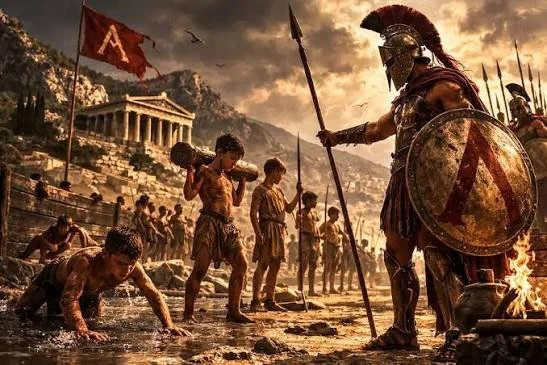
Boys traditionally entered the agoge around the age of seven.
They were separated from their families and placed under communal supervision.
Training emphasized:
Physical fitness
Discipline
Endurance
Obedience
Group loyalty
Military skills
Education
The agoge was not purely physical.
Young Spartans learned aspects of literacy, music, poetry, religious practice, and cultural traditions.
However, education was strongly oriented toward the values of the Spartan state.
Food and Endurance
Ancient sources describe Spartan youths as receiving limited food and being encouraged to supplement their meals.
The famous story of stealing food while being punished for being caught illustrates the emphasis placed on stealth and resourcefulness.
The historical reality is more complicated than the simplified modern stereotype.
Military Preparation
As boys grew older, their training increasingly emphasized military discipline.
They practiced:
Running
Wrestling
Fighting
Weapon use
Formation discipline
They also learned to endure hardship.
The Role of the Community
The agoge strengthened group identity.
Boys lived and trained together.
This created strong bonds between future soldiers.
Spartan military effectiveness depended heavily upon this cohesion.
Women and the Spartan System
Spartan women also received unusual physical training compared with women in many other Greek communities.
Their education was not identical to the male agoge.
It reflected broader Spartan concerns about physical fitness, household management, and the production of healthy citizens.
Limitations of the Spartan Model
The Spartan system depended on a highly unequal society.
Spartan citizens were supported by labor from helots and other dependent populations.
This allowed citizens to devote substantial time to military preparation.
Therefore, Spartan military culture cannot be separated from the social system that supported it.
Legacy
The agoge became famous throughout antiquity.
Other Greeks admired and criticized Sparta's discipline.
Modern popular culture has often transformed the agoge into a purely brutal warrior school.
In reality, it was a complex institution designed to reproduce a specific political and social order.