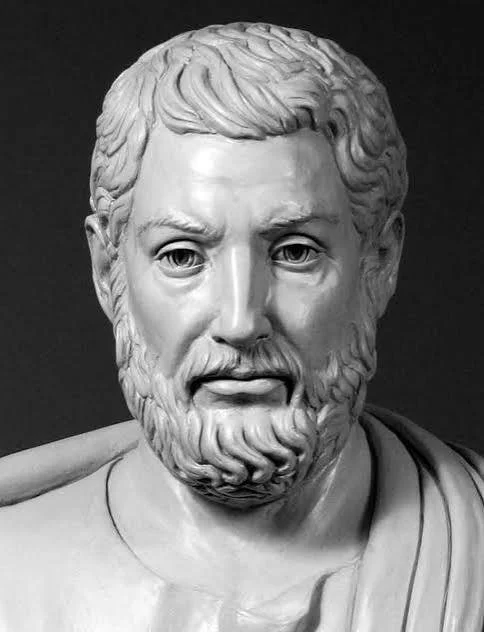
Cleisthenes is frequently described as one of the founders of Athenian democracy.
His reforms around 508/507 BCE transformed the political organization of Athens and weakened the traditional power of aristocratic families.
Rather than simply introducing voting, Cleisthenes redesigned the political community itself.
Athens Before Cleisthenes
Athenian politics had long been dominated by aristocratic families.
Political identity was strongly influenced by:
Family
Local connections
Wealth
Traditional status
This structure encouraged political factions centered on powerful individuals.
The Conflict with Isagoras
Cleisthenes competed with Isagoras for political influence.
Isagoras sought Spartan support and temporarily gained control.
Cleisthenes was expelled.
However, ordinary Athenians resisted the attempt to establish oligarchic rule.
Cleisthenes eventually returned.
The political crisis provided an opportunity for major constitutional change.
The Demes
One of Cleisthenes' most important reforms involved the deme.
Demes were local civic communities.
Citizens became formally associated with their deme.
The deme became important for:
Registration
Political identity
Local administration
Military organization
This reduced the ability of aristocratic families to control political identity through traditional kinship networks.
The Ten Tribes
Cleisthenes reorganized citizens into ten new tribes.
These tribes were constructed geographically.
Each incorporated citizens from different parts of Attica.
The goal was to mix populations and reduce the dominance of localized political factions.
The Council of 500
The earlier Council of 400 was replaced with a Council of 500.
Each tribe supplied fifty members.
The Council prepared matters for discussion by the Assembly.
Members were generally selected by lot.
The institution became one of the central mechanisms through which Athenian democracy operated.
Ostracism
Cleisthenes is also traditionally associated with ostracism.
Citizens could vote to exile a politically influential individual for ten years.
Importantly, ostracism was not necessarily a criminal conviction.
The person did not have to be found guilty of a specific crime.
Instead, the mechanism was designed as a political safeguard against dangerous concentrations of power.
The Assembly
The reforms strengthened the importance of the citizen assembly.
Citizens could debate important political questions.
This helped establish the principle that collective decisions should emerge from citizen participation.
Why the Reforms Were Revolutionary
Cleisthenes did not create modern democracy.
The system remained restricted to male citizens.
However, his reforms changed the basis of political organization.
Political identity became increasingly connected to civic membership rather than aristocratic family networks.
Long-Term Importance
The Cleisthenic reforms created the institutional framework upon which fifth-century Athenian democracy developed.
Later democratic leaders expanded and modified the system.
The importance of Cleisthenes therefore lies not simply in one law but in the restructuring of Athenian political society.