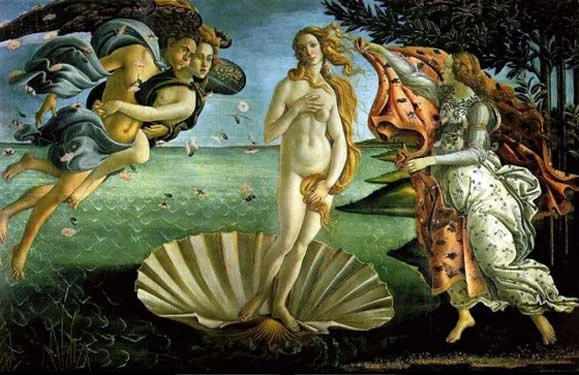
Aphrodite is one of the most famous goddesses of ancient Greece. She represents love, beauty, sexual attraction, fertility, and desire, although her precise characteristics changed across different periods and traditions.
Her unusual birth is one of the most striking creation stories in Greek mythology.
Aphrodite from the Sea
According to Hesiod's Theogony, Aphrodite emerged from the sea after the violent overthrow of Uranus.
Cronus attacked his father Uranus and severed his genitals.
The severed parts fell into the sea.
Foam formed around them.
From this foam, Aphrodite emerged.
The Greek word aphros means “foam,” which ancient writers connected with the goddess's name.
A Second Birth Tradition
Not all Greek sources describe Aphrodite as emerging from sea foam.
Homer presents a different genealogy, identifying her as the daughter of Zeus and Dione.
This contradiction is important.
Greek mythology frequently contains multiple traditions that coexist without being reconciled.
The Hesiodic tradition makes Aphrodite extraordinarily ancient, while the Homeric tradition gives her a more conventional divine parentage.
Aphrodite's Arrival
The goddess is often imagined arriving on the shore after emerging from the sea.
Later artistic traditions developed the famous image of Aphrodite standing or sitting on a shell.
The shell became one of her principal symbols.
However, the specific shell imagery became particularly prominent in later artistic traditions rather than representing a complete description of the earliest Greek myth.
Aphrodite and Desire
Aphrodite's power is not limited to physical beauty.
She represents eros, the powerful force of attraction that can overwhelm rational judgment.
This makes her both benevolent and dangerous.
Love in Greek mythology is rarely harmless.
It can create families and alliances, but it can also produce jealousy, betrayal, violence, and war.
Aphrodite and the Trojan War
Aphrodite plays a central role in the Judgment of Paris.
Paris is asked to decide which goddess—Hera, Athena, or Aphrodite—is the most beautiful.
Aphrodite promises him the love of the world's most beautiful woman.
Paris chooses Aphrodite.
The woman is Helen.
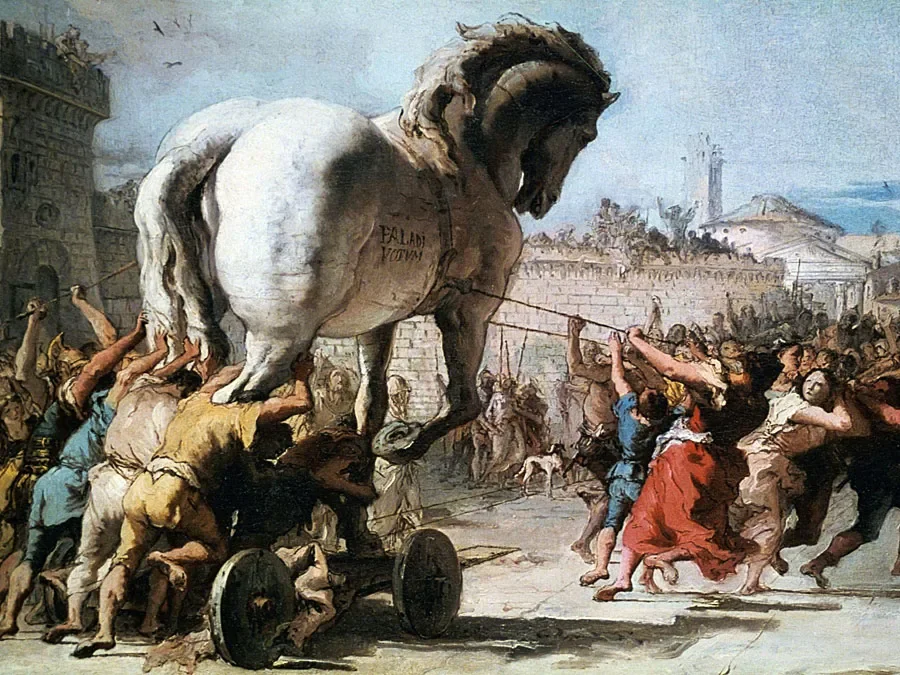
Helen's departure from Sparta contributes to the Trojan War.
Thus, Aphrodite's influence becomes linked to one of the greatest conflicts in Greek mythology.
Aphrodite and Hephaestus
In many traditions Aphrodite is married to Hephaestus.
The marriage is unhappy.
She has relationships with other gods, particularly Ares.
Hephaestus eventually catches Aphrodite and Ares together using an ingenious trap.
The episode appears in Homer's Odyssey and is treated partly as comic entertainment.
The Goddess of Beauty and Power
Aphrodite's importance demonstrates that beauty was not viewed merely as an aesthetic quality.
Beauty could function as power.
It could inspire loyalty, conflict, desire, jealousy, and political consequences.
The goddess therefore represents desire as a force capable of shaping history.
Conclusion
The birth of Aphrodite from sea foam is one of Greek mythology's most memorable creation scenes.
Yet its significance extends beyond the image of a beautiful goddess rising from the sea.
Aphrodite represents one of the fundamental forces of Greek myth: desire.
Her power can create relationships, inspire artistic beauty, generate children, and produce catastrophic wars.
The foam of the sea therefore becomes a metaphor for something much larger—the emergence of irresistible desire into the divine and human worlds.